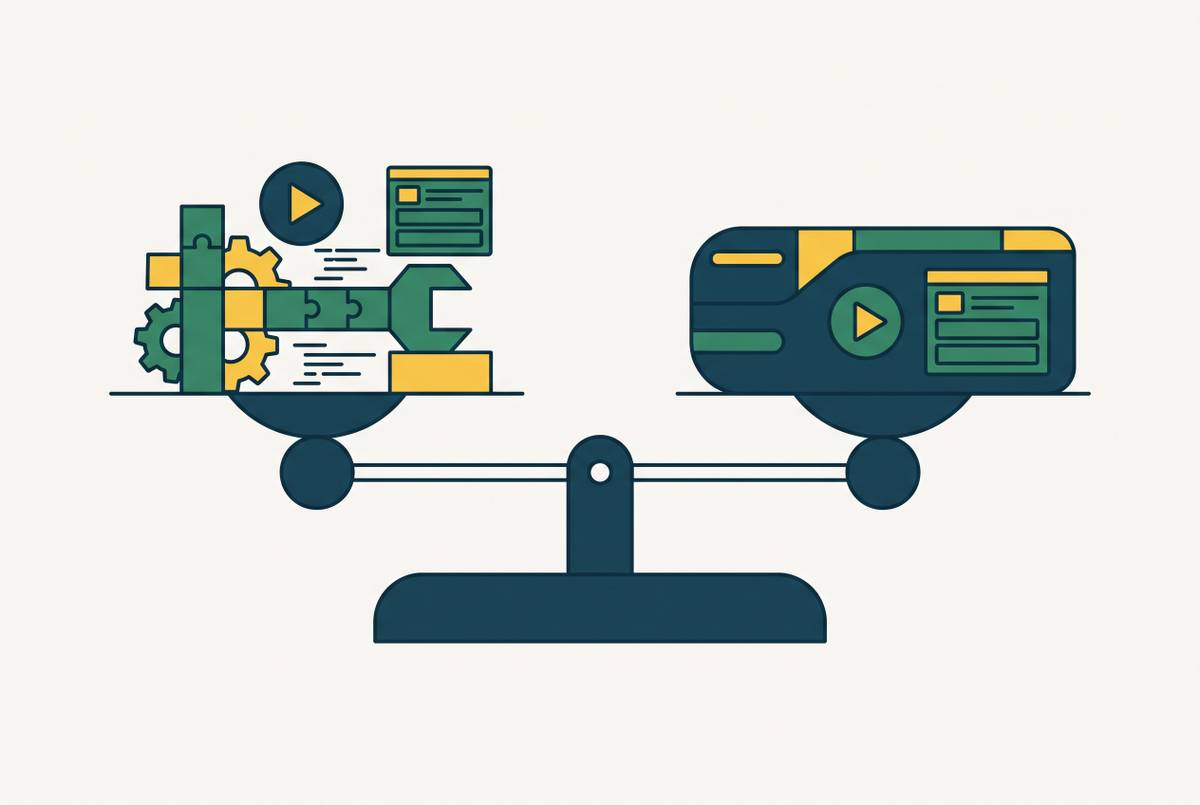
Training Video Platform Evaluation Criteria for Software Companies
Four production realities determine which platform fits a software team's actual workflow.
Choosing a training video platform for a software company means matching what a platform can actually do against how software teams actually produce content: how often the product changes, how much volume the team needs to output, how many languages the users speak, and who on staff is expected to sit down and make the thing.
Software products change on a rhythm most other industries do not share. UI updates, new features, deprecated flows, all of it makes training content go stale on a timeline measured in weeks, not years. That update burden is structural, and it ships with every release, whether the team is ready for it or not. Most of the people asked to keep training content current, customer success managers, L&D generalists, product marketers, are not video producers by trade; they are subject matter experts who got handed a camera. Customer education has also stopped being optional, and formal customer education programs have become standard practice across the SaaS industry. That is a fast shift, and it puts the emphasis on fit: which platform matches how a software team actually works, rather than which one has the longest feature list.
The four production realities that should anchor any evaluation
Four dimensions determine whether a platform holds up under real use, and they function less like a checklist and more like a stress test.
The first is update frequency: how fast a video or doc can be revised when the UI changes, without re-recording the whole thing. The second is scale: whether a team can produce more content without adding headcount, or whether every new video costs the same labor as the last one. The third is localization: whether translation is built into the core workflow or bolted on as a separate project after the fact. The fourth is who does the work: whether a CSM or product marketer can use the platform unassisted, or whether it demands a dedicated editor.
These four don't carry equal weight for every organization, but a platform that fails on any single one creates a bottleneck that compounds. Most platforms on the market optimize for one or two of these realities and treat the rest as an afterthought. The actual evaluation task is finding the one that covers all four well enough for a specific team's mix of content, headcount, and audience.
What update frequency actually demands from a platform
Traditional video production treats every change as a brand-new project, leaving teams with two bad options: let the tutorial go stale, or absorb the full cost of re-shooting it. Neither is sustainable once release cycles start compounding.
The meaningful split is between platforms that force a full re-upload every time something changes and platforms built around dynamic update workflows, where a change in one asset propagates through the content automatically. Dynamic SCORM is shaping up as a real differentiator heading into 2026: it lets LMS content update without re-uploading the entire package, which matters enormously for companies whose product UI shifts every quarter or faster. Static SCORM, by contrast, locks a course in place the moment it is exported.
Evaluators should also check whether editing happens at the script or asset level. Can someone fix step 4 of a ten-step tutorial without rebuilding the other nine? And does the platform route an edit through an approval step, or does it publish the second someone hits save? Version control on training content should be treated as a first-class requirement, not a nice-to-have buried in the enterprise tier.
There's a simple test for all of this in a vendor demo: ask what happens when the screenshot in step 4 of a ten-step tutorial changes, then count the clicks, time it, and note who has to get involved before it's live again.
Matching platform output capacity to the volume of content software teams need
Scale is about whether a team can hold a publishing cadence as the product and the user base both keep growing, not just how fast a single video gets made.
AI-assisted platforms have cut video creation time dramatically, in some cases by as much as 90%, which changes what a sustained cadence looks like for a two- or three-person team. Teams using these tools report producing several times more content with the same headcount. But that gain only shows up if the AI is actually removing manual steps rather than just labeling existing manual steps as "AI-powered." Worth checking in a demo: does the platform handle script cleanup, voiceover, captions, and zoom transitions automatically, or are those still separate tasks a human has to do one by one?
Templates and brand kits matter more at scale than most buyers expect going in. Without them, every new video reinvents the visual language from scratch, and consistency becomes a matter of individual discipline rather than platform enforcement, which never holds up once more than one person is creating content. Length discipline matters too, since completion rates fall by roughly half once a video runs past six minutes, so platforms that support chunking into short modules make scale and viewer attention work together instead of against each other.
Finally, check whether the platform covers the whole arc, record, edit, share, and scale, or only a piece of it. A platform that only handles editing still leaves a team stitching together separate tools for capture and distribution, and that stitching is where hours disappear.
Localization as an operational decision, not a translation project
For any software company with users outside one country or one language, localization that lives outside the main workflow effectively puts international users second in line. Content lags behind the English version, quality drifts, and support tickets fill the gap that documentation should have covered.
The real dividing line is between platforms offering one-click translation that generates localized voiceover and captions directly, and platforms where localization means exporting files and handing them to an outside translation vendor. Coverage matters more than a headline language count. A platform advertising fifty languages is irrelevant if it doesn't cover the three a company's actual user base speaks.
Quality of the localized output deserves as much scrutiny as the source content. A robotic-sounding dub or a mistimed lip-sync undercuts the professionalism of the original, no matter how polished that original was. Documentation needs the same scrutiny as video, and a platform that localizes the video but leaves the written step-by-step guide in English still leaves a team managing two workflows instead of one.
The cleanest way to test this: take a finished video and push it through the platform's translation workflow in a language the team actually uses day to day, then look honestly at how much manual correction the output needs before it's publishable.
Assessing whether a platform's workflow matches who actually creates the content
Content in most software companies gets made by the people who know the product, not by people who know video editing. CSMs, product managers, L&D generalists, sales engineers: these are the actual authors of training content, and none of them signed up to learn a timeline-based editor.
A platform that assumes professional editing skill creates a bottleneck right at the handoff. The subject matter expert knows the material but can't produce polished video; the video gets queued behind a producer who has the skill but not the knowledge. The entire value of AI-assisted production comes down to whether it removes the tedious steps, script rewriting, voiceover, zoom, captions, well enough that a non-specialist can go from raw material to finished, professional output on their own.
Worth checking is where the platform actually starts the process. Some begin with a screen recording that AI then cleans up, some start from a document or script that gets converted into video, and some lean on pre-built avatars and templates. Each modality suits a different kind of team and a different kind of content.
Auto-capture tools, the browser-extension style of workflow that turns clicks into an annotated guide as they happen, remove one of the biggest practical barriers for a subject matter expert: having to plan and perform a recording while also doing the actual task. Doing the job once while the documentation builds itself in the background is the real unlock here.
None of this works at scale without governance. Teams with several people creating content need control over who can publish, which templates are mandatory, and how approvals route before something goes live; otherwise distributed creation just produces a pile of inconsistent videos with no shared visual language. And if the platform itself needs a training session before anyone can use it, adoption stalls regardless of how deep the feature set goes.
Integration requirements that determine whether a platform fits the existing tech stack
A platform that can't push finished content into the organization's LMS forces manual distribution, which quietly cancels out the whole point of producing content at scale in the first place.
SCORM remains the standard most LMS platforms rely on for consistent completion tracking, and a platform without SCORM output creates friction at every enterprise deployment, no exceptions. The dynamic-versus-static distinction from earlier applies here directly: dynamic SCORM lets updates propagate without a manual re-upload, while static packages require a fresh upload on every single revision.
For companies training customers or partners rather than just employees, CRM integrations with tools like Salesforce or HubSpot matter specifically because they connect course completion data to sales and success workflows, closing the loop between education and revenue. A common mistake buyers make is selecting a platform based on its employee-training features, only to discover later it can't support customer or partner training at the volume the business needs. Worth asking any vendor directly: can this same platform serve all three audiences, employees, customers, and partners, without switching tools?
AI-powered search inside the video library, indexing both spoken words and on-screen text, is becoming a real differentiator for teams building out libraries with hundreds of product tutorials. A library that size is only useful if someone can actually find the right five-minute segment inside it. On analytics, the baseline should be engagement tracking at the individual video level: completion rates, drop-off points, knowledge check scores. Delivery tracking alone tells a team nothing about which content actually needs to be redone.
Where the major platform categories fall across these four realities
Screen-recording-to-polished-video platforms tend to be strongest on update speed and usability for non-specialists. AI handles voiceover, captions, and zoom directly from a raw recording, and video and documentation often get generated together from the same capture. These suit CSM, L&D, and product teams turning out software walkthroughs at real volume.
Avatar and script-based platforms are strongest on presenter-style output and language breadth; the result looks like a fully produced video with no camera or recording involved at all. The trade-off is that software UI walkthroughs need an added layer of screen content on top of the avatar, which suits policy, onboarding narrative, or compliance material better than a quick product tutorial.
Enterprise video platforms with AI layered on top are strongest on search, governance, and depth of LMS integration, with AI-powered search that indexes both spoken and on-screen content, and some now adding avatar-based creation as well. These fit large organizations managing sprawling video libraries and complicated permission structures across departments.
Interactive learning authoring tools are strongest on knowledge checks, branching scenarios, and SCORM compliance, but raw video creation usually requires a separate tool entirely. These suit L&D teams building formal, structured courses rather than fast software tutorials.
SOP-specific auto-capture tools are strongest on documentation workflow, turning clicks into annotated guides as the task happens. Polished video tends to be secondary here, which suits teams whose primary deliverable is a written SOP with video as a supplement rather than the main artifact.
Building a scoring approach that reflects a specific team's actual constraints
None of this framework means anything without weighting it to a specific team's situation. A two-person L&D team at a fast-moving startup should weight update speed and non-specialist usability above everything else. An enterprise operating across forty markets should weight localization and governance instead.
The practical approach: rate each of the four production realities, update frequency, scale, localization, who does the work, by importance to the specific team's context, then score every shortlisted platform against those weighted criteria. This forces an explicit trade-off decision instead of defaulting to whichever vendor has the longest feature list.
The trial itself should use real content, not a vendor's canned demo. Take an actual product tutorial that genuinely needs updating and run it through each platform's full workflow, start to finish. Measure the time from raw recording to publish-ready output, not just the time to create the first draft; that gap is where a lot of platforms quietly lose.
A few governance questions belong in every vendor conversation regardless of platform category: where is content data stored, is it used to train models, how are deletion requests handled, and can approval workflows be enforced at the template level rather than left to individual discretion? Before anything gets shortlisted, confirm the SCORM output type, dynamic or static, confirm LMS compatibility, and confirm the platform can actually serve every intended audience, employee, customer, and partner, without requiring a second tool bolted on the side.
The evaluation is finished when a team can answer a much narrower question honestly: can the people who actually know the content produce professional video on their own, on the company's real update cycle, in every language the users actually speak?