Content Maintenance Cost in Rapidly Updating Software Products
Outdated docs drain support budgets and silently erode customer retention.

Software ships fast now. Documentation doesn't. That gap has a name in engineering circles, content debt, and it behaves exactly like technical debt: it accrues quietly, it compounds, and by the time anyone notices, the fix costs far more than the upkeep would have.
Launch day gets treated like a finish line by the people who don't have to live with what comes after. Engineers know better. So do product managers who've shipped a second version of anything. Launch is the starting gun, not the tape. Software that stops changing doesn't hold steady, it rots: dependencies go stale, security holes open up, and competitors ship features on a weekly cadence that make last quarter's release look dated. That's the backdrop. Now layer in the content problem.
Every meaningful update to a product starts an invisible clock on the documentation, videos, SOPs, and onboarding flows built around the old version. Nobody rings a bell for this. No build fails. No alert fires. A screenshot goes stale, a walkthrough video shows buttons that no longer exist, and the content just sits there, quietly teaching new users the wrong thing, until someone complains or churns.
CI/CD pipelines and mature DevOps practices produce a paradox: they let teams push code multiple times a day now, but the content layer can't keep pace with that speed. CI/CD pipelines and mature DevOps practices let teams push code multiple times a day now. That's the whole point of modern release engineering. But if every one of those releases requires a person to sit down and manually rewrite a help article, a training video, and a release note, the documentation will always lose the race. Research from storytodoc.ai puts a number on what this costs: companies lose up to $52 million annually from inefficient process documentation, and employees waste 2 hours a day hunting for information that might not even be current anymore. That's not a rounding error. That's a structural cost sitting outside most budgets, waiting to be counted.
The four types of software maintenance and which ones generate content debt
Engineering has a standard taxonomy for maintenance work, four categories, and each one hits the content layer differently.
Corrective maintenance covers bug fixes and the failures that show up after launch. Every one of these fixes is a documentation trigger whether anyone treats it that way or not: patch notes need writing, troubleshooting guides need correcting, and any how-to steps built on the old broken behavior need to change.
Adaptive maintenance happens when the ground shifts underneath the product, a new OS version, a browser update, an API change on a platform the product depends on. The underlying feature might not change in substance at all. Doesn't matter. The UI looks different now. Every screenshot, every screen recording, every step-by-step flow built around the old interface is visually wrong the moment the update ships.
Perfective maintenance is feature improvement and UX polish, and in fast-moving SaaS, it consumes a substantial share of the maintenance budget. Retention depends on the product feeling alive, so teams keep refining. That same refinement is the biggest generator of content churn in the whole system, because it does two things simultaneously: it creates a need for new help content, and it obsoletes the old content, often for the exact same feature, in the same release.
Preventive maintenance, refactoring and technical debt cleanup, is the category everyone means to get to and rarely does. The content equivalent is the documentation audit that never makes it onto a roadmap. It's always next quarter's problem.
Engineering teams don't think of their release tickets as content triggers. There's no standard handoff where "feature shipped" turns into "documentation updated." It just doesn't exist in most workflows. So ask the diagnostic question directly: when the product changes next month, what happens to the documentation? If the honest answer involves someone manually recreating it from scratch, that recreation time is a hidden cost already baked into the business, whether it's tracked anywhere or not.
What the software maintenance cost benchmarks reveal about the content problem
The engineering numbers are well established. IEEE research puts 60% of total software cost in the maintenance phase, with only 40% going to initial development. That ratio alone should reframe how anyone thinks about a launch date. Multiple 2026 sources, including Intigate Technologies and IT Path Solutions, confirm the widely cited rule that ongoing maintenance runs 15 to 25% of the original development budget every year. For SaaS, fintech, and healthcare, where continuous deployment, compliance cycles, and multi-tenant scaling all pile pressure on at once, that climbs to 25 to 40% annually.
At scale, the numbers get harder to ignore. Gartner's 2026 forecast puts worldwide IT spending above $6.3 trillion, with software spending representing a major and growing portion of that total. At that size, treating maintenance as an afterthought isn't frugal, it's an expensive bet against math that's already been run.
Every study measures engineering and infrastructure maintenance, but none of those benchmarks account for the content layer. None of them budget a cent for the documentation, the training video, the onboarding flow, or the SOP that breaks the moment the underlying code changes. The content layer runs on borrowed time and no dedicated line item, in study after study.
The deferred-maintenance trap that shows up in engineering literature applies just as directly to content. Deferring engineering maintenance long enough turns it into a full rewrite, commonly cited at 5 to 10 times the cost of steady upkeep. Content libraries follow the identical curve. Docs go stale one release at a time, nobody catches up, and eventually the whole library needs a wholesale recreation project that costs a multiple of what regular updates would have. SaaS products can consume a significant share of development cost annually keeping pace with continuous deployment and competitive feature pressure. The content layer is expected to match that cadence with none of that resourcing behind it.
That's the real finding here. Content maintenance cost scales directly with release velocity, and because it lives outside the engineering budget line, it gets absorbed invisibly, in support tickets, in botched onboarding, in customers who quietly leave.
How outdated documentation inflates support costs, slows onboarding, and erodes trust
Follow a user who hits a stale doc. They don't self-resolve, because the instructions don't match what's on their screen. So they open a ticket. At that moment, the documentation has failed the one job it had.
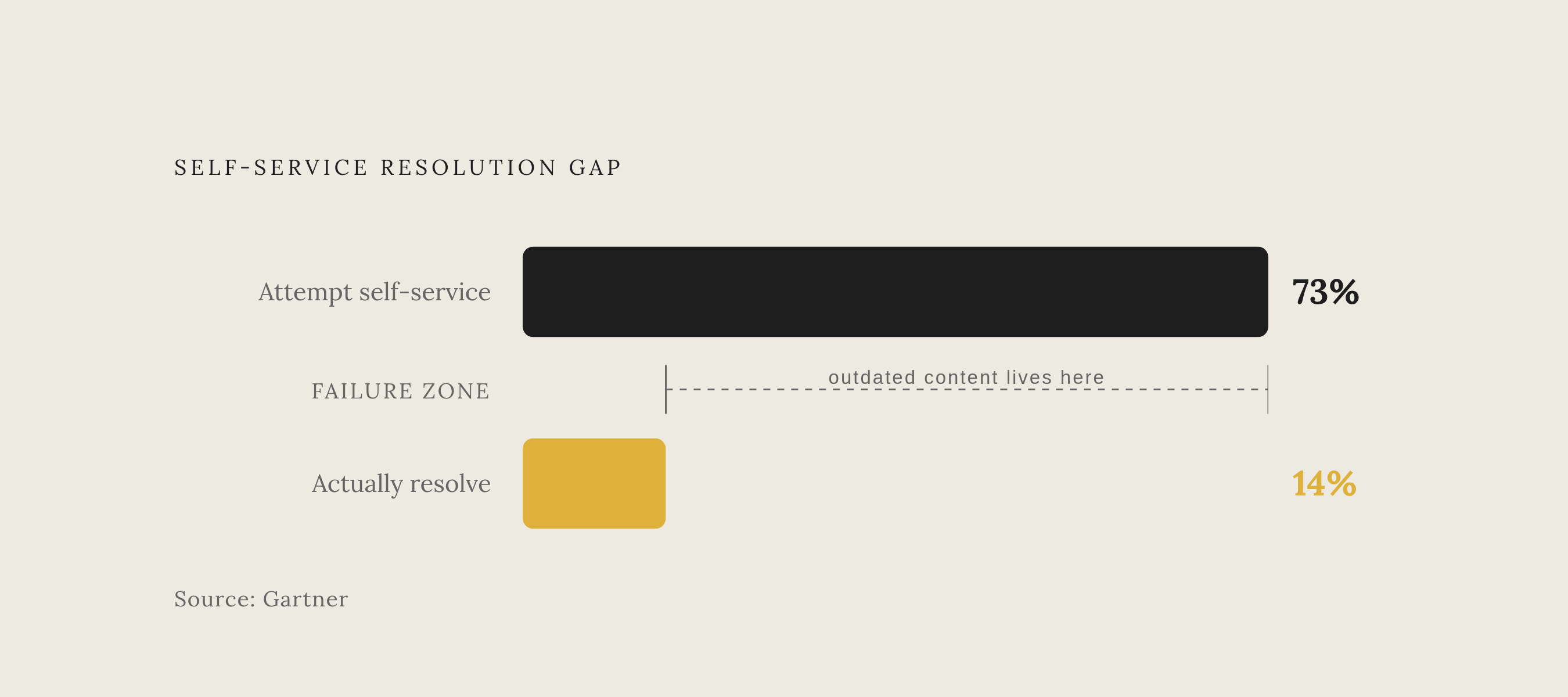
Gartner's research found that 73% of customers try self-service first, but only 14% actually resolve their issue that way. Outdated content is a major reason that gap is so wide. Salesforce research cited by document360.com adds more texture: 61% of customers would rather solve a straightforward problem themselves than talk to support, and 80% of high-performing service organizations offer self-service compared to only 56% of low performers. The ROI on keeping self-service content accurate shows up as deflected tickets. Skipping the maintenance means the cost shows up as ticket volume instead, dollar for dollar.
Onboarding carries its own version of this risk, and it's arguably sharper. GUIDEcx's State of Customer Onboarding 2026 report, based on a survey of hundreds of onboarding professionals, found that 62% of B2B companies have lost a customer to churn specifically because of a bad onboarding experience. Picture a new user following a walkthrough video built for a UI that no longer exists. They land on a screen that looks nothing like what the video describes. They don't conclude the video is outdated. They conclude the product is broken, or that nobody at the company cares enough to check. That's the real damage: a documentation failure gets misfiled in the user's head as a product failure, and it's the product that pays for it.
The internal side of this is just as expensive, just slower to show up on a dashboard. That same 2 hours a day employees lose hunting for information scales with headcount and with release frequency, so the more a company grows and the faster it ships, the worse this number gets, not better. New customer-facing hires trained on outdated materials learn workflows that don't exist anymore, and pass that confusion straight through to customers.
None of this generates an incident ticket the way a failed deploy does. A user fed wrong information by official docs doesn't file a bug report. The damage shows up weeks later, in NPS scores, in churn data, in a support escalation rate that's crept up and nobody can quite say why.
A practical framework for estimating your content maintenance cost
Engineering has its 15 to 25% annual benchmark. Content maintenance has no equivalent benchmark, no industry standard to check against. Any team serious about this has to build the estimate from scratch.
Four inputs make up a workable estimate:
Release velocity: count the meaningful UI or workflow changes shipping per quarter, meaningful meaning a non-technical user would actually notice the difference. Not every commit counts here, just the ones visible from the outside.
Content inventory: total up the unique pieces of documentation, video, and training material that exist, then figure out what share of that inventory touches features that change often. That percentage is the exposure number.
Update labor cost per piece: time how long it actually takes right now to update one video versus one article versus one SOP. This is where tool choice moves the needle more than anywhere else in the framework.
Trigger coverage measures what percentage of content updates get caught within a reasonable window after the corresponding release, versus discovered later only because a user complained.
Content that doesn't get updated on release isn't just sitting there wrong, it's actively steering users into dead ends, and each missed update multiplies the downstream support cost rather than just adding to it. If updating one piece of documentation takes two hours, and a team is holding fifty help articles against ten releases a quarter, that's a real, substantial labor bill hiding inside "other work," scaling in lockstep with however fast the team ships.
The market is starting to notice this as its own category. The standard operating procedures software market was valued at $371.07 million in 2025 and is projected to hit $541.05 million by 2032, a 5.53% CAGR, according to 360iResearch. That's organizations beginning to fund this as a discrete line item rather than folding it into general overhead. Once the estimate is built, it does three things: it gives finance a real budget line, it gives the team a triage order for which content gets fixed first when time is short, and it sets a benchmark against which any new tool or process can be judged.
Six capabilities that separate content systems built for rapid change from those that aren't
The real question isn't which tool to buy. It's which capabilities actually make content cheaper and faster to keep current at a systems level, because the wrong infrastructure turns every single release into a fire drill.
A 2026 analysis of what separates dedicated documentation platforms from repurposed wikis and shared drives points to six capabilities that matter:
AI writing and search cuts down the time needed to draft or rewrite content from a blank page, so long as the AI assists a human's judgment rather than replacing it outright.
Version control by release means content gets tagged and branched by product version, letting a team keep accurate docs live for multiple release states at once, which matters a lot for anyone supporting enterprise customers on older builds.
Multi-language output without duplication lets one edit to the source content propagate outward, instead of forcing a separate update workflow for every locale.
Support and dev integrations connect the documentation workflow directly into the ticketing and release systems where the actual change information already lives, rather than depending on someone remembering to pass it along.
Behavioral analytics track which docs get heavy traffic but low resolution scores, which is about as direct a signal as exists for which content is failing right now and needs attention first.
Publishing without engineering lets content owners push a fix the moment it's ready instead of waiting in a deploy queue behind a developer's other priorities.
Creation speed ends up being the single biggest predictor of whether a team builds a real, living documentation library or just accumulates a handful of docs that go stale and get abandoned. Tools that turn a screen recording into a finished SOP in minutes, not hours, change that math directly. Video carries its own specific problem here: one UI change can visually invalidate an entire training video, start to finish. Platforms that let a team re-record just the affected segment, instead of the whole thing, change the cost calculus by a wide margin. Training content changes constantly, policies shift, product UI shifts, internal workflows evolve, so the best tools make updating easy rather than expensive.
Why localization multiplies content maintenance cost, and how to contain it
Running documentation in five languages means the content maintenance problem doesn't stay one problem. It becomes five, and they almost never update in sync. That means international users are, by default, working off older information than English-speaking users, systematically, release after release.
The stakes here are concrete, not abstract. Research across language and learning contexts suggestsnal Journal of Educational Research, cited in industry sources, shows comprehension improves by up to 30% when training material is delivered in a learner's native language. Users who can't fully understand instructions don't struggle quietly and push through, they churn. CSA Research backs this up from the buying side: 76% of consumers prefer to buy from brands that communicate in their language, and 40% flatly refuse to purchase from a website in a different one. Outdated localized content is worse than no localized content at all, because it doesn't just fail to help, it actively misleads someone who trusted it more than a machine translation.
The traditional localization workflow was never built for this release cadence. Sequential translation tacks days or weeks onto every single update cycle. Treating each language as its own separate localization project builds maintenance lag directly into the process, by design, not by accident. The predictable result: localized content sits permanently behind the source language, and the gap widens with every release that ships.
AI-powered localization changes that math. Platforms that propagate an edit across every language from a single source update, instead of routing each language through its own workflow, bring the cost of maintaining six languages much closer to the cost of maintaining one. Localization belongs inside the content update workflow from day one, not bolted on afterward as a translation project. Every release that triggers an update in the primary language should trigger the localized versions in the same motion.
Reducing content maintenance cost in practice: where to start and how to measure progress
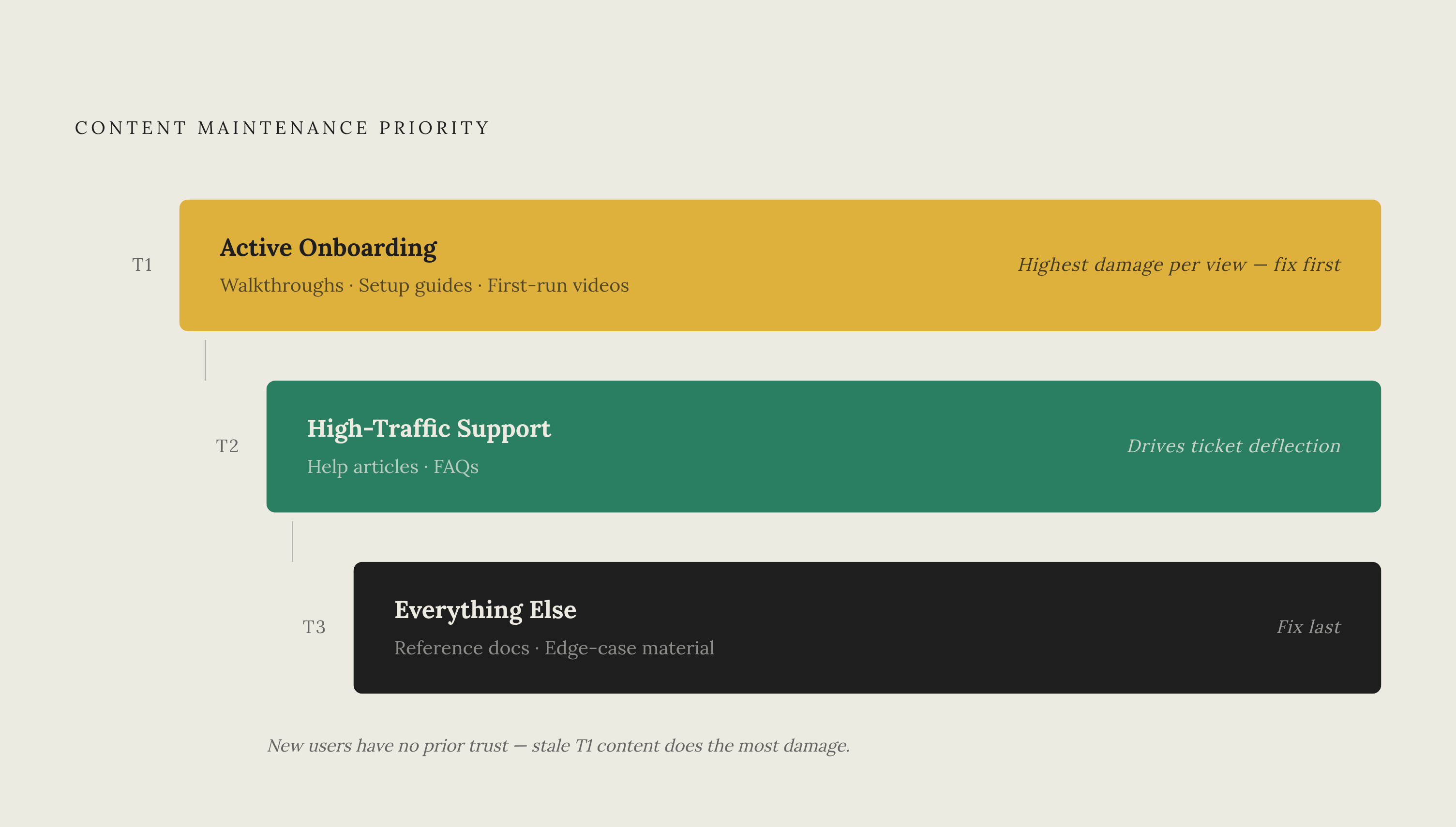
Content doesn't age at a uniform rate, so don't start with a full audit of everything. Start with the content that's both high-traffic and tied to the features changing fastest, since that's where staleness does the most damage the quickest.
A three-tier triage works well for sequencing the work:
Tier 1, active onboarding paths, is content brand-new users touch in their first sessions, the walkthroughs, the setup guides, the first-run videos. Stale content here does the most damage per view, because a new user has no prior trust in the product to fall back on. Fix this tier first, every time.
Tier 2, high-traffic support content: help articles and FAQs that get heavy self-service traffic deserve the next slot, since keeping these current is what actually drives the ticket deflection numbers referenced earlier.
Tier 3, everything else. Reference material that sees fewer visits and edge-case documentation can wait longer between passes without doing much visible harm, making it where limited time and budget should go last, not first.
Measuring progress means tracking a small set of numbers over time rather than declaring victory after one clean-up sprint: trigger coverage (how fast updates follow releases), self-service resolution rate, and time-to-update per content type. None of these numbers move overnight. But a team that starts tracking them has already done something most competitors haven't: it's put a number on a cost that used to be invisible, and a cost that's visible is a cost that can finally be managed instead of just absorbed.