Video Production Agency vs Internal Team for Onboarding Content
Choose based on volume and update speed, not just the production budget upfront.
Onboarding video content forces a choice between hiring a video production agency or building a team in-house, and that choice comes down to four variables: cost structure, update velocity, volume, and product complexity. Get the weighting wrong on any one of them, and the content you paid for stops matching the product it's supposed to explain. Most organizations already know video works for onboarding. What they haven't figured out is which production model actually fits how their onboarding content needs to live and change over time.
Onboarding video isn't marketing video wearing a different hat. Marketing content gets polished once, ships, and lives on reputation for months. Onboarding content has to be right the moment a new hire or new customer hits play, and if the software changed last Tuesday, "right" has an expiration date. Add in the fact that most companies now use video for training in some form, and this stops being a nice-to-have decision. It's a production decision most teams are already living with, whether they picked their model on purpose or backed into it.
What each model actually delivers, and what it requires
A two-minute training video looks simple from the outside. It isn't. Strategy, a creative brief, storyboarding, scripting, choosing a location or set, lighting, sound, filming, editing, graphics, branded visuals: each of those steps needs a different skill, and skipping one usually shows up later as a video nobody wants to update.
An agency sells access to that whole chain without asking you to hire it. A director, a DP, an editor, a motion designer, a sound person: all on call, none on your payroll. Agencies scale up for a big project without draining your internal staff's time, which is exactly what makes them attractive for a product launch or a high-stakes training push. The catch is control. You don't own the calendar. Revisions go into someone else's queue, and if a shoot needs rescheduling, that costs money and days you don't get back. Agencies are fast when the job is complex, because the infrastructure to handle complexity already exists. They're slow when the job is small and urgent, like fixing one outdated screen capture.
Building internally means hiring the chain instead of renting it. A functional in-house setup needs, at minimum, a video editor around $70,000 a year, a producer around $75,000, and a motion designer around $85,000, putting year-one costs near $350,000 and settling to roughly $300,000 a year after that. A leaner version, a two-person team of a videographer at $60,000 to $80,000 and an editor at $55,000 to $76,000, plus $20,000 to $30,000 in equipment, runs closer to $150,000 a year. Either way, that cost doesn't move with output. Produce ten videos or a hundred, the payroll's the same, so the per-video math only gets favorable once volume stays consistently high. What you gain in exchange is speed and familiarity: no briefing lag, no explaining your product from scratch every time.
Both models hide costs that rarely show up in the first estimate. Agency revision rounds run $500 to $2,000 each, and localization multiplies the per-video price every time a new language gets added. Internal teams carry benefits, management overhead, software licenses, training, hardware refreshes, and the quieter cost of keeping specialized people busy enough to justify their salary.
How cost structure actually breaks down by volume
Agency spend is variable. You pay per project, and the number moves with what you ask for. Internal spend is fixed. You pay the payroll whether this month's output is five videos or zero.
A 2 to 3 minute corporate video from an agency runs anywhere from $2,000 to $30,000, depending on crew size, studio use, hired talent, and how much post-production polish it needs. At the low end, around $1,000 a minute, you're looking at single-camera setups with natural light and an internal presenter. At the high end, near $10,000 a minute, that's a full crew, studio lighting, hired talent, custom motion graphics, and licensed music. A full crew day, director, DP, gaffer, sound engineer, production assistant, costs $3,000 to $8,000 before anyone in front of the camera gets paid, and on-screen talent adds another $500 to $1,500 a day.
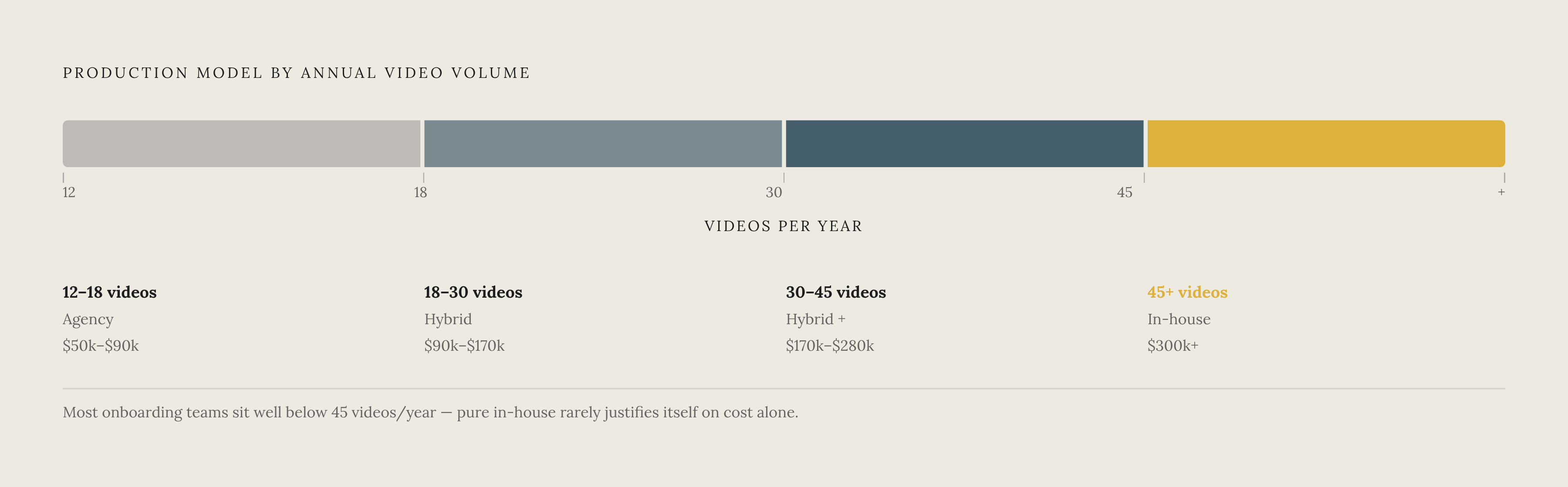
Volume changes which model wins. At 12 to 18 videos a year, agencies come out ahead, landing around $50,000 to $90,000 total. At 18 to 30 videos, it's close enough that a hybrid setup makes sense, running $90,000 to $170,000. Push past 30 to 45 videos and the hybrid model pulls ahead more clearly, at $170,000 to $280,000. Only once a team needs 45 or more videos a year does full in-house plus agency support start to pencil out, at $300,000 and up.
Internal teams tend to become cost-effective once output hits roughly 8 to 12 videos a month, consistently. Below that line, the fixed payroll cost makes every single video more expensive than just paying an outside shop per project. Subscription-style agency services, the kind that bill $3,500 to $22,000 a month for a set batch of 10 to 50-plus edited videos, sit in between: per-video cost lands around $200 to $1,500, but only if the volume commitment gets used.
Here's the part most onboarding and L&D teams miss: they aren't producing 45-plus videos a year. Most sit well under that number, which means the pure in-house model rarely justifies itself on cost alone. Once volume drops out as the deciding factor, the choice shifts to the other three variables, and that's where things get more interesting.
Where update velocity becomes the deciding variable
Onboarding content ages faster than almost anything else a company produces. Software UIs get redesigned with every release. Onboarding steps get rewritten the moment a team figures out what's causing early drop-off. Compliance language shifts with new policy. An HR team that needs to update onboarding after a policy change and then waits on a vendor turnaround is sending new hires through steps that are already wrong. That wait is a cost, even if it never shows up on an invoice.
Agencies aren't built to absorb that kind of churn cheaply. Revisions get priced as one-off exceptions, not as a built-in part of the content's life. Rescheduling a crew for a small fix still carries real crew-day costs that add up quickly. And every time the product changes, the outside team needs to be brought back up to speed, because familiarity with your product doesn't carry over from the last project automatically.
Internal teams close that gap by default. Same-day turnaround on a quick clip is realistic for someone who sits down the hall from the product team; it's almost never realistic for an outside vendor working through a request queue. Product knowledge already lives in the building, so there's no briefing lag when a screen changes. Updates can become part of the team's regular rhythm instead of a new project that has to get scoped and quoted.
Ask three questions before picking a model. How often does the product or the onboarding process actually change in a year? What does it cost when a new hire follows two weeks of outdated instructions? Is the update need predictable, tied to quarterly releases, or is it constant, tied to continuous deployment? Teams shipping software fast have an update velocity problem that agency pricing structurally can't solve without the cost climbing faster than the volume numbers would suggest.
How product complexity shapes which model produces better output
Agencies and internal teams fail in different directions. An agency can hand back something beautifully shot that gets the product wrong, uses terminology nobody on the product team would recognize, or needs three rounds of review just to fix factual errors. They know production. They don't know your product. An internal team tends to produce content that's accurate but rough around the edges, inconsistent visually, or paced in a way that loses the viewer halfway through. They know the product. They don't always know the craft.
Complexity tips the scale toward an agency when onboarding content has to do more than explain a feature. If it also needs to reinforce employer brand, support training across multiple offices, and hold up to executive scrutiny, professional production support earns its cost. The same is true for launch moments, where the video is a first impression and production quality is doing double duty as a signal about product quality. Heavy animation or motion graphics work, the kind needed to explain an abstract system architecture or how two products integrate, often exceeds what a lean internal team can pull off on its own.
Complexity tips toward an internal team when the software is technical and workflow-specific enough that accuracy matters more than visual polish. Products with a lot of edge cases, user roles, or configuration paths benefit from having a subject-matter expert two doors down instead of on a call once a month. And when content has to move in lockstep with the product, an internal team can keep pace with a production schedule that an outside partner simply can't match.
Working with an outside partner means giving up some direct control over creative decisions. For onboarding content, where accuracy isn't optional, that loss of control is a real risk, not just a preference some teams have. Neither failure mode is automatically worse. Which one costs more depends entirely on whether your onboarding content lives or dies on polish or on precision.
Where AI-assisted production changes the calculation for internal teams
AI video tools have started pulling apart the cost structure that used to make in-house production expensive by default. Platforms built for this kind of work automate the parts of the pipeline that used to require a crew: screen capture, script generation, text-to-voice narration, and in some cases automatic translation. Removing crew, studio, and equipment costs from the equation moves the per-video cost floor down substantially, with some estimates putting the reduction at 70 to 90 percent compared to traditional production.
A handful of platforms have built specifically around this shift. Some generate AI avatars and voiceovers, letting a team produce a professional-looking video without a camera or a studio, which matters most for global teams that need the same content in several languages. Others focus specifically on learning content, with fast update capability suited to organizations where information changes often, which lines up directly with the update velocity problem onboarding teams already have. And some are built around turning an existing script, slide deck, or recorded webinar into finished video, automatically trimming filler words and dead air out of raw footage.
The effect on the in-house math is direct: fewer specialist hires are needed to hit a given volume. One person with the right AI tooling can now produce what used to take a two- or three-person team, which pulls the break-even point down from that 8-to-12-videos-a-month threshold a two-person in-house team requires. The goal in these situations isn't better video. It's video at a volume a small budget can actually sustain.
Localization is where this shows up most clearly. Traditional agency localization means paying multiple voiceover artists per language, on top of studio time, and that cost compounds fast for any company running onboarding across several markets. AI platforms that offer one-click translation turn that from a variable cost that scales with headcount into something closer to a fixed feature. AI video tools are no longer a fringe workflow. They're becoming the default starting point for teams that don't have agency-level budgets but still need agency-level output.
A decision framework across the four variables
Four variables, and each one carries a different weight depending on what kind of onboarding content is on the table. Cost structure comes down to whether spend is fixed or variable, and that's mostly a function of how much and how consistently a team produces. Update velocity measures how often content has to change to stay accurate, and it's the variable software teams underweight most often. Volume is simply the total number of videos needed in a year, and the thresholds from the cost breakdown apply directly here. Product complexity measures how much subject-matter access and factual precision matter relative to visual polish.
An agency makes the most sense when annual volume sits below roughly 12 to 18 videos and the content, once made, doesn't need constant revision. It also makes sense for high-stakes, high-visibility moments, a major launch, an executive audience, anything tied closely to employer brand, and for any project that needs heavy animation or live-action work an internal team isn't equipped to handle. If there's no internal production infrastructure yet and volume doesn't justify building one, an agency avoids sinking cost into capacity that would sit idle.
An internal team, especially one working with AI tools, makes more sense once volume climbs past that same threshold, once update velocity is high enough that agency turnaround becomes a liability, and once product complexity demands the kind of subject-matter access that only comes from sitting next to the people who build the product. None of the four variables settles the question by itself. Weigh them together, against the shape of your own onboarding content, and the right model usually becomes obvious rather than debatable.