Build vs Buy Decision Criteria for LMS-Integrated Video Tools
Total cost of ownership, not subscription price, determines whether to build or buy.
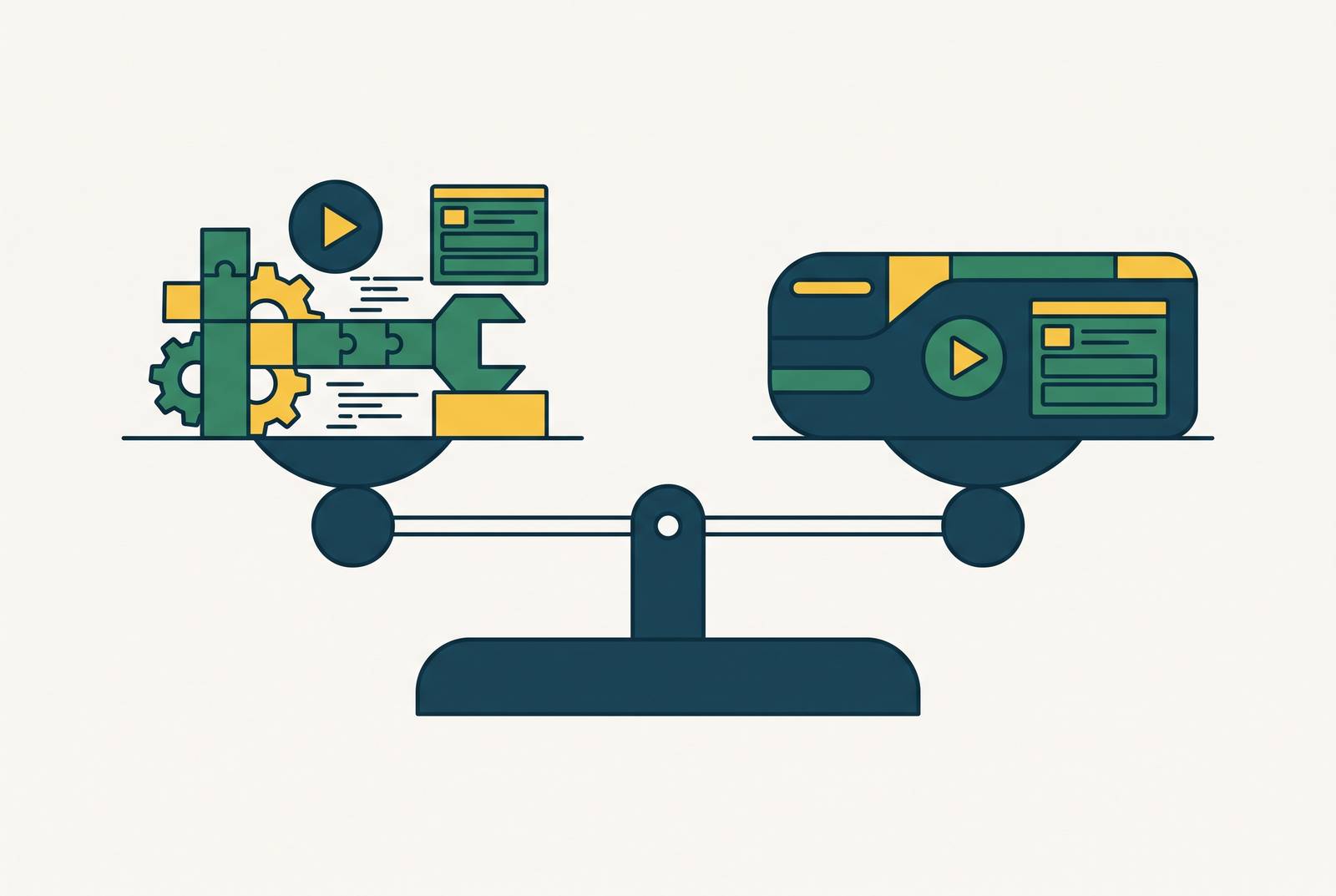
Building or buying an LMS video tool is not really a spending decision. It is a decision about what your team controls now and what it will wish it controlled in two years, and most teams get the framing wrong before they even open a vendor comparison sheet.
The three paths and the hybrid most teams actually take
Three real options exist, and a fourth one shows up whether you plan for it or not.
Buy means renting a finished, hosted platform. The vendor handles maintenance, patches, and uptime. Learners can sit inside a course within weeks. The tradeoff is control: you inherit whatever video player the vendor built, their tracking model, and a customization ceiling you can't see until you hit it.
Extend means taking an open-source system, Moodle being the dominant example (running on roughly 145,000 to 147,000 registered sites across more than 235 countries), and building on top of it. You get more room to move than a SaaS product gives you, but only at the exact points the core was designed to let you extend. Push past those points and you've quietly forked the codebase. Every future upgrade from the open-source project now has to be manually reconciled with your changes, which is exactly the kind of work nobody budgets for until it's overdue.
Build means a custom platform from the ground up. Full control over video, tracking, and the learner experience, at a real cost: a full custom build in 2026 runs somewhere between $25,000 and $150,000-plus and takes four to nine months to reach first launch. That kind of spend only pays back once you're operating at scale.
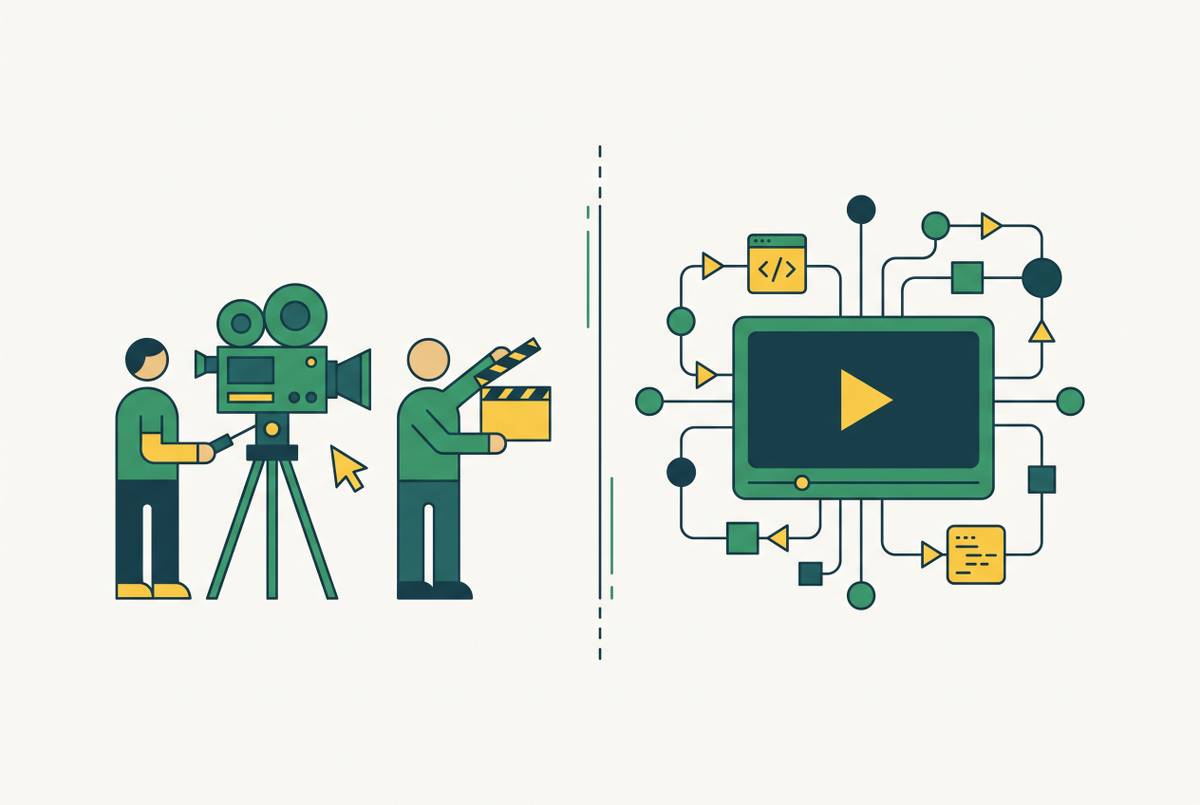
Then there's the path most teams end up on without ever naming it. Hybrid keeps a bought or extended system for the parts that are already solved, courses, enrollment, grading, and builds custom only the layer that actually differentiates the product. That layer is almost always video and analytics. A hybrid build typically ships in 8 to 12 weeks, faster and cheaper than going fully custom.
In this pattern, the LMS backbone owns the boring, essential stuff: course structure, enrollment records, grade books. The custom video layer owns the experience, and it writes results back into the LMS through LTI launch and xAPI statements. These four paths are not equally weighted options on a menu. Most organizations land in the hybrid quadrant eventually, whether that was the plan on day one or not.
What the real total cost of ownership looks like across each path
Comparing a subscription quote to a build quote is comparing two different things. The number that actually matters is total cost of ownership, and it rarely resembles the number on the proposal.
Take a SaaS quote of $15 per user. Add setup work, compliance reporting configuration, and a full month of admin labor to get the thing actually running, and the effective cost lands closer to $47 per user. That gap never shows up in the sales deck. Across the industry, year-one LMS costs typically run about 2.5 times the subscription quote once setup, migration, admin labor, and content are folded in. Implementation services alone can reach or exceed the annual license fee, and integration overhead adds further cost on top of that.
On the build side, an MVP-scope custom LMS, meaning core course delivery, progress tracking, basic user management, and one to three integrations, typically runs $30,000 to $70,000-plus and takes three to five months to launch. Expect 400 to 500 development hours for a full build.
The cost curves cross at different points depending on growth. Per-seat SaaS fees compound as your user base grows. Custom builds carry a heavier upfront capital cost but a more predictable operating cost year over year. One packaging trend worth flagging for 2026: AI-powered analytics are increasingly sold as tiered add-ons, meaning features bundled into your plan last year might sit behind a pricier tier this year, pushing your SaaS TCO up mid-contract without any change on your end.
Maintenance costs deserve their own line item. A team supporting three LMS platforms should expect 20 to 40 engineering hours a month in upkeep. At a conservative $150 an hour fully loaded, that's $36,000 to $72,000 a year, just to keep things running, before a single new feature ships. Third-party integration platforms, if you go that route instead, typically run $12,000 to $60,000 a year depending on scale.
The break-even signal is fairly consistent: if your user count is climbing and your integration requirements are getting complicated, the math tends to favor custom once you clear roughly 5,000 monthly active users with more than three custom integrations in play.
The integration layer: where architectural decisions become irreversible
LTI, SCORM, and xAPI get talked about like interchangeable acronyms. They're not. Each one reflects a different assumption about what learning data actually is and where it's supposed to live.
LTI 1.1 support ended on June 30, 2022. LTI 1.3 replaced it with OAuth 2.0 and JWT for secure launch and access. Any team still running LTI 1.1 integrations is carrying technical debt that's been overdue for a rewrite for years now.
SCORM still does its job well for fixed, mandatory compliance training. LTI 1.3 handles grade sync, Deep Linking, and external tools sitting outside the LMS proper. These aren't rival standards fighting for the same job, they're complementary, built for different kinds of content.
xAPI, also known as Tin Can API, exists specifically because SCORM has limits. SCORM was built around a single context: one learner, one browser, one course. xAPI was built to capture learning wherever it actually happens, inside or outside that narrow box. The practical strategy in 2026 involves choosing both SCORM and xAPI. It's SCORM and xAPI: keep SCORM for the formal, mandatory compliance track, and layer xAPI on top for the informal, skills-based learning that doesn't fit SCORM's frame.
Watch the "standards support" column on any vendor comparison sheet closely. It determines whether your content can actually move between systems later, and whether enterprise buyers will take you seriously at all. Roughly 46% of organizations still struggle to connect their LMS platforms with legacy systems, and a bought solution that doesn't support your existing integration stack doesn't solve that problem. It just hands it back to you with a new coat of paint.
There's a newer wrinkle worth watching too. AI is starting to get applied to legacy SCORM content: agents that can read a compiled SCORM package, pull out the text, video, and audio, and index it for semantic search or repurpose it into microlearning chunks. A built or hybrid architecture is far more likely to support that kind of work than a locked-down SaaS system that treats your content as a black box. Standards exist to cut the cost and time of updating training content. When modules follow universal specs, switching platforms or bolting on new tech doesn't mean redoing the work from scratch.
The decision criteria that actually separate build from buy
None of this works as a checklist you score and tally. Treat these as levers instead. One strong signal pointing toward "build" can outweigh three or four smaller signals pointing toward "buy."
Lean toward buying when: LMS integration is a checkbox on your list, not something that sets you apart. Basic SSO, roster sync, grade passback, buying here saves three to six months of integration work you don't need to do yourself. This also fits when training needs are standard, your user base is stable and sits under roughly 1,000 people, and you're not wiring into any proprietary systems. It fits, too, when your team simply doesn't have LMS integration chops yet. LTI 1.3, AGS, NRPS, Deep Linking, these have real learning curves, and building that expertise from scratch takes time a pre-product-market-fit team usually doesn't have. And if you need to support Canvas, Moodle, Blackboard, and Brightspace fast because sales needs it, not because it differentiates you, buying is almost always the faster road. As a rule of thumb, a store-bought LMS should cover about 90% of your critical functionality and 80% of your required functionality before it clears the bar.
Lean toward building when: LMS integration is the actual competitive edge, custom grade passback logic, deep content embedding, real-time data exchange. A generic integration layer will cap what you can build long before you're ready to stop. Building also makes sense when 90% of your customers sit on one LMS and you need platform-specific features a generic tool can't reach, or when compliance, data sovereignty, or audit logging requirements go beyond what a vendor's settings panel allows. If you're selling the LMS experience itself, a platform-as-product or white-label model, building is close to mandatory. And if your team has already built LMS integrations before, that expertise makes the build path faster and less risky than starting over with someone else's platform. One clean signal: if you're already spending more than 20% of engineering time maintaining a bought solution's integrations, the economics have already flipped in favor of building.
Hybrid or extend fits when: The core LMS is solid but the video, analytics, or experience layer is where you actually differentiate, so you own only that piece and leave the rest alone. It also fits pre-product-market-fit teams racing to launch who still want the option to build custom later, once they know exactly which integration features customers actually need. Designing the product layer early to abstract away integration details makes that later migration from bought to custom a lot less painful.
Before deciding anything, run through five questions: Is LMS integration infrastructure, or is it core value? How many LMS platforms need support in the next 12 months? Does the team have real LMS integration expertise today? What does the integration need to do that an off-the-shelf tool doesn't already handle? And what does it actually cost, ongoing, to own this in-house?
Where the video production layer fits into the architecture decision
Video isn't a commodity feature bolted onto an LMS. For a lot of teams, it's the layer they most want to control, which means the build-vs-buy logic for video often runs opposite to the logic for the LMS backbone itself.
Between 93% and 98% of organizations now use video for employee training. Producing good video quickly isn't optional infrastructure anymore, it's a real production capacity problem. The goal that's taken hold in 2026 is making video creation accessible to anyone on the team, regardless of technical skill, so L&D staff can turn out onboarding videos, compliance training, software walkthroughs, and process docs at scale without hiring a videographer.
Training content that shows up where people already work does more good than the same content locked in some isolated video library nobody opens. That means a video tool's integration into existing workflows matters just as much as its production features. AI-assisted workflows, script generation, AI voice, template-based assembly, exist precisely for this situation, where production volume outpaces what a traditional team can deliver. The point isn't better individual videos; it's production at scale, full stop.
Combined AI workflows, an LLM for scripting, a video generator, a design tool for polish, often save significant hours per course compared to traditional production. For any of that to work inside a real training stack, the tools need to support SCORM compliance and plug into the LMS already in place. One question cuts through the noise here: does the video tool write learner data back to the LMS through xAPI or LTI, or does it keep viewing data siloed in its own dashboard? That answer decides whether the learning evidence you're generating is portable or stuck.
The AI video tool landscape for LMS-integrated production
These tools sit at different points on the control-versus-speed spectrum, and they're built for different workflows. No single one is the right call for every architecture.
Colossyan leans into AI-powered training video creation with strong support for learning-specific use cases: avatars, voiceovers, structured scripts. Its ability to update videos fast is a real differentiator for organizations where information changes often, and it supports multilingual output for global teams that need consistency across regions.
HeyGen sits in the same avatar-and-voiceover tier, useful for teams that need presenter-style video without putting anyone on camera.
Knowlify is built specifically around turning existing knowledge into animated explainer video. Its core differentiator is document-to-video AI, which lets users upload a training manual, an internal procedure document, a compliance doc, a product guide, a slide deck, or a PDF and generates a complete animated training video from that source material. The workflow is built around how training teams already operate, not around learning a new production skill.
Pictory is strongest for repurposing existing material into video assets at scale, turning a webinar recording into shareable clips, or a product page into a short explainer. It leans more toward content repurposing pipelines than LMS-native production.
Veed brings AI-driven editing, subtitle generation, avatars, and collaboration tools into one place, with features like Magic Cut, background removal, and eye contact correction. It generates captions automatically, with AI-driven translation and voice dubbing built in, and it's collaboration-forward, a good fit for teams where multiple people touch the same asset.
Whichever tool gets evaluated, run it through the same lens as the LMS itself: does it produce SCORM-compliant output, does it write xAPI statements, does it support LTI launch, and can it be white-labeled or embedded inside the LMS rather than living as a separate, disconnected platform.
How content production decisions connect to onboarding and training outcomes
The architecture decisions above aren't abstract. They show up directly in how fast a new hire gets productive and how much of that training actually sticks.
A video tool that writes back to the LMS through xAPI means a manager can see, in the same dashboard as every other course metric, whether a new hire actually watched the onboarding video or skipped to the end. A tool that silos its own analytics means that data lives somewhere else entirely, disconnected from completion records and compliance reporting, which makes it functionally invisible to anyone running the program.
Production speed matters just as much as data portability. An L&D team that can turn a process document into a training video in an afternoon, instead of waiting weeks for a production vendor, can keep onboarding content current as processes change. Stale training video is worse than no video at all, because it teaches the old process with total confidence.
What matters isn't picking the flashiest AI tool on the market. It's about making sure the production layer and the LMS backbone speak the same language, SCORM, xAPI, LTI, so that the content produced today still has a home two platform migrations from now.