When to Keep Training Video Production In-House
AI tools slash production time, making in-house training videos viable for most software teams.
Most teams that outsource training video do it out of habit, not analysis. Nobody ran the numbers this quarter; somebody ran them three years ago, and the vendor relationship just kept renewing on its own momentum. That made sense when professional-quality video required professional producers, full stop. AI-assisted tools have cut per-minute production cost by 80% or more, and outsourcing by default deserves a hard second look for most software teams with recurring content needs.
What "in-house" actually means in 2025, and how AI changes the definition
The old version of in-house meant a dedicated videographer, a studio room somewhere in the office, an editing suite, and overhead landing near six figures a year before a single video got made. That's a real cost structure, and it's why so many teams never even considered building internally.
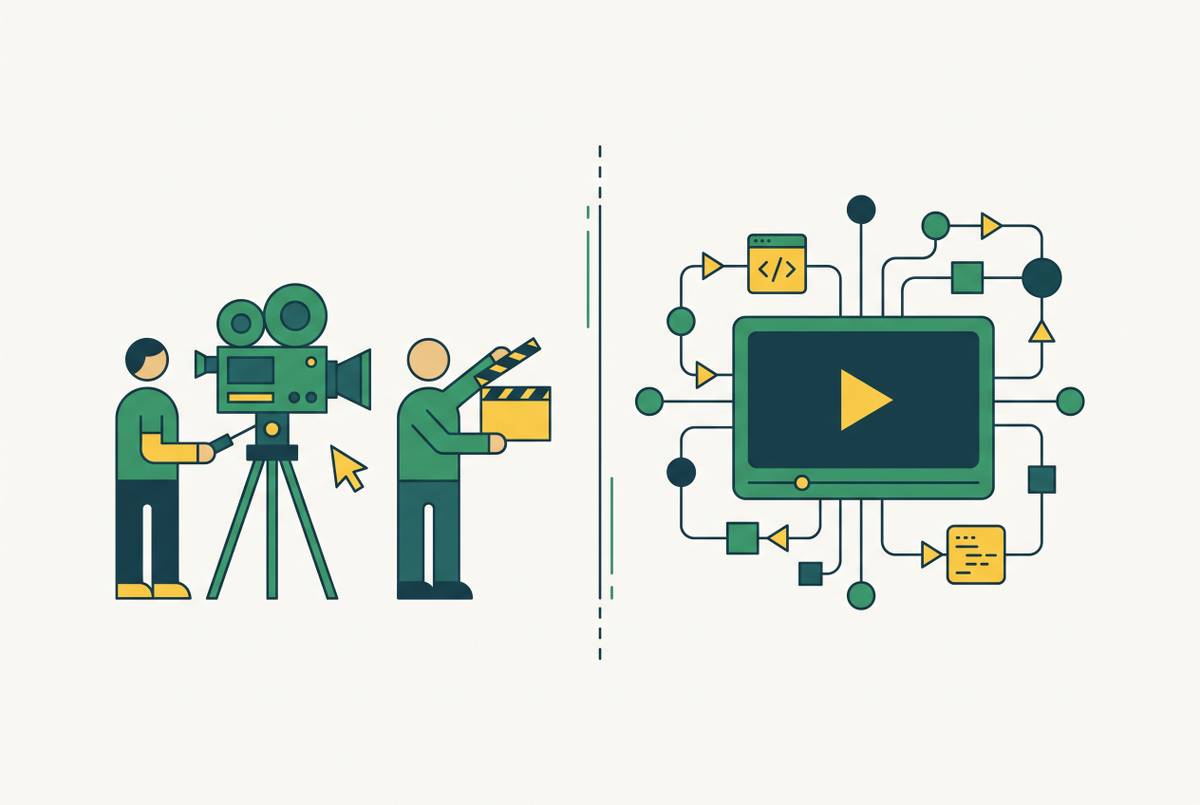
The new version looks nothing like it. A subject matter expert opens an AI-assisted platform, drafts a script, records a take, lets the tool handle narration and sync, and publishes, with no producer anywhere in the loop.
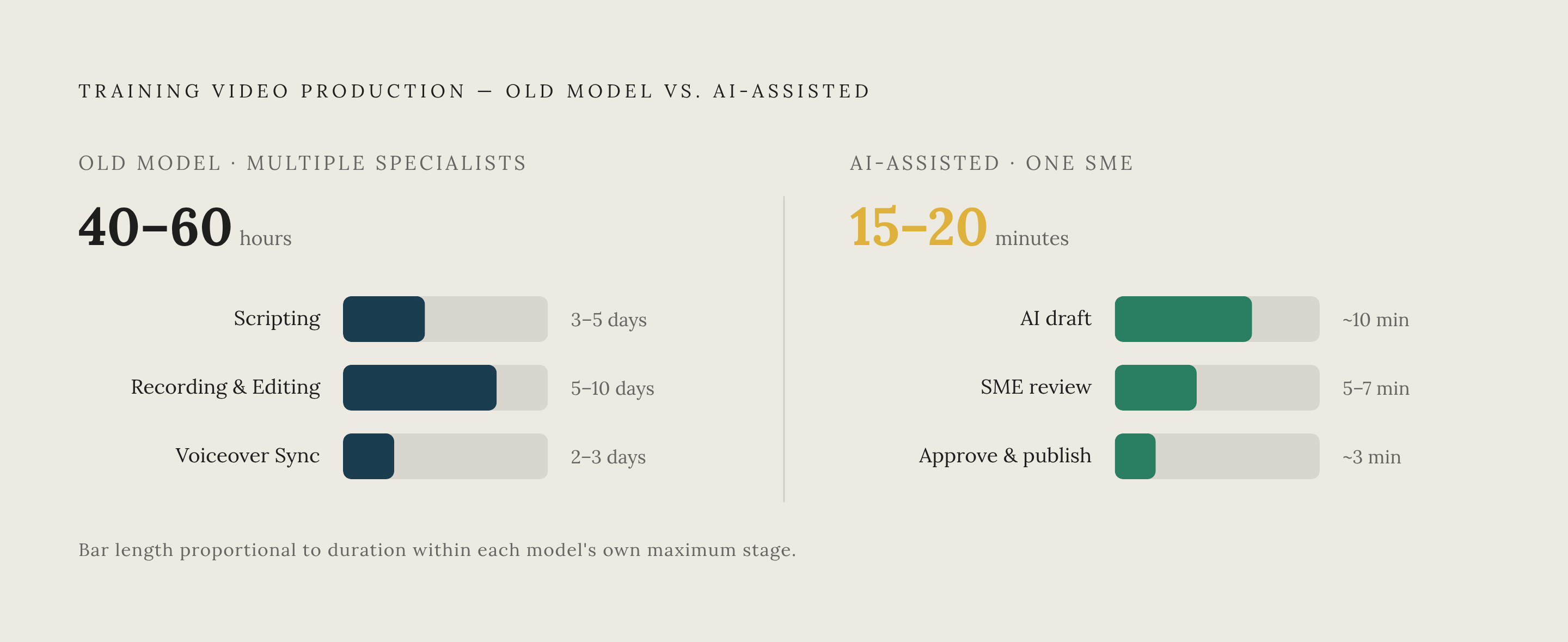
Look at what happens to the timeline. Scripting that used to take three to five days now takes minutes, recording and editing that used to run five to ten days now takes an afternoon, and voiceover sync that used to mean two or three days of back-and-forth is automatic. A process that used to eat 40 to 60 hours across multiple specialists now takes one SME about 15 to 20 minutes, most of it spent reviewing a draft the AI already wrote.
The bottleneck moves, but it doesn't disappear. Production capacity stops being the constraint once the tool handles that part; what's left is a decision-making problem: who approves the video, who owns it once it's live, what gets made next. In-house production, in this new form, means owning a workflow more than standing up a media department.
Current tools split roughly into two camps: avatar-based, script-to-video platforms built for structured training with quizzes and branching baked in, and screen-recording-forward tools that let software teams move fast on process walkthroughs and SOPs. Both count as in-house now, and neither needs a producer on staff.
The four conditions that make in-house the stronger choice
In-house isn't right for every team, and treating it as a default just replaces one kind of laziness with another. Four conditions decide it, and most teams only need to check two of them.
Volume comes first. Weekly compliance updates, constant onboarding cohorts, a new walkthrough every sprint: high, recurring output favors in-house, because outsourcing cost compounds per video while in-house cost mostly flattens once the tool is paid for.
The second condition is proprietary or sensitive content. Internal SOPs, unreleased features, personnel onboarding, anything with compliance exposure attached: none of that belongs on an external vendor's shared drive.
Rapid iteration is the third. Software teams that ship constantly need training content that moves on the same cycle as the product. A polished outsourced video that takes three weeks to revise after a UI change stops being an asset; it starts actively teaching people a screen that no longer exists.
Available tooling is the fourth. The relevant question is whether the SMEs already on staff can produce professional output with what's on the market right now, more than a matter of budget. A few years ago the answer was no regardless of budget, but today it's usually yes.
Score two or more of these, and in-house wins on return almost every time. The one real exception is occasional high-stakes brand work: an executive keynote, an investor film, an award submission. Those can still make sense to send out, even for a team that's moved everything else in-house.
Volume is the strongest signal, and here's what "high enough volume" actually looks like
Volume is the cleanest of the four conditions because it's arithmetic, more than judgment. A mid-level in-house videographer runs close to six figures once benefits and overhead get added to salary, and that number only pays for itself with sustained output. A team making four videos a year should keep paying a vendor per project and stop overthinking it.
AI-assisted production resets the threshold entirely. The tool absorbs the labor that used to require a salaried hire, and a platform subscription replaces that salary outright. The break-even point doesn't drop from dozens of videos a year to some smaller number of dozens; it drops to a handful.
Software companies hit the volume wall faster than most, and the data shows why. According to ATD, U.S. companies spent an average of $1,207 per employee on training in 2024, and that spend turns directly into a backlog: content that needs to get made, then kept current as the product changes under it. That spend turns directly into a backlog of content that needs to get made, then kept current as the product changes under it — and the gap between how much content is needed and how fast it can get produced is a recurring pressure that budget alone doesn't resolve.
The general pattern holds: teams with recurring, high-frequency content needs consistently find in-house production wins the cost-and-speed comparison over a full year. Updateability counts as volume even when it doesn't look like it on paper. Fifty modules that each need a revision whenever policy or product shifts is a recurring workload wearing a one-time-project disguise.
Why proprietary content is the most overlooked argument for keeping production internal
Most of the in-house-versus-outsource debate gets framed as dollars per finished minute, salary against vendor invoice. Sensitivity rarely gets named out loud in that conversation, and that's the omission that costs teams the most, since it's often the real reason the decision breaks one way or the other.
Some categories of training content just shouldn't leave the building. Unreleased features, roadmap-adjacent walkthroughs, internal HR and compliance processes with legal exposure attached, customer-specific onboarding that reveals proprietary workflow, SOPs that encode process knowledge a competitor would pay to see: none of it belongs in a vendor's project folder, however good the vendor.
Software companies feel this acutely because the UI never sits still. Here's the failure mode: a vendor gets briefed on a feature, builds the walkthrough, and by the time it's published, the feature has already shipped in a different form. Wherever release cycles and production cycles don't line up, that's exactly where the video goes stale before it's even live.
AI-assisted in-house tools sidestep the problem by letting the person who owns the knowledge make the video directly. The engineer or product manager who built the feature documents it directly, cutting accuracy errors and confidentiality risk in the same move. There's a brand-consistency bonus too: in-house teams bake approved templates, terminology, and tone into the tool itself, instead of renegotiating those details with an outside vendor on every project.
Rapid iteration as a structural requirement for software training teams
Training content has a shelf life, and that shelf life shrinks every time the product ships something new.
Stale content is a double failure: it teaches a UI nobody sees anymore, and it can't reinforce knowledge that fades without timely repetition regardless of how accurate it was on day one. That's the real cost of a slow revision cycle, well beyond an aesthetic complaint about outdated screenshots.
Outsourced vendors run on production schedules, not sprint cycles. A revision adds days, sometimes weeks, and a team shipping every two weeks can't wait that long without the training library falling permanently behind the product it's supposed to explain. In-house AI workflows close that gap: update the paragraph that's now wrong, regenerate the module, done. A product change triggers a content fix the same week, not the same quarter.
For any team on a fast release cadence, that speed carries more weight than a marginal bump in visual polish. Treating polish as the higher priority is exactly the mistake that leaves training libraries stale, and it's the mistake outsourcing defaults teams into without anyone deciding it on purpose.
When outsourcing still wins, and how to draw the line within a hybrid model
The four conditions point toward in-house when they line up, and toward outsourcing when they don't. Neither side wins by default, but the burden of proof sits with outsourcing now, more than the other way around.
Outsourcing still wins in specific cases: one-off, high-stakes external content that needs cinematic value, like brand films, investor narratives, or award submissions; complex 2D or 3D animation that needs specialized tools and artists a team won't use often enough to justify owning; and teams with genuinely no bandwidth to absorb a new workflow, like a single-person L&D function already stretched thin.
Most teams that run through this exercise land on a hybrid: outsource the flagship, build the fleet in-house. One polished brand explainer a year gets made externally with a specialist crew, while dozens of onboarding modules, SOPs, and product walkthroughs get made internally on an ongoing basis by the people who actually know the material.
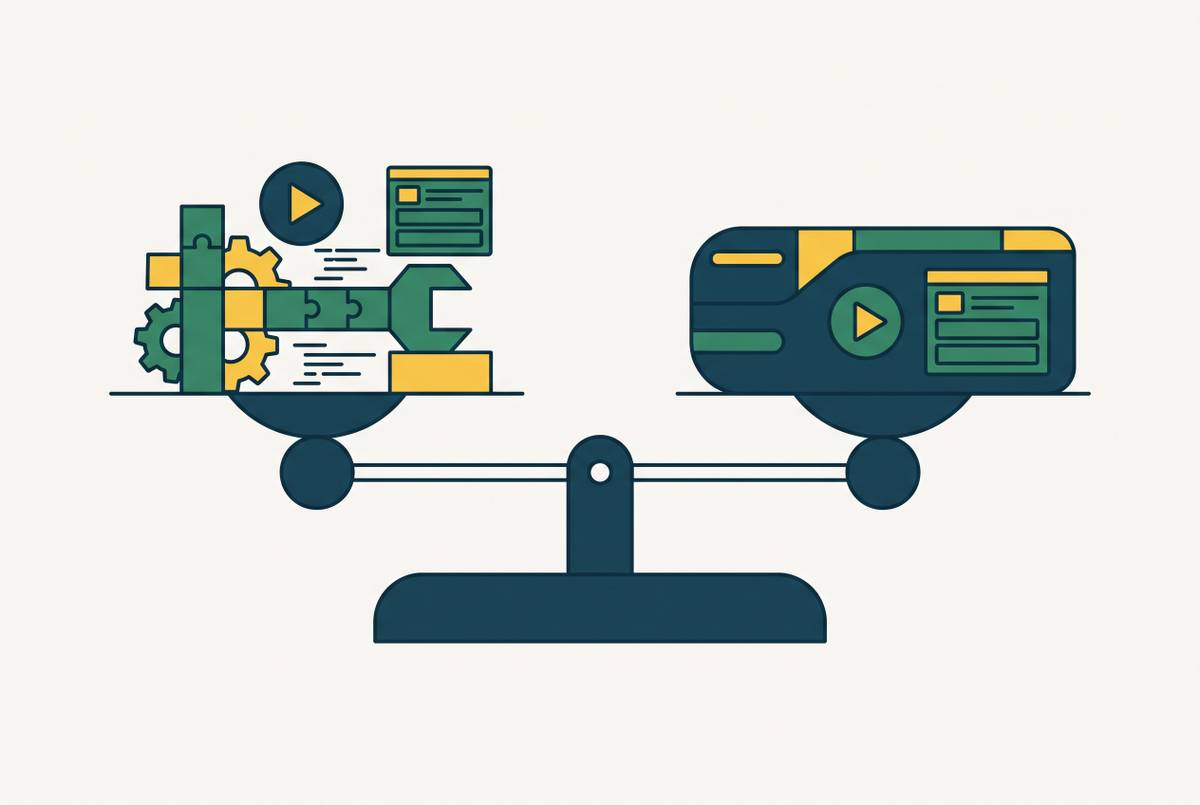
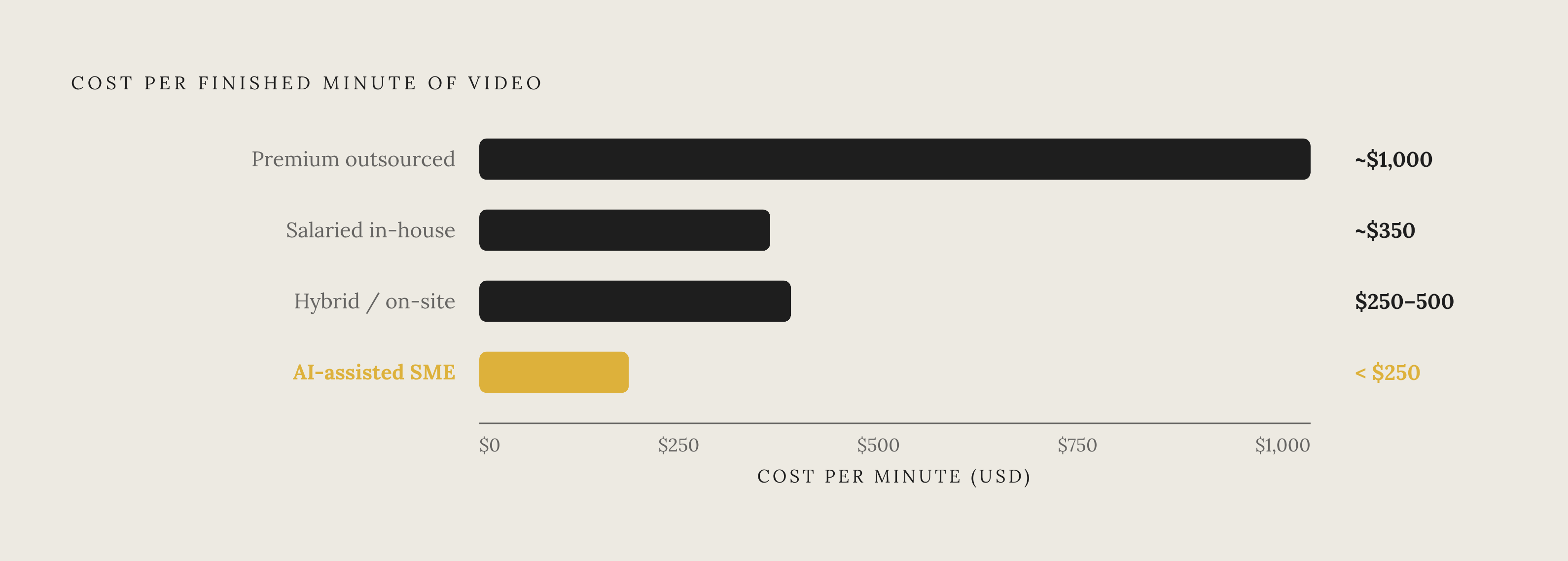
The numbers make the split obvious. Premium outsourced production runs around $1,000 per finished minute, while hybrid or on-site production runs $250 to $500 per finished minute. A salaried in-house videographer, at steady output, works out to roughly $350 per finished minute, and AI-assisted SME production undercuts all three. The line gets drawn by content type, not company size; plenty of large enterprises outsource one flagship project a year while running everything day-to-day entirely in-house.
Building the internal capability: what the team and toolstack actually need to look like
Here's the failure mode that shows up most often: a team decides to go in-house, buys a platform, and six months later quietly drifts back to a vendor because the workflow never turned into a habit.
What makes it stick is the structure around the tool, alongside the tool itself: designated content owners inside each function, customer success, L&D, product, who make videos themselves instead of routing every request through one central bottleneck; a platform matched to the content type, with screen-recording tools for software walkthroughs and SOPs, script-to-video tools for structured courses and compliance material, or both for teams doing double duty; templates and brand standards built into the tool itself, more than enforced by someone reviewing every video after the fact; and a publishing layer that tracks completion and engagement, so the data actually gets back to the team that needs it.
Good training video, regardless of who makes it, includes captions, a clear learning objective, and a runtime held to three to six minutes, since engagement drops fast past that mark.
Localization deserves a decision up front, not a patch later. If the content reaches non-English-speaking users or employees anywhere in the org, the tool needs to handle that from day one; bolting it on later leaves the global audience permanently behind the domestic one.
The toolstack choice and the team model are really the same decision. A platform that still needs a specialist to operate just rebuilds the dependency in-house production was supposed to kill. The right tool is the one where the SME who knows the material can make the video without anyone else's help.
Applying the framework: mapping your team's situation to the right decision
Four questions settle it. How often does the team need to make or update content? That's volume. Does the content involve anything proprietary, sensitive, or pre-release? That's sensitivity. Does the product change faster than an outside vendor can turn around a revision? That's iteration speed, and whether the SMEs on staff can produce professional output with tools available right now, no production specialist required, is tooling accessibility.
Answer yes to two or more, and in-house is the strong bet. Answer yes to all four, and outsourcing should be treated as the occasional exception, more than the standing arrangement.
None of this has to happen all at once, and none of it is permanent. Start with whichever content category scores highest across the four conditions, prove the workflow actually holds up, then expand from there. AI moved the threshold for what's possible; most teams can now build professional training video in-house, with the right tool already on the market. The real question is whether a given team has actually decided to use it, or is still paying someone else out of habit.