True Cost per Training Video in Software Companies
Vendor quotes hide the real cost buried in internal labor and maintenance.
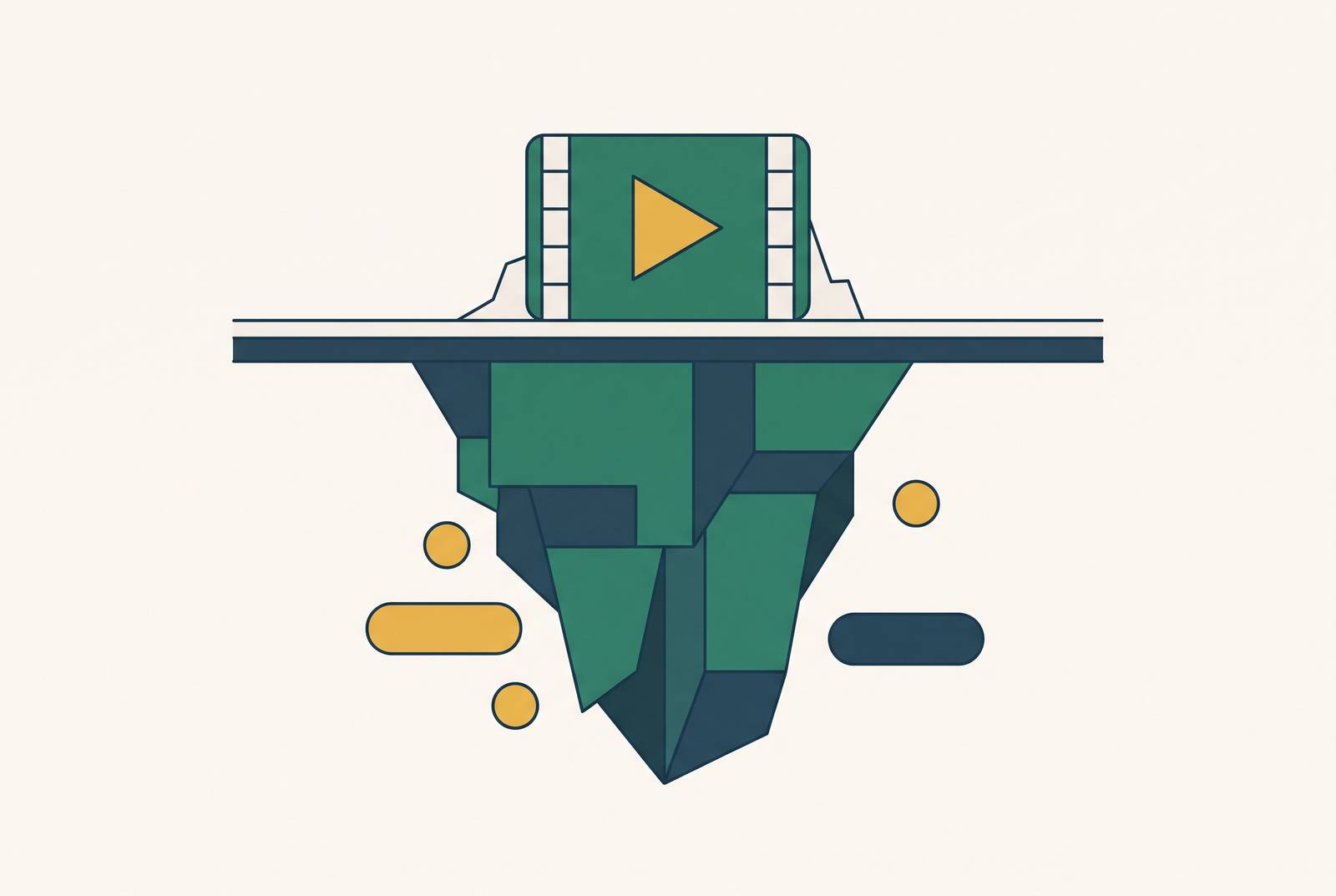
A per-minute rate from a vendor tells you almost nothing about what a video actually costs, and treating it as the real number is the first mistake most training teams make. Traditional corporate video runs $1,500 to $10,000 per finished minute, and that spread exists because pre-production planning, camera crews, and manual editing eat the budget before anyone opens a timeline. Software training video sits lower, at $400 to $2,000 per minute, and format explains most of that range.
The vendor quote covers only one term in a much longer equation. The true total cost of a software training video is the production cost plus internal labor (a realistic floor of 40 to 60 hours per video at a blended internal rate), plus revision overruns at $500 to $2,000 per out-of-scope round, plus music and stock licensing ($200 to $2,000), hosting ($50 to $500 a month indefinitely), plus maintenance across the content's useful life at $2,000 to $5,000 per update, plus localization, plus learner time multiplied by headcount. A five-minute video produced through a traditional workflow can quietly consume tens of thousands of dollars in internal time that never appears on any invoice, and if the underlying software changes twice a year, annual update costs alone can exceed what the video cost to produce in the first place.
Simple screen recordings run $400 to $1,200, and they're fast to make but just as fast to go stale, since the recording is tied to whatever the interface looked like on the day someone hit record. Animated UI walkthroughs, the more durable format in this category, run $900 to $1,700. A full SaaS product demo for the US market runs $6,000 to $15,000 once scripting, UI animation, voiceover, motion graphics, and two to four revision rounds get folded in, though most B2B companies land closer to $2,500 to $5,000 for a two-to-three-minute demo. Basic internal training tops out around $5,000, while multi-module enterprise courses climb to $25,000 and past $150,000 depending on scope. Self-serve screen recording tools let a team produce something for $26 to $200 total, with quality and shelf life taking the hit accordingly.
These figures capture only part of the real cost, and that's the point worth sitting with. An invoice shows what the vendor did, but the vendor is the smaller part of the story. Everything the organization does around that engagement, the labor nobody itemizes, sits on top of the quoted number, and most budget conversations skip that part entirely. That omission is the actual subject of this piece.
The internal labor cost that never appears on any invoice
A five-minute training video, made through a traditional workflow, typically demands 40 to 60 hours of internal effort. That number rarely shows up in a planning document because it's spread across people who each touch a small piece of the project and never see the whole thing.
Scripting alone can eat multiple days. Recording, editing, voiceover sync, and revisions follow, each phase pulling in a different mix of subject matter experts, instructional designers, project managers, and reviewers. None of that time gets billed, yet all of it gets spent. ATD's 2024 State of the Industry benchmark puts the average direct cost of a learning hour at roughly $165 across surveyed organizations, a figure that folds staff time in alongside the vendor fee.
There's a second tax, quieter than the first: onboarding a new editor onto traditional video software takes an average of 40 hours per employee, or thousands of dollars in lost productivity before that person produces anything usable. A project scoped as a modest vendor engagement can quietly consume tens of thousands of dollars in internal time that finance never sees on a line item. The vendor quote answers a narrower question than the one most teams think they're asking, and mistaking the two is where training budgets actually go wrong.
How revision cycles quietly multiply the cost of a single video
Revisions are the line item most teams get wrong, almost without exception, since each out-of-scope round with a vendor runs $500 to $2,000, and that's before counting what it costs internally.
Every revision loops the subject matter expert, the reviewer, and the project manager back into the process. A revision costs the vendor's hours, plus the reviewer's afternoon, the SME's attention pulled off actual product work, and the project manager's time spent chasing sign-off again. The root cause is almost always an instructional design problem rather than a production one, and misreading it as a production issue is exactly how teams end up paying twice. Settle the teaching approach before anyone touches a camera or a recording tool, since that single sequencing fix removes most revision pressure before it starts, and it costs nothing.
Quotes also tend to exclude line items that surface later, during finalization, when it's too late to negotiate them away. Music and stock footage licensing runs $200 to $2,000, while hosting and platform fees add $50 to $500 a month, indefinitely. Captions and accessibility work get scoped as an afterthought more often than not, which means they get priced like one too. Lock in a fixed revision count without locking the script first, and the count gets blown past almost every time.
Maintenance costs: what happens when the product changes after the video ships
Software doesn't hold still. A training video that references a specific button, menu, or flow has a shelf life measured against the product's release cadence, not against the video's own quality, and most production budgets ignore that fact entirely.
Updating existing content under a traditional model costs $2,000 to $5,000 per update, nearly what it costs to produce new short-form content from scratch. Live-action and talking-head formats take the biggest hit, because any meaningful change usually forces a reshoot: new footage, new presenter time, new editing pass. Animation carries a structural advantage that's easy to underrate at the outset. Updating an animated sequence often requires only a design revision rather than a reshoot, which cuts long-term update costs by an estimated 30 to 50% against live-action. That gap alone should decide format choice for anything tied to a live product; treating it as a stylistic preference rather than a cost decision is how teams end up locked into reshoots for years.
The question worth asking at the point of purchase is what the video costs over its useful life, given how fast the underlying product changes, more than what the video costs to make today. The format decision made on day one quietly decides whether next year's update is a minor edit or a full rebuild, and most teams never make that decision on purpose; they back into it by defaulting to whatever format looked cheapest at the outset. That default is the single most avoidable cost in this entire piece.
Localization: the cost multiplier most global teams discover too late
A large share of global employees prefer training content in their native language, yet many companies produce training video in only one or two languages. The gap between those two numbers is explained almost entirely by cost, and the cost is a direct artifact of the reshoot model.
A set of compliance training videos in English already carries a substantial production cost. Reshooting the same videos with native presenters and localized graphics across additional languages multiplies that budget sharply. Faced with that math, most organizations make the short-term rational call: produce in English, ship it everywhere, and absorb the comprehension gap. That call is defensible on a spreadsheet and costly in practice, because the comprehension gap doesn't stay contained to the training department.
It shows up as lower completion rates, compliance gaps in markets where English isn't the first language, slower onboarding for non-English-speaking staff, and a two-tier training experience where headquarters gets the polished version while every other office improvises a workaround. Localization is a cost-of-ownership problem baked into the production format chosen at the start, and treating it as a translation problem to solve after the fact is exactly what drives the expense up. AI-driven localization tools are starting to break the reshoot model, turning per-language cost into a fraction of what it used to be, but only for teams that build localization into the workflow from day one instead of bolting it on after shipping.
Learner time as a cost category organizations rarely quantify
Every hour an employee spends watching a training video is an hour not spent doing the job that video exists to support, and that's an organizational cost whether or not it ever touches a production invoice.
One instructional designer's math shows the mechanism plainly: $10,000 in development costs for three 20-minute modules, spread across 1,200 learners, works out to $8.30 per learner. Cost per learner falls toward zero as the audience scales, which means longevity matters more than the sticker price on production. A video that gets re-watched because it was outdated, confusing, or incomplete isn't a minor annoyance, and it doubles the per-learner cost of that piece of content, instantly, without anyone re-approving a budget.
The cheapest video to produce is frequently the most expensive video per learner-outcome, once completion, comprehension, and retraining costs get counted honestly instead of ignored. Chasing the lowest quote is, in this narrow but important sense, a costly instinct, and it's the instinct most procurement processes are built to reward.
How AI production workflows change the cost structure, not just the price
Traditional production, at $1,000 to $5,000 per finished minute, kept most training content outdated and rarely refreshed, because refreshing it cost nearly as much as making it in the first place. AI video platforms compress that cost by 80% or more, which makes frequent updates economically viable instead of a budget luxury reserved for flagship courses.
The shift changes the labor model as much as the price tag. AI handles script cleanup, voiceover generation, zoom effects, and captioning: the tedious work that used to consume most of the 40 to 60 hours per video under the old model. Subject matter experts spend 15 to 20 minutes reviewing a draft instead of hours building one from a blank page. Teams using these tools report producing five to ten times more content with the same internal headcount, which turns the conversation from whether the organization can afford an update to why it wouldn't do one.
Maintenance costs drop for a structural reason: updating an AI-generated video is an edit, because the underlying format is modular by design rather than locked into a single continuous take. Localization shifts just as much. Per-language cost that used to require an entirely new production budget becomes closer to a checkbox than a line item. That combination, cheap updates paired with cheap localization, matters more than the headline price drop, and it's the part most vendor pitches undersell.
Several platforms compete in this space with different emphases. Some lean toward recording-first workflows with lighter editing; others toward outbound and sales-enablement use cases, priced at varying per-seat monthly rates depending on feature depth. The category most directly aligned with the cost drivers named above, internal labor, revision overhead, maintenance cycles, and localization, centers on one workflow: screen recording that turns directly into a polished video and step-by-step documentation, with language support built in rather than added on later. Whether that support is built in versus bolted on decides whether the savings show up in year one or never show up at all.
What is the true total cost of a training video when you factor in pre-production, revisions, and maintenance?
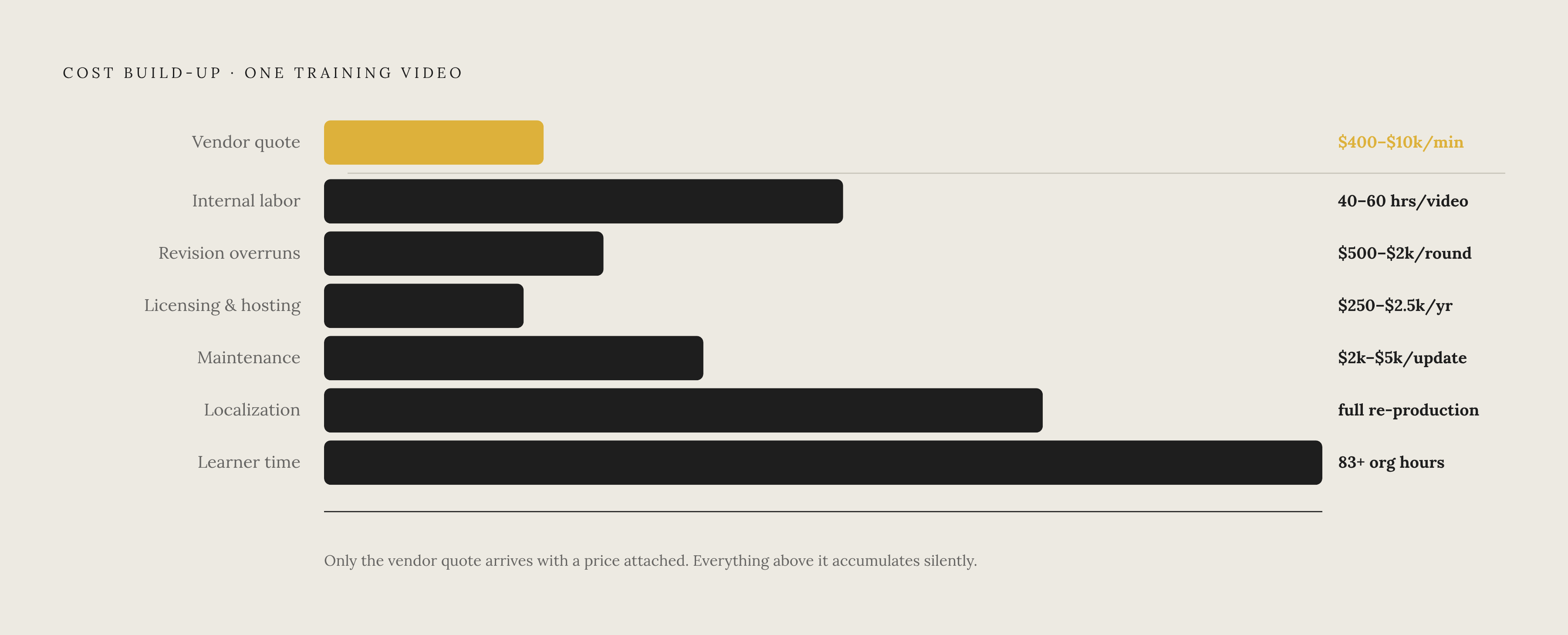
The true cost of a training video is production cost plus internal labor, plus revision overruns, plus licensing and hosting, plus maintenance across the content's useful life, plus localization, plus learner time multiplied by headcount. Written out that way, the vendor quote is one term in a much longer equation, and treating it as the whole equation is a common and costly mistake in how organizations budget for training, one that's easy to keep making, since the vendor quote is the only number that arrives with a decimal point already attached.
Start with the vendor quote, then add estimated internal hours, a realistic floor of 40 to 60 hours per video, multiplied by a blended internal rate. Estimate revision rounds honestly rather than optimistically: at $500 to $2,000 per out-of-scope round, three rounds can double a small video's budget without anyone noticing until the invoice lands. Factor in update frequency next. If the underlying software changes twice a year and each update runs $2,000 to $5,000, the annual cost of keeping that video current can exceed what it cost to produce in the first place. Localization needs scoping upfront, not retrofitting later, because building a video for other languages after the fact always costs more than building it that way from the start. Finally, count learner hours directly: a ten-minute video watched by 500 employees represents roughly 83 hours of organizational time, and if comprehension is weak enough to trigger retraining, that cost effectively doubles.
Content longevity paired with learner outcome is the variable that matters most in this framework, and it deserves more weight than production price gets in almost every budget conversation today. A $500 video watched by a thousand people who retain none of it costs the organization more than a $5,000 video nobody has to sit through twice. Budget conversations with finance get more credible, and often more favorable, once cost-per-learner-outcome becomes the metric under discussion instead of the quote at the top of an email thread. Teams that run this math before committing to a production model are the ones with the leverage to fix these costs structurally, instead of managing them project by project, forever.