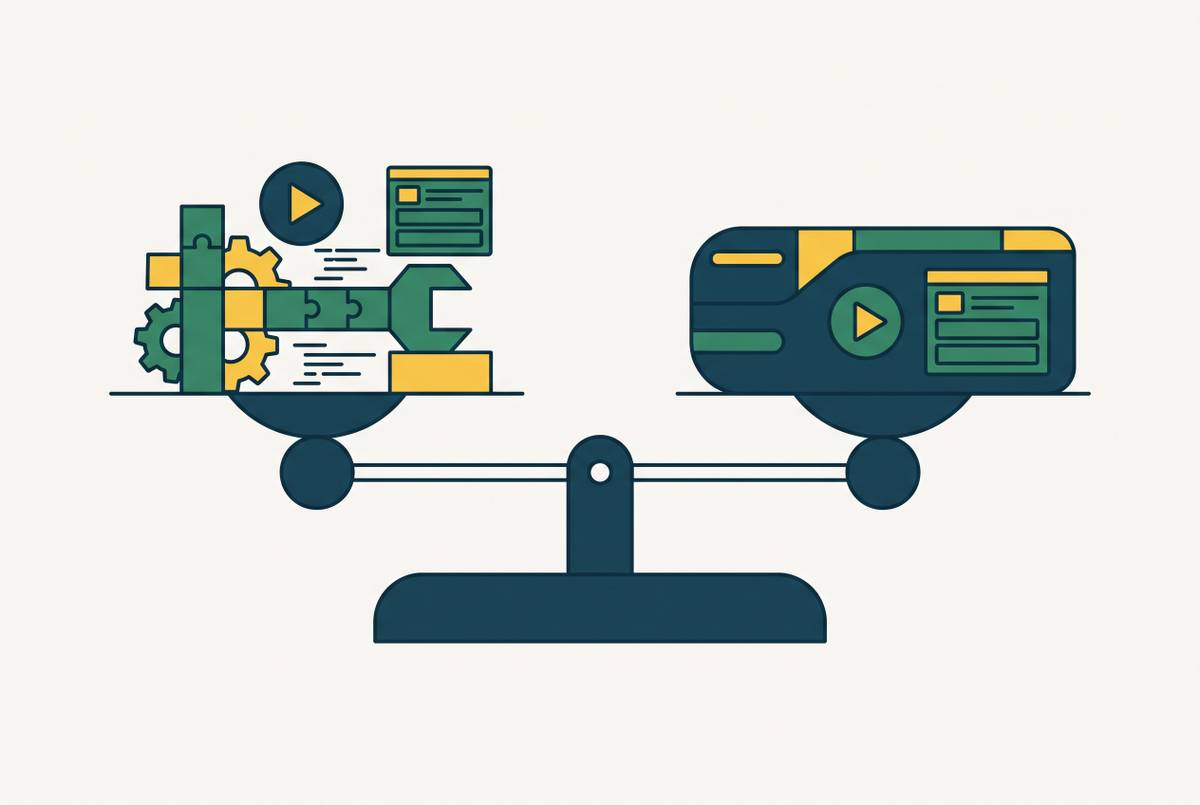
In-House Video Team vs AI Platform for Software Training
AI platforms cut training video costs by removing the bottleneck of fixed production teams.
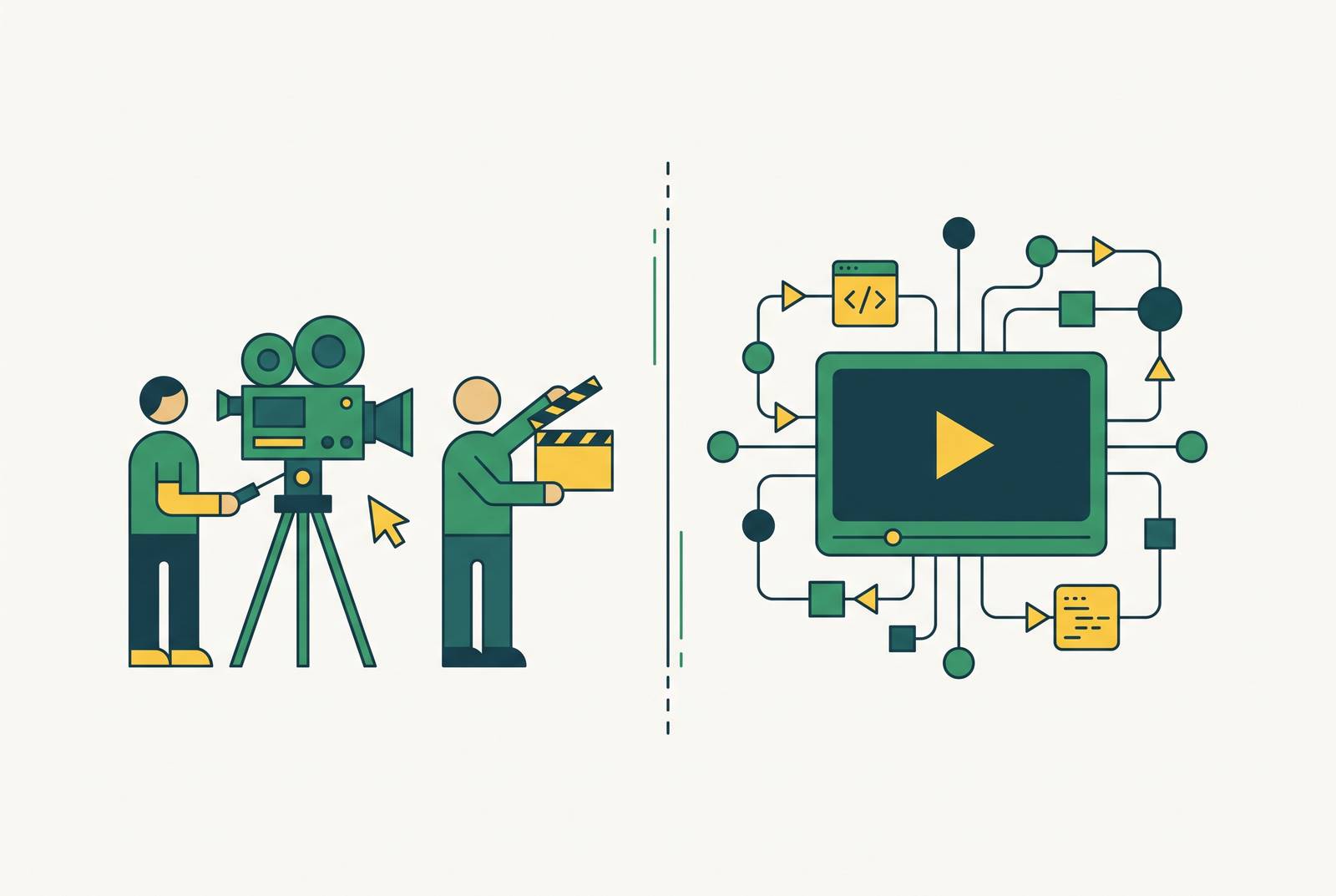
A two-person setup, one person shooting and one editing, runs about $150,000 a year once you count salary and overhead: camera body, mics, lighting, a laptop that won't choke on 4K footage.
That cost only pays for itself at a steady clip of roughly 8 to 12 finished videos a month, every month, no exceptions. Most software training teams never hit that pace, because demand doesn't arrive steady, and it arrives in bursts instead. A feature ships, a workflow changes, a support pattern shows up in the ticket queue, and suddenly three videos are due Friday. A fixed two-person team either sits idle between bursts or misses them outright, and there's no third option.
Hiring an agency doesn't fix this; it just moves the failure point. Agencies charge $3,000 to $10,000 per finished minute, and a full video with scripting, shooting, and revisions runs $10,000 to $50,000 with a 4 to 12 week turnaround. A product that ships updates every two weeks cannot wait 12 weeks for a training video about a feature that's already been iterated on twice, and that timeline alone rules agencies out for day-to-day training work.
Then come the costs nobody puts in the initial budget. Traditional video tool costs run $10,000 to $30,000 a year per creator, and because only one or two people actually know how to run the camera and the timeline, every request, from customer success, from product, from sales enablement, funnels through the same two inboxes. Scaling means hiring another editor or writing another agency check. There's no version of this where volume gets cheaper per video; it only gets more expensive, linearly, forever.
In-house teams still have their place. A yearly brand film, an executive interview, a customer testimonial shot with a real relationship behind it: an in-house team or a trusted agency earns every dollar there. The mistake is applying that model to training content, which is frequent, narrow, tied to one product screen, and needed this week rather than next quarter.
What AI platforms actually deliver, and at what cost
The cost structure looks different. Instead of paying per finished minute, most AI platforms charge a subscription: $20 to $100 a month for core plans, $1 to $5 per minute on usage tiers, $200 to $500-plus a month for enterprise access with more seats and controls. There's no invoice per video and no haggling over a round of revisions.
Speed is where this actually shows up in daily work, not just on a pricing page. A training video that takes two to three weeks with a production team gets done in a matter of hours on one of these platforms, with no scheduling a shoot, no waiting on a studio slot, and no sitting in an editor's queue behind four other requests.
The features that matter for software training aren't cosmetic add-ons. Script cleanup and voiceover generation cut out the need to hire voice talent or book studio time. Smart zoom, auto-captions, and branded templates give a raw recording the polish of an edited video without an editor touching a single frame. Screen capture that tracks clicks and keystrokes at the pixel level covers exactly what process documentation needs: the gap between "here's roughly what to do" and "here's the exact button, right there." Some platforms generate a written SOP alongside the video from the same recording, so one pass of work produces two finished formats instead of one.
The platform landscape splits by use case. Some are built around avatar-led enterprise presentations, some focus on multilingual L&D content that needs constant updates, and some specialize in lip-synced localization. A newer category exists specifically to turn a screen recording into a finished, polished training video in one pipeline, and that category maps most directly onto what SaaS training teams actually need to produce.
Judgment about which videos are worth making at all, brand strategy, high-stakes narrative shoots, the human rapport built during a live onboarding call, remains a human responsibility, and no platform is trying to take it on. Everything else is a production bottleneck AI is built to remove.
Where the cost math actually breaks for each model
In-house economics break below roughly 8 to 12 videos a month. Below that line, per-video cost climbs, because salaried staff get paid whether the queue is full or empty. Above that line, the team can't keep up without adding headcount. There's no comfortable middle; it's a model with a floor and a ceiling both working against you.
AI platform economics don't have that floor. A team making two videos a month pays the same subscription as a team making twenty, and unit cost drops as volume rises, the exact opposite of how in-house economics behave. Set against agency or freelance rates, the per-video gap stays wide even at high output; it doesn't close with scale, it widens.
One number worth sitting with: video-based onboarding that's genuinely good can cut support tickets substantially or more. A team fielding a large volume of tickets a month at $15 a ticket saves thousands of dollars a month from that alone, which often covers the platform subscription several times over before anything else is counted.
What matters more than either price tag is what the money unlocks. In-house dollars buy concentrated capacity sitting behind one queue, while platform dollars buy distributed capacity: customer success, product, and L&D can each make their own videos without waiting on a shared team. And the cost nobody puts in a spreadsheet is the cost of waiting: onboarding that stalls, documentation that goes stale, users who never get trained because the video simply didn't exist yet.
The scalability gap that becomes visible when teams try to grow
Training programs rarely fail because the content strategy was wrong. They fail because execution can't keep pace once the program has to run across time zones, device types, and a product that keeps changing shape underneath it.
In-house scaling is linear, and that's the whole problem with it. More languages, more products, more regions means proportionally more headcount or more agency invoices, with no efficiency gained from doing more of it. Cost rises exactly as fast as need does, every time.
AI platform scaling breaks that pattern in three concrete ways. New features generate new videos without new hires attached, localization becomes additive instead of multiplicative in cost, which earns its own section below, and access spreads across teams, so customer success, product, and L&D each make content in their own lane instead of routing everything through one bottleneck. Modular content, the kind these platforms are built to produce, stays more current and easier to maintain, because a video built from reusable screen-recording pieces doesn't need to be rebuilt from scratch every time the product changes shape.
Localization as the hidden cost advantage of AI platforms
Most of the world doesn't operate primarily in English, and any team producing training content only in English has built an audience ceiling into the product, no matter how good the content is.
Traditional localization is its own project with its own budget: new voiceover talent per language, a translation review pass, captions re-synced frame by frame. Every additional language multiplies the cost; it never just adds to it.
AI platforms bring a different shape to this. Translation triggers new voiceover generation and caption timing automatically, so adding a language becomes a matter of minutes, not a multi-week sub-project with its own vendor. Employees trained in their preferred language are more likely to engage with and complete courses, and that gap is the difference between a training program that gets used and one that gets ignored.
Enterprise adoption backs up where this is heading: major enterprises across industries have adopted AI dubbing and localization at scale, and translation accuracy for business and training content has improved substantially across leading platforms. Different platforms lead on different pieces of this stack; some specialize in lip-synced presenter video, some in multilingual L&D updates, some in raw voice quality. For the most common SaaS training need, one-click translation attached to a screen recording, the AI-first screen recording category handles it directly, with no separate localization vendor in the loop.
The quality question, where "good enough" is and what it means for training content
Quality in a training video isn't about cinematography, and nobody's grading the lighting. It's about clarity, accuracy, pacing, and whether someone can actually follow along and complete the task afterward. The bar is functional, not aesthetic, and confusing the two is where most of the debate about AI video quality goes wrong.
A raw, unedited screen recording fails that functional bar even when every fact in it is correct. Bad audio, no zoom on the part of the screen that matters, no captions, no script: all of it reads as low effort, and that impression quietly erodes trust in the content regardless of how accurate the underlying information is.
AI platforms close the gap to what's best called "professional functional": clean voiceover, smart zoom on the right part of the screen, captions, consistent branding. The gap to cinematic production stays open, sure, but for the content types training teams actually make, walkthroughs, SOPs, onboarding flows, feature explainers, that gap was never the one worth closing. Professional functional is the right standard for this content on its own terms, not a compromise version of some higher standard.
The premium production tier still earns its place in a few specific spots: an annual brand film, a customer testimonial shot in a real environment with a real relationship behind it, executive content where the person on camera matters as much as the message. Everywhere else, video-based onboarding at professional-functional quality drives faster time-to-value and stronger retention than text-only training, according to Wyzowl. Polished and accurate consistently beats cinematic and late, every time this gets tested.
The onboarding and retention stakes that make the production decision consequential
This isn't an abstract production-efficiency question. The stakes sit directly on revenue, and 63% of users name onboarding as a key factor in deciding whether to subscribe at all, which makes it a conversion lever pulled well before the sale closes.
The clock is short and unforgiving. 43% of all SMB SaaS customer losses happen within the first 90 days, which is exactly the window where production speed decides whether the right training content even exists when a new user needs it. Forrester's ROI framing puts a hard number on the stakes: every dollar invested in customer onboarding returns five dollars in revenue and cost savings, a 5:1 ratio that only holds if the content actually ships on time. Customers who complete full onboarding report 82% satisfaction, against 19% for those who complete only part of it, and underneath that satisfaction gap sits a simpler question: did the content exist, and was it good enough, at the moment someone needed it?
An in-house team running a 4 to 12 week production cycle cannot turn around a video fast enough to onboard the next cohort onto a feature that shipped three weeks ago. That's the exact point where production speed stops being an operations detail and becomes a retention number. A 2026 Gitnux report ties onboarding automation to a substantial jump in day-30 retention, and the mechanism behind it is plain: content that's ready and good the moment someone needs it, instead of three weeks later, after the frustration has already set in.
Worth holding onto here: customers who meet an actual human during onboarding renew at a 65% higher rate, and human presence still matters a great deal. Freeing customer success teams from video production duties gives them the time back to spend on exactly that kind of direct engagement, which is the one thing on this list AI was never going to replace.
The hybrid model most mature teams settle into
Framing this as in-house versus AI platform, pick one, misses how well-run teams actually operate once they've been through a few growth cycles. The real split looks less like a competition and more like a division of labor, and getting that division wrong is the actual mistake to avoid here.
AI platforms handle the high-frequency, time-sensitive volume: feature walkthroughs, onboarding flows, SOPs, training updates, sales enablement content, somewhere in the range of 10 to 20 pieces a month. Traditional or in-house production gets reserved for the 3 to 5 high-stakes projects a year that actually warrant it: a brand film, a product launch's hero video, an executive or customer testimonial shoot.
This split keeps human expertise where it makes the most difference: creative strategy, brand judgment, relationship-driven storytelling, while freeing people from the parts AI handles faster and cheaper without any real trade-off. Teams that try to push high-frequency training content through an in-house or agency pipeline almost always hit a queue backlog or a budget ceiling before they've covered half their actual content needs. AI raises that ceiling substantially. Keeping any in-house capacity at all only makes sense once a company is producing enough high-stakes content, real annual brand work, real launches, real executive content, that 3 to 5 projects a year becomes an actual production program rather than a favor called in from marketing once a year.
For most early- and mid-stage SaaS teams, resource-constrained, hungry for content, serving users across several countries at once, the honest starting point is an AI platform, with human production layered in only once specific content types demand it. Platforms built around turning a screen recording into a finished video, voiceover, zoom, captions, localization, and an SOP document, all from one pass, match this content type directly. That's the workflow the content was always going to need, whether or not the budget spreadsheet admitted it yet.