Opportunity Cost of Subject Matter Expert Time in Video Production
SMEs are trapped in production chains that drain them from their actual work.
What the production process demands from an SME, step by step
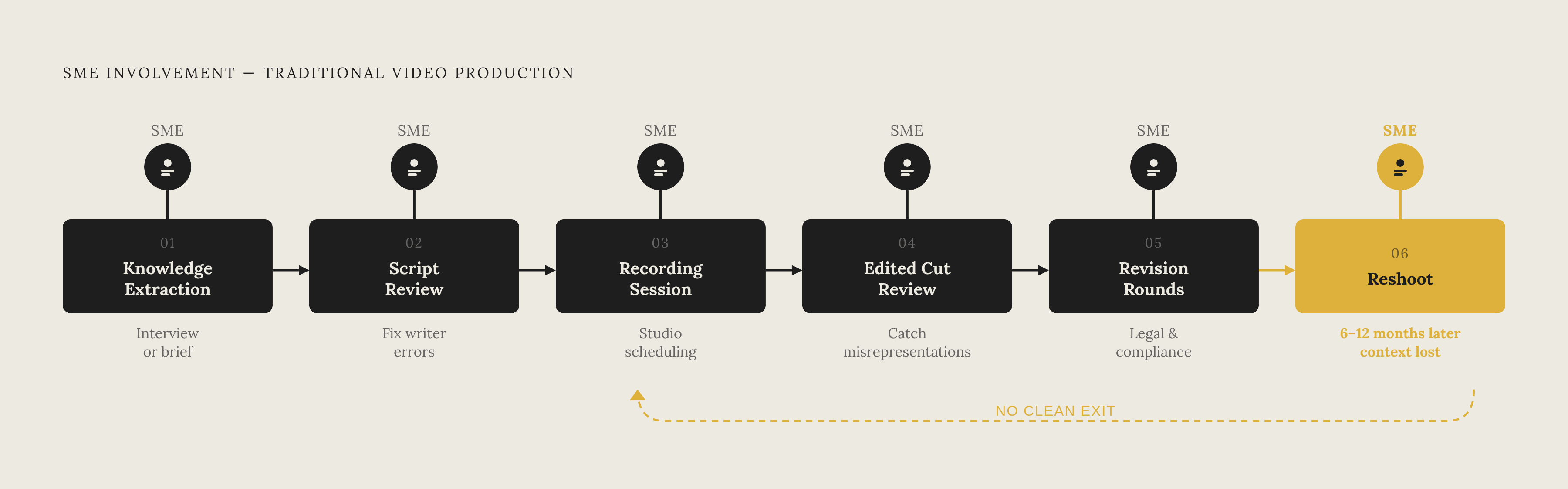
Most people talk about "SME involvement" like it's a single meeting on a calendar. It runs more like a chain, and every link pulls the expert further from the work they're actually paid to do.
Here's roughly how the chain runs. Someone extracts knowledge from the SME first, usually through an interview or a written brief, before a script exists. A writer drafts something next, and the SME has to review it and fix the technical errors, because writers without domain depth get the details wrong more often than not. Then comes the actual recording, which gets scheduled, rescheduled, and held hostage by studio time or equipment availability. Once footage exists, the SME reviews the edited cut, catching misrepresentations or outdated steps that crept in somewhere along the way. Revision rounds follow, often triggered by legal, compliance, or product stakeholders who weren't in the room for any of the earlier steps. And if the underlying product changes, the whole thing gets reshot, sometimes six to twelve months later, when the SME barely remembers the nuances they explained the first time.
Production-hour ratios for eLearning typically run 80 to 300 hours of work per finished hour of content. The SME isn't on the hook for all of that, but review cycles and revision rounds keep dragging them back in throughout the entire span, not just at the start. Internal labor for reviews and stakeholder sign-off is a frequently overlooked cost on a project, pushing true costs 20 to 50% above whatever the vendor quoted. Nobody notices this gap until the invoice for "one video" turns into three months of a director's calendar, spread thin across a dozen other things that person was actually hired to do.
How SME bottlenecks become organizational bottlenecks
A State of Instructional Design survey, run with Synthesia across more than 400 practitioners globally, ranked SME delays as the second-largest barrier to speed, cited by 30% of designers. A State of Instructional Design survey, run with Synthesia across more than 400 practitioners globally, ranked SME delays as the second-largest barrier to speed, cited by 30% of designers, a pattern that shows up the same way almost everywhere. L&D teams name this bottleneck first, unprompted, when asked what actually slows them down, and this pattern appears the same way almost everywhere. Getting the right expert, at the right moment, to hand over the knowledge a script needs, is the recurring chokepoint.
Three failure modes tend to compound each other. SMEs are too busy to film, so production slips and content ships late or sometimes never ships. Every video gets treated as a bespoke, one-off production, so there's no reusable asset library and no institutional efficiency building up over time. And a single SME often ends up the dependency point for several projects running in parallel, which turns one person's calendar into a bottleneck and a vulnerability for the whole department.
Reshoots make all of this worse. When a software feature changes or a policy gets updated, an entire long-form video often has to be scrapped and rebuilt from scratch. The SME gets pulled back in six to twelve months after the original shoot, right when the original context is hardest to reconstruct.
The effect on content quality and reach when SME time is rationed by bottleneck rather than by design
Scarce SME access doesn't just slow things down. It changes how content teams make decisions, and usually for the worse. They work off assumptions instead of confirmed facts. They skip review rounds they know they shouldn't skip. They ship drafts that are technically incomplete, because the alternative is missing the deadline. Every one of those shortcuts introduces an error or an ambiguity the SME would have caught, given the time.
Long-form video becomes the default when nobody's built a system for modularity, and long-form is exactly the format most likely to lose the learner. Sixty percent of employees pause a training video partway through, and 35% never come back to finish it. Video length research backs the pattern: shorter formats consistently outperform longer ones for retention and completion. Completion rates drop by half once a video crosses the six-minute mark. That alone should kill the habit of defaulting to a 20-minute explainer because it felt thorough to make.
Localization is the quieter cost this produces. When every video is a costly, one-off production tied to a single SME's calendar, translating and re-recording it for each language market gets expensive fast, and most teams just don't do it. Global markets end up an afterthought because the production model was designed without any provision for them.
What a well-designed SME workflow looks like (and the efficiency it recovers)
None of this is an argument for cutting SMEs out of the process. It's an argument for making their involvement narrow, scheduled, and strategic, instead of reactive and sprawling across every stage of production. SMEs should contribute knowledge, not production labor. Their job is accuracy, full stop, and any workflow that also asks them to be scriptwriters, editors, or schedulers is misusing the most expensive person in the room.
A few structural fixes recover SME time without touching accuracy. Separate knowledge extraction from content production entirely: structured interviews or annotated recordings give a content team something to build from later, without the SME sitting in on every downstream meeting. Build a network of SMEs instead of routing every project through the same one or two people, so no single calendar becomes the bottleneck for an entire department. Give SMEs direct ownership over updates rather than funneling every change through L&D, since they're the first to know when something's shifted and the handoff moves faster that way. Co-creation sprints, where instructional designers pair with SMEs in short workshops instead of a long email chain of drafts, have cut course development time by up to 30%, according to documented cases tracked by industry observers.
Border States is the clearest example of what this looks like when it works. Redesigning its content creation system produced a fivefold improvement in SME efficiency, cutting content creation time from 48 hours down to 9, and quality went up, not down. The gain didn't come from finding a faster SME. It came from restructuring the workflow around the SME's time instead of around production convenience.
Where AI reduces SME involvement without reducing content accuracy
Some parts of video production can come off an SME's plate entirely now. Script cleanup is one: an SME talks through a process naturally, on a rough recording or a screen capture, and AI turns that into a clean, structured script without a writer sitting in on the call. Voiceover generation removes the need for the SME to ever step into a recording booth. Captions, smart zoom, and annotation, tasks that used to mean an editor scrubbing through footage frame by frame, happen automatically now. Localization turns into a one-click translation step, so a single knowledge-capture session produces content for every language market without the SME giving up a second more of their time. The same source recording can also generate a written standard operating procedure or how-to article alongside the video, so one explanation from the SME produces two finished assets instead of one.
Judgment is the one thing AI doesn't touch: what's actually accurate, what edge case matters, what the learner genuinely needs to know versus what's just nice to include. Those stay human decisions. Good AI-assisted workflows make those decisions easier to reach fast, they don't remove the need to make them.
According to an Association for Talent Development study, organizations using AI-powered video training tools have cut content production time by 90%, with 31% higher knowledge retention compared to traditional text-based training. That retention number matters past the first viewing: higher retention means fewer re-training cycles later, and fewer re-training cycles mean fewer times an SME gets pulled back in to correct a misunderstanding a text manual left behind. Generative AI works less like a replacement for the SME and more like an instructional designer riding along in their pocket, cutting the friction of turning raw expertise into finished content without asking the SME to learn a production skill set they never wanted.
Tools available for AI-assisted video production in 2026
Choosing a tool comes down to a short list of real questions. How much SME time does it actually require across scripting, recording, and review? Does it produce both video and documentation from a single source recording, or does it force a second pass for each? How does it handle updates when a product detail changes next quarter, and does it support localization without spinning up a separate project each time? Can someone outside the production team run it without a training session of their own?
Colossyan is worth a close look for organizations built around training use cases specifically. It supports avatars, voiceovers, and structured scripts, and because videos update quickly, it fits environments where product details or policies change often. It also supports multilingual video creation, which handles the localization gap directly instead of treating it as an afterthought bolted on later.
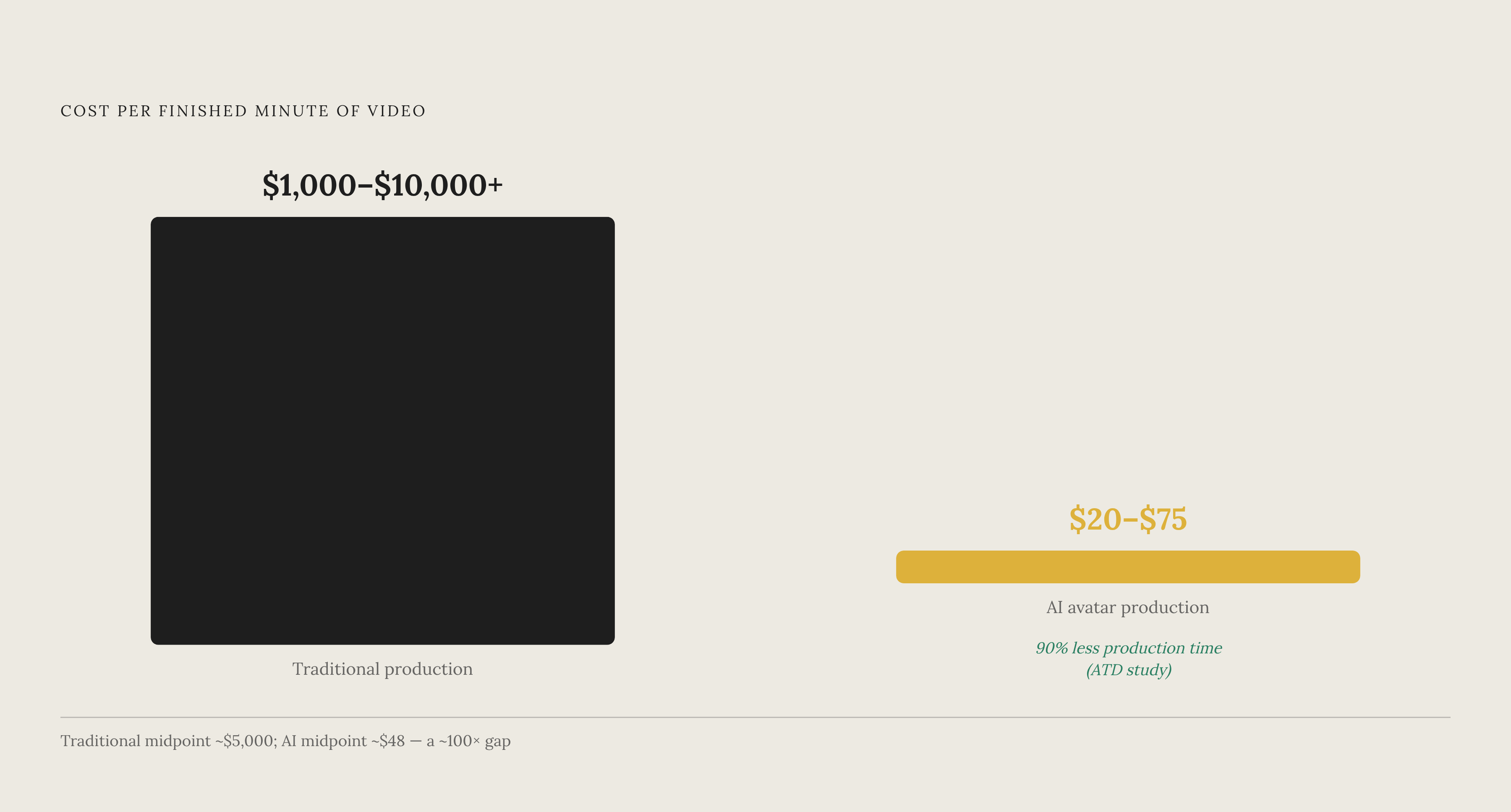
Cost has come down enough to change the math on this decision. AI avatar video production now runs somewhere in the $25 to $75 range, sometimes as low as $20 to $30, against the $1,000 to $10,000-plus per finished minute that traditional production has historically demanded. That price point suits internal training at scale well. For customer-facing brand content, the visual quality still reads as better suited to internal audiences than to a polished external-facing asset, and anyone betting a launch campaign on it should reckon with that gap before committing budget to it.
How to calculate the ROI of recovering SME time through AI-assisted production
The numbers already on the table are SME hourly cost at $150 to $300, the number of video projects running per quarter, and the average hours each one consumes across recording, review, and revision. Multiplying that out, the cost of SME time in production stops being an abstraction. It becomes a line item that's been hiding in plain sight the whole time.
Now look at the savings side. Documented cases show AI-assisted production cutting content production time by 90%, and even a conservative slice of that applied just to SME-specific tasks (review, correction, re-recording) adds up fast at $150 to $300 an hour. Update costs shrink too: modular, AI-editable videos mean a product change requires editing one short asset instead of re-engaging the SME for a full reshoot. Localization costs drop out of the equation almost entirely, since AI-assisted localization removes much of the per-language SME and production cost that used to make global reach a budget decision instead of a default.
One marketing platform vendor has documented that SaaS customer education videos deliver a 40% reduction in support tickets. Fewer escalations land back on the SME's desk months after the video shipped and the project was supposedly closed out, a downstream effect worth counting.
None of this argues for spending less on expertise. It argues for spending SME time on the one thing nobody else can do, and letting everything else move without them.