Calculating the Cost of SOP Documentation Alongside Training Video
Duplicating documentation and video kills training budgets faster than most teams realize.
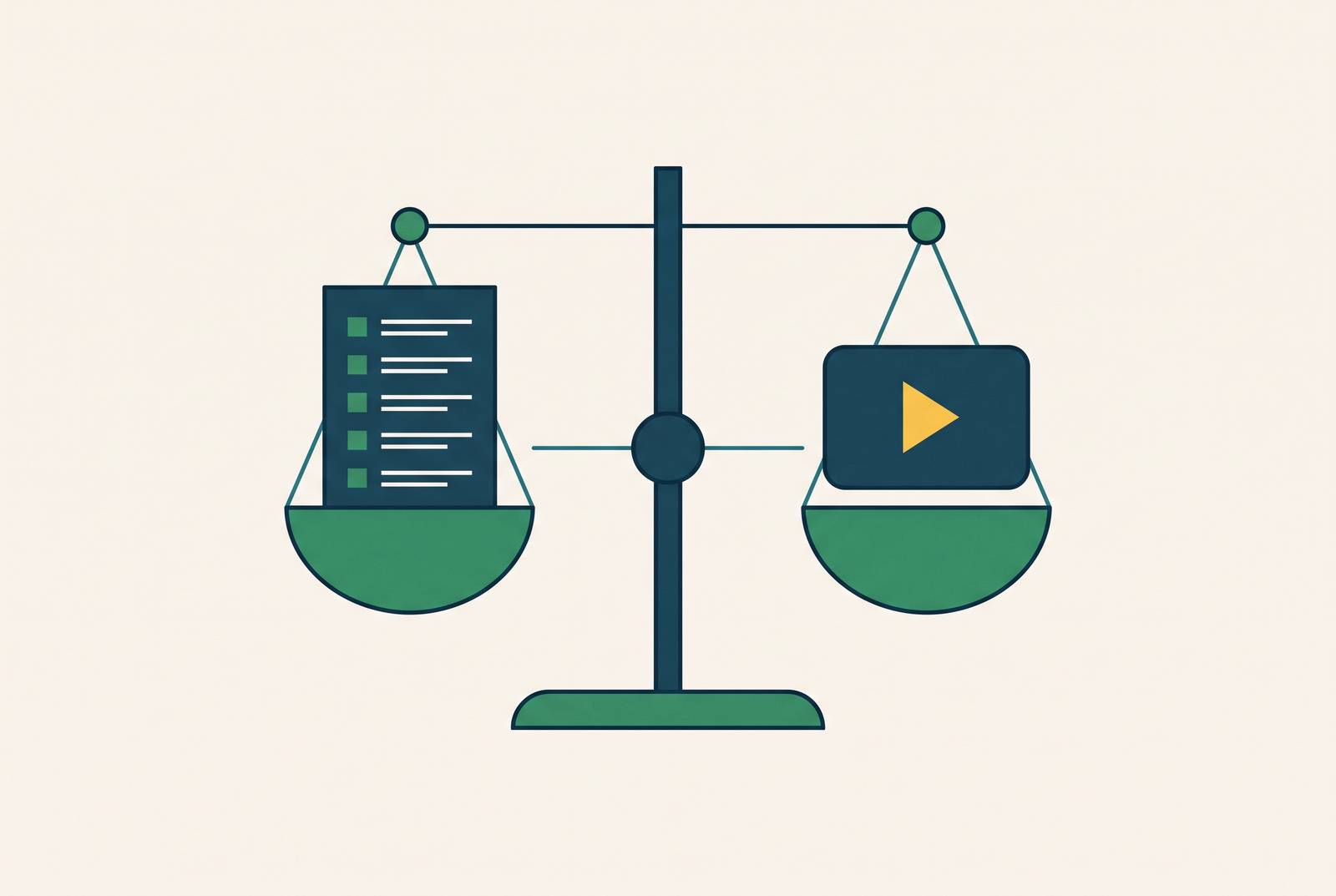
Training budgets are getting harder to justify, and the split between two separate documentation formats is a big reason why. When teams calculate SOP documentation and training video as two separate budget lines, they routinely pay twice for the same subject-matter expert's time, the same script logic, and the same revision cycle, without anyone in either department noticing.
What organizations are spending on training content at scale
The numbers are big enough that a small percentage of waste turns into real money fast. U.S. corporate training spend hit $102.8 billion in 2025, a 4.9% rebound according to Training Magazine, so even a rounding error in how that gets allocated adds up across an entire industry.
What's odd is that per-employee spend is falling while hours climb. Industry data suggests per-employee spend has been falling in recent years even as training hours have climbed, a pattern driven by cheaper content libraries and AI-assisted builds. Cheaper content libraries and AI-assisted builds are pushing out the expensive, fully custom projects that used to dominate training budgets.
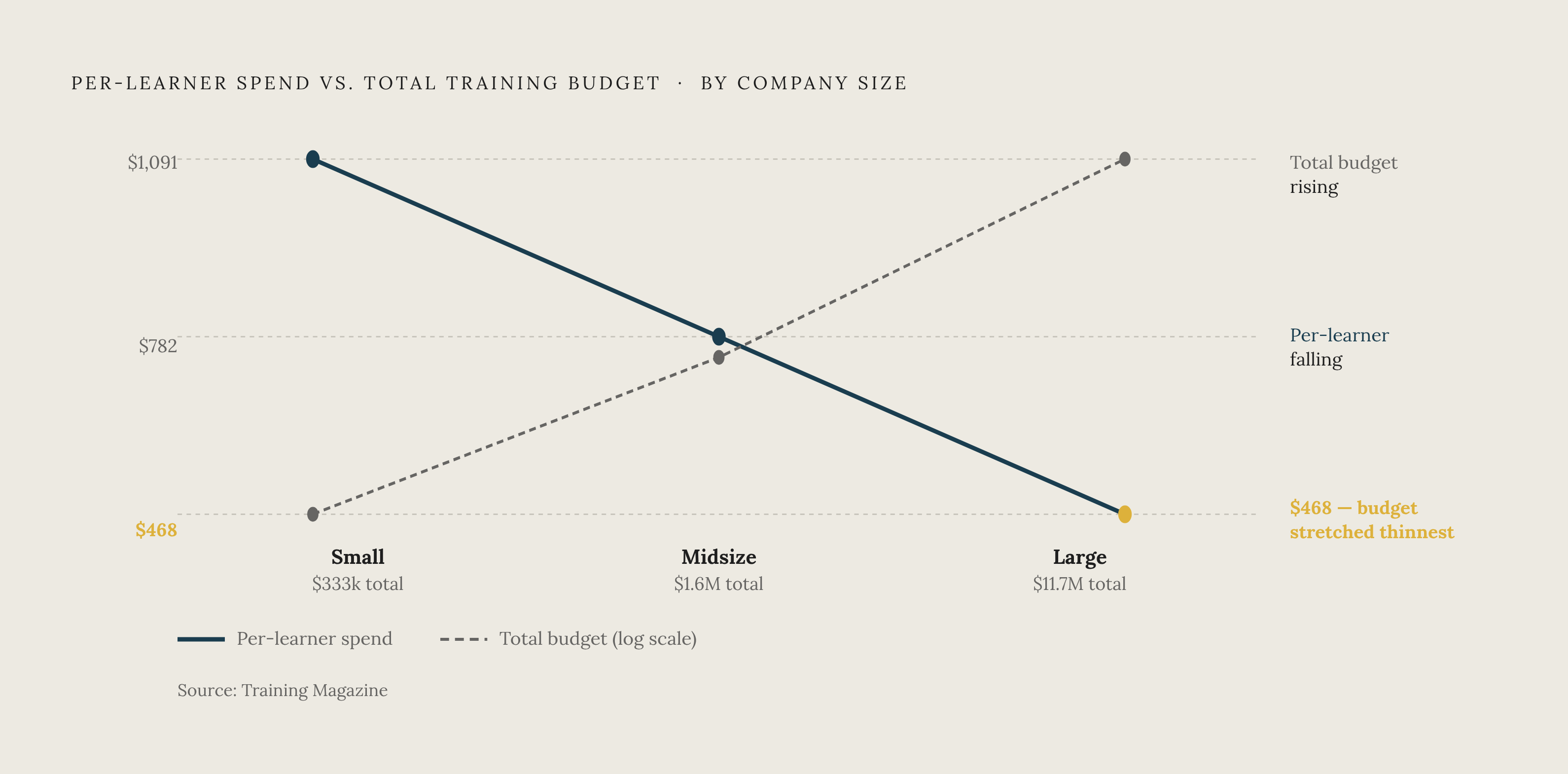
Company size changes the math a lot. Training Magazine's data shows small companies spending $1,091 per learner on an average total budget of $333,305. Midsize companies spend less per learner, $782, on a much bigger pool: $1.6 million. Large companies spend just $468 per learner but pour $11.7 million into the total budget.
That falling per-learner number at bigger companies can look like efficiency on a slide deck. It's really a sign of how thin the budget gets stretched once you're funding hundreds or thousands of SOPs and videos at once, custom content included. Only 8% of organizations currently measure whether their learning programs actually move the business, a figure that should worry any finance team reviewing an L&D budget. Most teams have no idea if their SOP or video spend is paying off. That lack of visibility is exactly why the duplication below goes unnoticed for so long.
The real cost of SOP documentation, from consultant fees to internal time
SOP documentation gets built five different ways, and each one hides its costs differently. Per SOPX figures, a consultant or boutique agency runs a project-based SOP engagement anywhere from $5,000 to $50,000, with hourly consultant rates landing between $150 and $400, or $1,500 to $5,000 for a full day.
Regulated industries push those numbers higher still. Medical device, pharma, and food safety work is at the top of the range, and Technical Writer HQ cites $175 an hour as typical for a medical-device SOP consultant. A fractional COO folds SOP work into a broader retainer, usually $5,000 to $15,000 a month, but the SOPs still get written by interviewing the same internal team, so the real bottleneck isn't the COO's calendar. It's yours, because the SOPs still get written by interviewing the same internal team, not by the fractional COO.
Virtual assistants are the cheapest paid option on paper. A VA can only write down what someone tells them. A senior operator still has to walk them through every process step by step, one conversation at a time. SOP software platforms sidestep some of that: the market for these tools was valued at $371.07 million in 2025 and is projected to hit $541.05 million by 2032, a 5.53% compound annual growth rate, per 360iResearch. Published pricing on these platforms runs roughly $249 to $799 a month.
None of those fee schedules mention the cost that actually eats the calendar. Estimates put internal time at 10 to 15 hours just to produce the first batch of SOPs, a cost that falls on whoever owns the process knowledge regardless of who does the writing. And that cost doesn't stop once the SOP is filed. Every policy change, every UI update, every workflow tweak triggers a new round of extraction and review, so the "one-time" writing cost quietly turns into a maintenance line that nobody budgeted for.
The real cost of training video production, broken down by stage and format
Training video pricing swings wildly depending on what you're actually making. A basic internal training video runs $1,000 to $5,000, according to dmakproductions.com figures, while a full multi-module enterprise program climbs to $25,000 or more, sometimes well past $150,000.
Per-finished-minute pricing makes those ranges easier to compare across different video lengths. 2026 data puts corporate and training video at $1,500 to $10,000 per finished minute, with animated explainers at the higher end, often used for SaaS products that need to visualize something abstract.
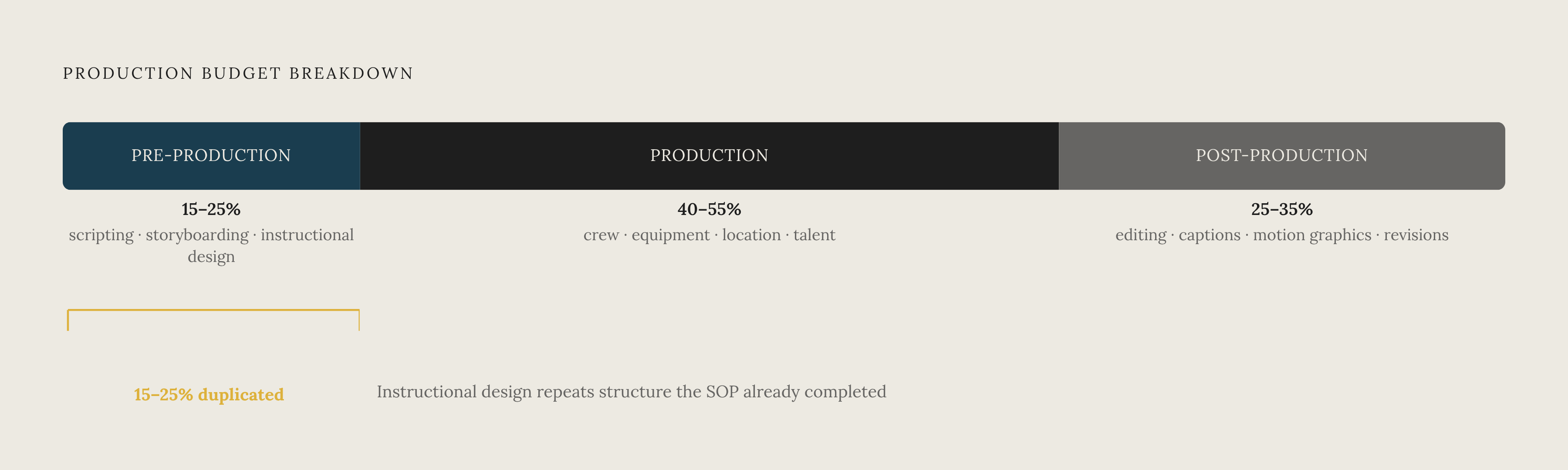
Budget splits across three production stages, and skipping the first one is where costs quietly spiral. Pre-production, which covers scripting, storyboarding, and instructional design, takes up 15% to 25% of total budget according to Colossyan. Skipping it means reshoots eat far more than the 15% to 25% would have cost upfront. Production, the crew, equipment, location, and talent, eats 40% to 55% of the budget; a full crew alone runs $3,000 to $8,000 a day before anything else gets paid for. Post-production, which covers editing, captions, motion graphics, and revisions, claims the remaining 25% to 35%, and every revision round past the first one or two adds real cost.
Instructional design, on its own, typically makes up 15% to 25% of the video budget, per dmakproductions.com numbers, and that overlap matters most for this piece. That's the exact same structural work an SOP already does, mapping out steps, decision points, and sequence.
The economics also don't scale the way teams hope. One course creator who needed more than 30 explainer videos found hiring a production team financially out of reach entirely, because the per-video math works for a single flagship asset, not for a whole library. Localization costs are rarely included in the first quote. Every added language means re-translating on-screen text, re-recording or replacing voiceover, and reworking captions, and it typically lands as a separate ask months after the original budget got signed off.
What the combined cost looks like when SOP and video are scoped together
Lining up the SOP and video budgets side by side makes the duplication obvious. The subject-matter expert gets pulled in twice: once for the SOP interview and review, once again for the video script review, describing the exact same process both times. Scriptwriting gets billed twice as well, once as SOP drafting and again as video scripting, even when the underlying steps are identical.
Instructional design compounds the problem further. That 15% to 25% chunk of the video budget mostly repeats work the SOP already did to structure the process. Nobody flags it as redundant because two different teams, often in two different departments, are managing the two projects. And revision cycles stack on top of each other rather than sharing the load: a single process change triggers an SOP update and a video reshoot, billed separately, reviewed separately, approved separately.
Put a real number on it. A midsize SaaS company scoping SOPs and training video for a new onboarding workflow might land a consultant engagement at $5,000 to $25,000, plus a single training video module in the low thousands of dollars. That's before localization, before revisions, before the next product release forces an update. Stacking those together, the combined cost for one workflow can outstrip what a midsize company's per-learner budget, $782 according to Training Magazine's figures, allocates across an entire training program.
Maintenance makes the gap worse over time, not better. Animated content can cut long-term update costs by 30% to 50% compared to live-action, per dmakproductions.com data, because a change usually means a design tweak instead of a reshoot. That saving only occurs if the content was built with future updates in mind, and teams running separate SOP and video workflows almost never plan that far ahead.
Localization is the surcharge that never gets named until it's due. Treating each new language as its own side project instead of a built-in step multiplies the true multi-language cost well past the original production spend, landing on someone's desk long after the initial budget conversation closed.
The real number isn't SOP cost plus video cost. It's that sum, plus the duplication tax, plus the maintenance tail, plus a localization bill nobody quoted at the start.
Where AI-assisted workflows collapse the cost structure
There's a documented case that shows what happens when a company actually fixes this. Sonesta Hotels cut video production costs by 80%, a structural fix rather than a marginal saving, after moving off traditional production and onto an AI platform for training content, according to Colossyan. That's not a marginal saving. That's a structural fix.
AI tools take over the execution layer, voiceover generation, captions, editing, branded templates, so the subject-matter expert only has to explain the process once, instead of once per deliverable format. A handful of platforms now operate in this space. Colossyan builds AI avatars into structured, multilingual scripts. Camtasia has become something close to the standard tool for screen-recorded software training. Vyond handles animated character training but is noted for being animation-skill-intensive. And a newer category of platform, purpose-built for turning a raw screen recording into a finished video with AI voiceover, smart zoom, and captions, while generating a step-by-step written article from the same capture, cuts out the separate SOP-writing and video-scripting cycles entirely. A team that genuinely needs both outputs from the same knowledge should investigate that category first.
AI-first production fits explainers, training, SOPs, internal updates, and anything recurring. A hybrid approach, shooting real footage once and then editing, summarizing, localizing, and repurposing it inside an AI workflow, makes more sense for content suited to that shoot-once model, per Visla's guidance. A Brandon Hall Group study found organizations using AI-powered video for training saw a 75% jump in knowledge retention compared to text-only delivery, while cutting content production time by as much as 90%.
None of this removes the need for a human to decide what the video should actually say. AI handles production, not concept, and that division holds regardless of how good the tooling gets. The IAB's 2025 Digital Video Ad Spend Report found 86% of ad buyers are already using or planning to use generative AI for video creative, which tells you where the industry consensus is landing: AI as the production layer, humans still setting the strategy.
Localization gets solved the same way it got created, at the platform level. One-click translation across languages is now a built-in feature on several of these tools rather than a separate project with its own quote and its own timeline. That's the surcharge from the earlier section, closed off rather than pushed down the road.
How to calculate your team's true combined cost before choosing a workflow
Start with an inventory. List every process that needs both an SOP and a training video: those are the exact items where the duplication tax runs highest, and where a unified workflow saves the most.
For each item on that list, map the labor separately from the fees:
- SME interview or walkthrough time, usually the largest cost nobody tracks
- Script or SOP drafting time
- Review and approval cycles, counted by round, not just hours per round
- Production time, whether that's filming or platform generation
- Localization, calculated as the number of target languages times the rework each one demands
Then apply a maintenance multiplier. A process that changes quarterly carries four times the revision cost of one that updates once a year, and that multiplier almost never makes it into the original budget conversation.
Compare that true cost against the three workflow models actually available. Consultant plus traditional video production carries the highest upfront cost and the highest revision cost, with localization tacked on as an extra line every time. SOP software paired with a separate video tool lowers some fees but keeps duplicating SME time, since the two systems still don't talk to each other. A unified AI workflow, screen capture turned into a polished video and a written document at the same time, removes the duplication tax right at the SME and scripting stage, and treats localization as a built-in step rather than a follow-up project.
Video length discipline saves money on its own. Completion rates drop by half for videos over six minutes. Per x-pilot.ai guidance, quick tips and feature highlights should run 30 to 90 seconds, tutorial walkthroughs 2 to 5 minutes, and onboarding modules 5 to 10 minutes. Shorter modules aren't just easier to watch. They're cheaper to update every time something changes.
Measurement closes the loop. With only 8% of organizations currently tracking whether their learning programs move the business, according to LinkedIn's Workplace Learning Report, the teams that build measurement into the workflow from day one are the ones that can actually justify a unified platform to finance. Track support ticket deflection, time-to-value for new users, and how often revision cycles actually get triggered. Those three numbers tell you whether the workflow is working, not just whether it shipped.
The goal was never to find the cheapest price per video. It's finding the workflow where one investment in a subject-matter expert's knowledge produces both the SOP and the video, without getting taxed twice for saying the same thing two different ways.
Sources
- Video Production Cost: What You'll Actually Pay in 2026
- How Much Does Video Production Cost in 2026? – The Visla Blog
- Hiring Someone to Build Your SOPs: What It Costs in 2026 | SOPX
- Training Video Production Cost Guide for 2026: Pricing & ROI
- Video Production Costs: 2026 Pricing Guide | Colossyan
- 13 Best SOP Software Tools for 2026 - Whale
- SOP Software Compared: 10 Tools to Replace Paper SOPs (2026)