The Maintenance Tax Every Biweekly Release Adds to Your Training Video Library
Keeping training videos current with biweekly releases costs more than teams initially budget.
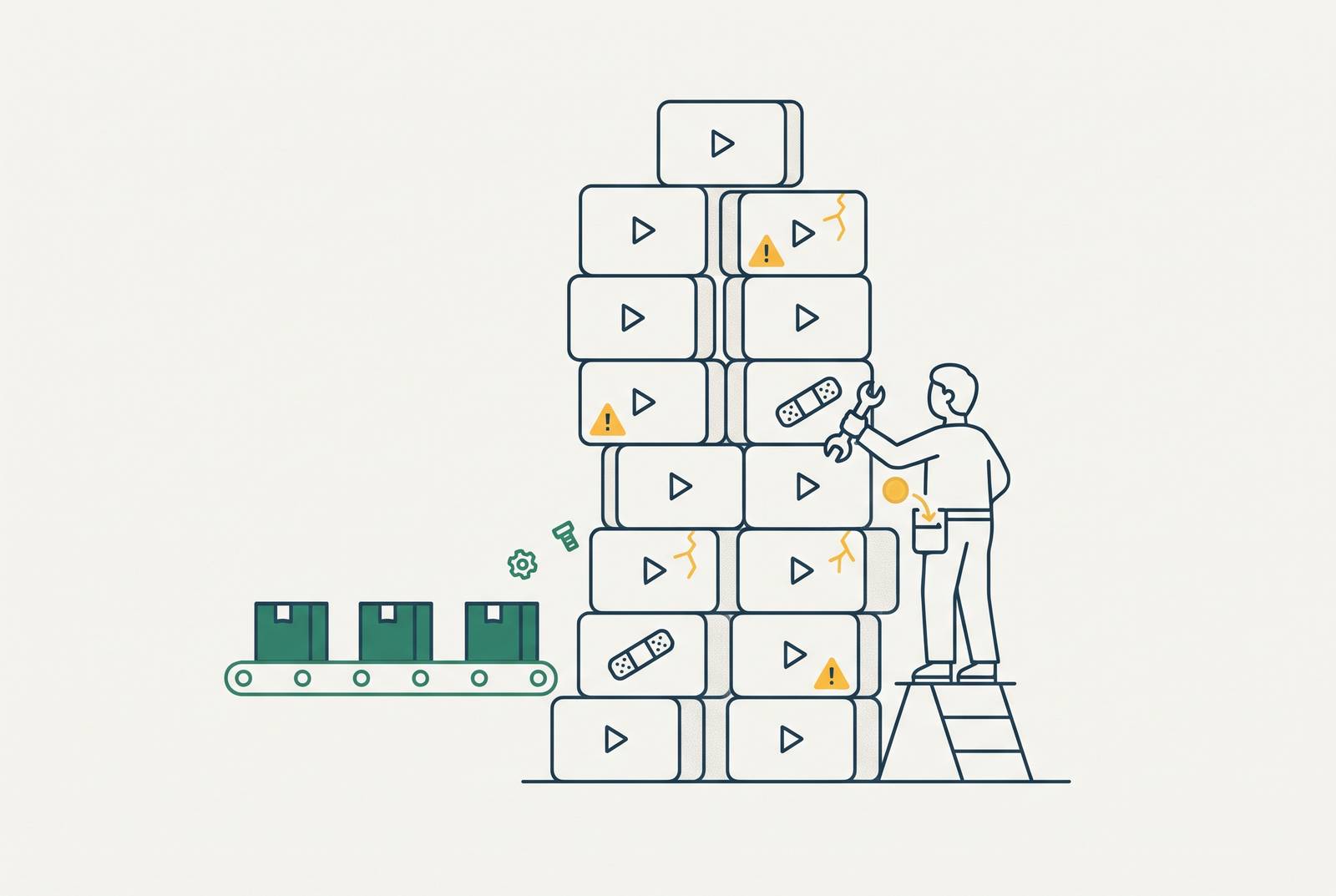
To keep software training videos up to date through biweekly releases without reshooting, teams need clips they can replace, source files they have kept, and content review that follows the release cycle. AI-assisted editing and dubbing can then reduce the cost of each change. The maintenance tax grows with the library, so treating updates as isolated fixes eventually leaves teams spending their time for creating new training on maintaining old content.
Why biweekly release cadences turn training libraries into depreciating assets
With two-week sprints, software teams can change the interface, navigation, terminology, or workflow shown in training videos every two weeks. Other development cadences exist, but the underlying conflict stays the same. The product keeps changing while the recording stays the same. A walkthrough can be accurate when published and out of date a few weeks later, even if nothing was wrong with its original production.
The video still loads, plays, and looks finished. Yet a trial user following its instructions may find a different navigation bar or a menu item that has moved. The recording now competes with the live product instead of explaining it, and the mismatch undermines trust at the moment onboarding is supposed to build it.
This makes obsolescence a built-in consequence of the release cadence. Even a polished recording loses value when the steps it teaches no longer match the software. How long it stays useful depends in part on how easily the team can update it when the product next changes.
How the burden compounds as a library grows
A small library may contain a feature in only one or two videos. As the library expands, that feature can appear in introductory lessons, advanced walkthroughs, segment-specific variations, and tutorial sequences. The next change reaches all of them at once.
That is the blast radius of a release. Library growth does not simply add separate assets to maintain, because those assets overlap in what they show. A navigation redesign can invalidate dozens of pieces simultaneously, including videos whose main subject has not changed. Their route to that subject has changed, which is enough to require an edit.
Alumio’s official FAQ states, “The Alumio platform delivers new releases every 2 weeks with new features and fixes.” That schedule shows how often changes can come, though it says nothing about how Alumio keeps its own training up to date. For a library covering an integration platform on that cadence, every release creates another review point. If a changed feature shows up in several content tiers, the team has to review more than the tutorial for that feature.
The compounding effect comes from those shared dependencies meeting repeated releases. A team is maintaining more appearances of the same changing product across more files, while the next round of changes is already approaching.
What the tax actually costs when measured against traditional production
The initial shoot can be the cheapest part of a training video’s lifetime. Updates, localization, and versions for different teams add costs that rarely appear in the original production budget. Those costs arrive later, under separate requests.
A text or graphic swap is a relatively small edit when the source files are available. Replacing a section takes more work, and re-recording narration means producing the audio and getting its timing right. A version in another language adds translated overlays and another voice track, so making the same change across markets can cost many times as much as the source-language update.
Without source files, those comparisons may break down because a small requested change may require a partial or full rebuild at close to the original production cost. The distinction between “update” and “new video” then becomes largely a budgeting label. Localization can repeat that expense for each language and each affected video.
The decision is therefore not simply whether an update quote looks high. It is whether the existing production structure makes repair cheaper than replacement. When a quote approaches the cost of a new video, rebuilding can produce a better result and restore the editable source files needed for the next release. The economics depend on what the first production leaves available to change.
Why teams discover the problem late — and what reactive maintenance actually looks like
Reactive maintenance is a natural outcome of treating each video as a finished asset. Someone requests it, someone produces it, and publication closes the task. Nothing in that sequence assigns a future review trigger. The library can look complete while its accuracy deteriorates between releases.
The first trigger is often a support ticket. A learner reports that the tutorial does not match the app, the team fixes that video as an exception, and the next release begins without a system for finding similar mismatches. Other out-of-date recordings stay online until someone comes across them.
This is why the workload can seem to arrive suddenly. At a hundred or more videos, a platform redesign can leave dozens needing attention at once. If each repair requires a full re-recording, the response can consume weeks after a major release. What looked like a manageable collection of occasional tasks has become a maintenance backlog.
An inaccurate tutorial continues to look like a working resource. Teams find out how much work there is late because they count finished videos while product changes keep making the instructions in those videos out of date.
The design decisions at production time that determine future update cost
The next video is an opportunity to change that model. Build it as self-contained sections, with one topic or step in each, so a changed workflow step can be replaced without disturbing unrelated content. This is an investment in the next edit. The start and end of a section give the editor clear points where the repair can begin and end.
Put frequently changing information in text overlays. Dates, version numbers, policy references, and statistics are easier to revise on screen than in a recorded voice track. If they are spoken aloud, a simple correction can mean a studio session, an audio edit, and work to get the timing right. The choice is made during production, but its cost returns with every revision.
For traditionally recorded series, plan voice continuity as well. Use the same narrator and arrange future sessions at the same rate, so later sections can match the existing voice and tone. A living style guide serves the same purpose for visuals. Documenting colors, fonts, icons, and motion style lets another qualified editor maintain the series when the original creator is unavailable.
Retain the source files from day one. They preserve access to the parts that make a targeted edit of the finished recording possible. Together, these choices make maintenance less dependent on reconstructing past work. None requires regretting the existing library, but each can make the next addition cheaper to keep current.
How do teams update walkthrough videos without re-recording the whole thing?
Independent, replaceable clips provide the structural answer. Each clip covers one step or action, so a product change has a bounded editing target. If a step changes, the team replaces the clip showing it. The rest of the walkthrough stays intact.
That differs sharply from a continuous single-take recording. In that format, a change anywhere in the workflow can force a full or near-full re-record, even when most of the instructions remain accurate. Clip-level structure can turn a weeks-long maintenance cycle into an afternoon’s work because it reduces the scope of the repair.
Distribution must support the same approach. In a workflow where each published instance reflects the updated video, replacing an outdated clip also updates the version available through the academy, knowledge hub, in-app tutorials, and shared links. The team does not have to republish separate versions manually.
These are two separate criteria for an update-ready system. It needs a small unit of repair and a way for the revised video to reach its existing audiences.
Synchronizing content review with the product release cycle
To put that architecture to work, make content review a standing part of the sprint. A day or two before release, the product team shares a changelog or feature diff with the enablement team. The enablement team maps those changes to affected training content and assigns the updates. Review begins with the product change.
The mapping must follow the blast radius. A changed menu item may appear in an introductory lesson, an advanced task, and a segment-specific walkthrough, so reviewing only the feature’s main tutorial misses part of the work. Clip-level structure then narrows each affected video to the step that needs attention. By release time, the update list is already prepared and work is in progress.
This gives maintenance a predictable weekly rhythm within the release cycle. Instead of waiting for a large batch of discrepancies, the team repeatedly reviews a defined set of product changes and sizes the corresponding content work. The pre-release window bounds the task in time. Replaceable clips bound it within the recording.
The operational goal is to finish the corresponding updates before the release goes live. An early review can show what work is needed before users run into the mismatch, though it cannot ensure that the updates will be done in time. Without those regular reviews, even a library that is easy to edit can fall out of step with the product.
How AI-assisted production changes the unit economics of updates
Platforms built for this workflow can take a recorded or uploaded screen capture and handle script cleanup, voiceovers, zoom, captions, and accompanying documentation. Customer education, L&D, and product teams can then update professional training content without dedicated video production staff. The format becomes less dependent on specialist availability.
This changes the economics of a small correction. When the team can replace a clip and regenerate its narration without repeating a traditional production cycle, keeping the lesson accurate becomes a smaller recurring task. The release review still has to find which lessons a release has made inaccurate.
AI dubbing applies the same cost reduction to localization. AI dubbing reduces the per-language burden that otherwise multiplies across a large library by handling source-language changes across markets. It makes the structural approach more practical when one lesson has several language versions.
The limit is the training need itself. AI-assisted video works well for policy updates, process documentation, and standardized training, while demonstrations requiring a person on camera and personality-driven content still benefit from traditional recording. The aim is cheaper, faster maintenance where the format supports it.
What a sustainable maintenance model looks like for a library of fifty or more videos
For a library of fifty or more videos, the sustainable model treats each recording as part of a maintained system. Its clips are replaceable, its variable information is easy to edit, and its source files remain available. A living style guide and a plan for voice continuity help later edits match what is already there. These are properties of the library.
The operating rhythm connects that library to product development. Before each release, the enablement team gets the changes, finds the lessons they affect, and assigns repairs with a clear scope. AI-assisted production and dubbing cut the work it takes to make those repairs. Together, the structure and process bring release-paced maintenance within a small team’s capacity.
Measurement supports that rhythm without replacing it. Training video management platforms can provide analytics and LMS integration, including completion rates, drop-off points, and learner engagement data. Those signals can show which videos need a review before a support ticket comes in. They work alongside the changelog-driven review, which points straight to known product changes.
The target is to bring the library’s corresponding updates forward by days or weeks so they are complete when the product release goes live. Reaching it takes all four parts, including clip-level architecture, update-ready production, release-synchronized review, and lower-cost editing. A team that only accelerates re-recording still inherits the same expanding workload.