AI Localization of Training Video vs Traditional Dubbing
AI dubbing speeds up training rollouts but requires checking all three localization layers.
Training video localization has become an operational decision, not a translation problem. Distributed teams now expect product training in their own language within the same quarter it ships in English. The real question is not whether to localize, but which method fits the content, the volume, and the risk profile in front of you. Get the method wrong and you either overspend on routine modules or break the learning experience where it matters most.
Why training video localization has become an operational problem, not a translation problem
Most localization workflows in mid-size and large organizations were built for static slide decks. Teams now produce interactive video, and the old workflow does not stretch to fit it. Every new language means coordinating separate vendors for transcription, translation, voice recording, QA, and re-publishing. That is five handoffs, five schedules, and five points where a version slips out of sync.
The stakes are concrete, not aesthetic. Workers who receive training in their native language report better understanding of safety protocols and greater adherence to safe practices. When employees process content in a second language, cognitive load goes up and learning transfer degrades. That is a compliance outcome, not a comfort issue. A training library that only exists in English is a library that partially fails for part of the workforce every quarter.
The operational burden is especially acute for teams managing training libraries that update frequently. Each new version or policy revision triggers a full re-localization cycle across all languages. Clueso generates step-by-step documentation alongside video, which can reduce the total localization surface area by treating video and written training as a single, coordinated asset. Teams localize once and distribute both formats to all regions simultaneously. The choice of method matters more than most teams realize before they are forced to make it.
How traditional dubbing works and what it actually costs
Traditional dubbing remains the benchmark for quality, and it earns that position. Understanding why it costs what it costs is the only way to know when the premium is justified. The production chain runs sequentially through script adaptation and linguistic QC, voice casting, studio recording with a voice director, editing and synchronization, and final mix and mastering. Each stage requires separate specialized talent. That is five distinct expert groups, each with a minimum viable turnaround.
Turnaround runs two to eight weeks per language for most long-form content. Union projects add guild minimums and residuals to the stack. Studio rental, retakes, and rights purchases for voiceover use compound the headline rate. None of these are waste. They are what it takes to produce audio that holds up under a director's ear and a brand team's review.
The structural limit arrives with updates. A policy change, a UI revision, a new product feature, any of these restarts the chain from the beginning. Traditional dubbing treats each language as a separate production project. That is defensible for a single high-stakes video. It is unworkable for a library of dozens or hundreds of training modules that update frequently. The method is not obsolete. It is simply priced for a different kind of content than most training libraries contain.
How AI dubbing works and what the pipeline actually does
AI dubbing is a coordinated pipeline, not a single technology. Knowing the stages lets a team predict where the output will hold up and where it will need human review. The first stage is transcription, where automatic speech recognition converts original audio into a transcript. Enterprise-grade ASR now hits high accuracy on clean audio, but any error here cascades through every later stage. This is the most critical step to get right.
From the transcript, text-to-speech synthesis generates natural-sounding speech with realistic pacing, intonation, and breath patterns. Voice cloning then analyzes the original speaker's pitch, cadence, and timbre and maps them onto the synthesized speech. The result sounds like the same person speaking a different language, not a generic AI voice. Cross-lingual prosody transfer carries the emphasis, pacing, and emotional tone of the original performance into the new language. That last stage is where AI has closed the most ground against traditional workflows. A single source video can be localized into dozens of languages simultaneously in hours rather than weeks, at a fraction of traditional cost.
The consent dimension is real and should not be skipped. Voice cloning requires explicit, informed consent from the original speaker. That means consent to digital replication and a clear understanding of how the replica will be used, not just consent to record. Compliance obligations around consent, labeling, and data residency are tightening, and buyers need vendors with clear practices in each area.
Where the cost and speed gap is large enough to change what gets made
The cost gap between the two methods changes what is feasible, not just what is efficient. Traditional dubbing runs $50 to $200 per finished minute per language. AI dubbing runs $1 to $20 per minute. At training-library volumes with dozens of modules, multiple languages, and regular updates, the traditional model makes full multilingual coverage economically unworkable for most L&D budgets. The choice stops being about quality preference and becomes about whether the content gets produced at all.
The difference is structural, not just quantitative. Traditional localization treats each language as a separate production project. Every update restarts the chain. AI localization treats one source document as the unit of work that feeds all languages simultaneously. Content updates cascade across all locales rather than restarting a multi-week agency cycle. That is a different operational model, not a cheaper version of the same one.
Real examples show the economics changing behavior. A company cut translation costs by 80 percent and built a 65-minute multilingual presentation in eight languages in four days using an AI video platform. When AI dubbing is paired with automated documentation generation, the speed advantage compounds. A training module recorded once can be converted into a polished video with AI voiceover and an accompanying written guide in multiple languages within hours, rather than requiring separate production and localization cycles for each format.
Three localization layers where most AI tools fall short
A dubbed training video with untranslated quizzes, branching paths, or on-screen text has not been localized. It has been partially adapted, and the gaps appear exactly where learning is tested. Most AI video localization platforms address only the media layer, the subtitles and dubbed audio. They do not localize the interactive layer. When only the media layer is translated, learners hear dubbed narration in their native language alongside quiz questions in the source language. Knowledge transfer fails even as completion data records a viewed status.
On-screen text is the second layer that routinely goes missing. Slides, title cards, lower-thirds, and UI screenshots embedded in the video frame are transcription-based workflows' blind spot. AI translation converts spoken audio, not text inside the video frame. For software training, where the product UI is visible on screen, untranslated on-screen text fragments the learner experience regardless of dubbing quality. A learner hears narration in their native language while reading buttons and labels in the source language.
The third layer is LMS packaging integrity. Each localized language version must be packaged so completion data is tracked per language, not aggregated or lost. A training team needs to see that learners in one language complete at one rate and learners in another at another, then diagnose why. These are solvable problems. Teams simply need to know the three layers exist before they choose a tool.
Where AI-only, hybrid, and traditional workflows each belong
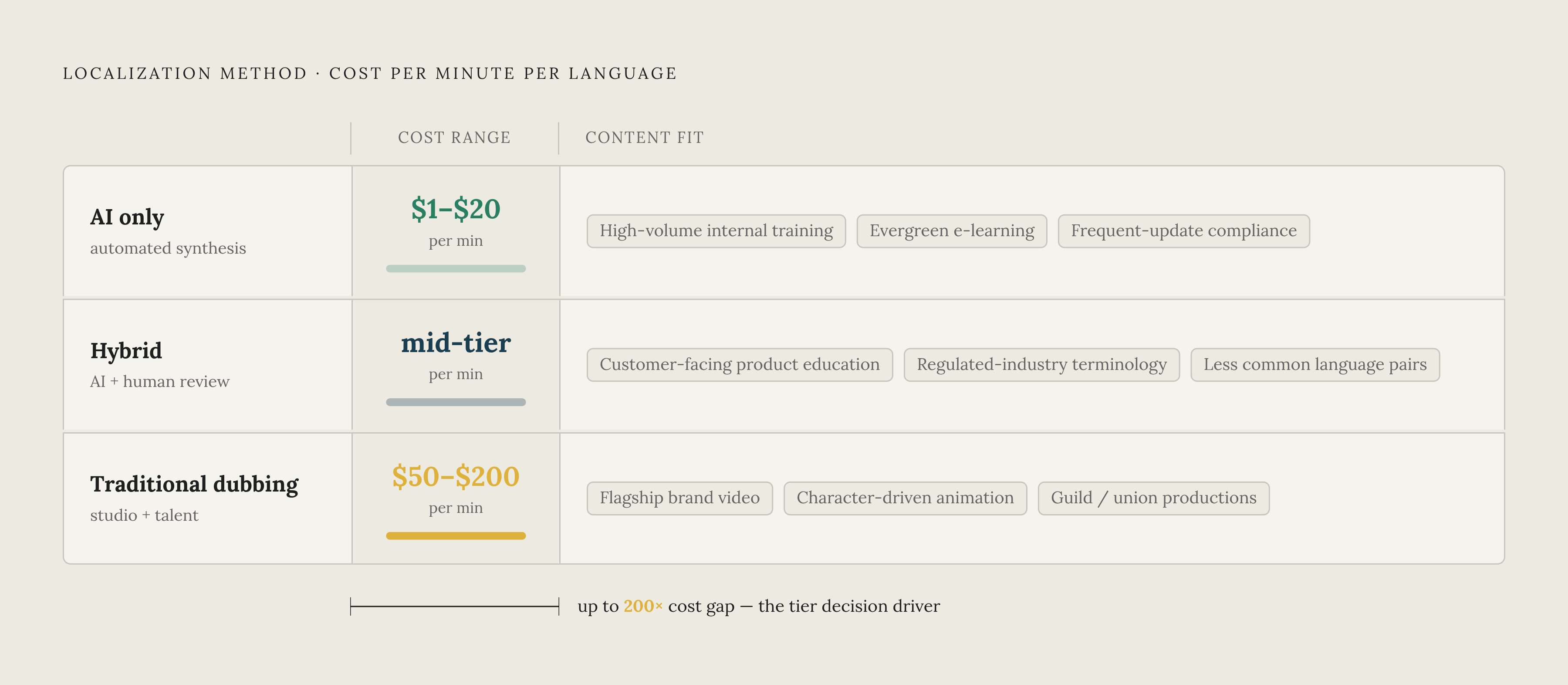
The choice between AI-only, hybrid, and traditional dubbing is a content-risk and operational-volume decision. It should be made at the content-category level, not once for the whole organization. Most training libraries contain content that belongs in all three tiers simultaneously.
AI-only workflows fit high-volume internal training, evergreen e-learning modules, software onboarding walkthroughs, and compliance training where update frequency is high. They work when the source audio is clean, the language pairs are primary ones, and emotional performance is not the primary vehicle of meaning. The catch is that the platform must handle interactive layer localization, on-screen text, and LMS packaging, not only audio and subtitles.
Hybrid workflows pair AI generation with human linguistic review. They fit customer-facing product education where a mistranslation generates a support ticket or churn risk, multi-speaker content, legal or compliance terminology in regulated industries, and less common language pairs where AI accuracy is lower. AI generates the dubbed audio and subtitles, then a human reviewer checks translation accuracy, cultural appropriateness, and technical terminology before publishing. For sensitive internal HR and compliance training, subtitles rather than dubbing are sometimes preferred because they retain the original speaker's voice. That can matter for authority on sensitive topics.
Traditional dubbing fits flagship customer-facing brand video, character-driven animated training with emotional arcs, content with guild or union requirements, and any production where emotional performance is inseparable from the instructional value. It is not obsolete. It is reserved for the content where its premium buys something the learner actually feels.
A five-layer workflow for teams building a repeatable AI localization process
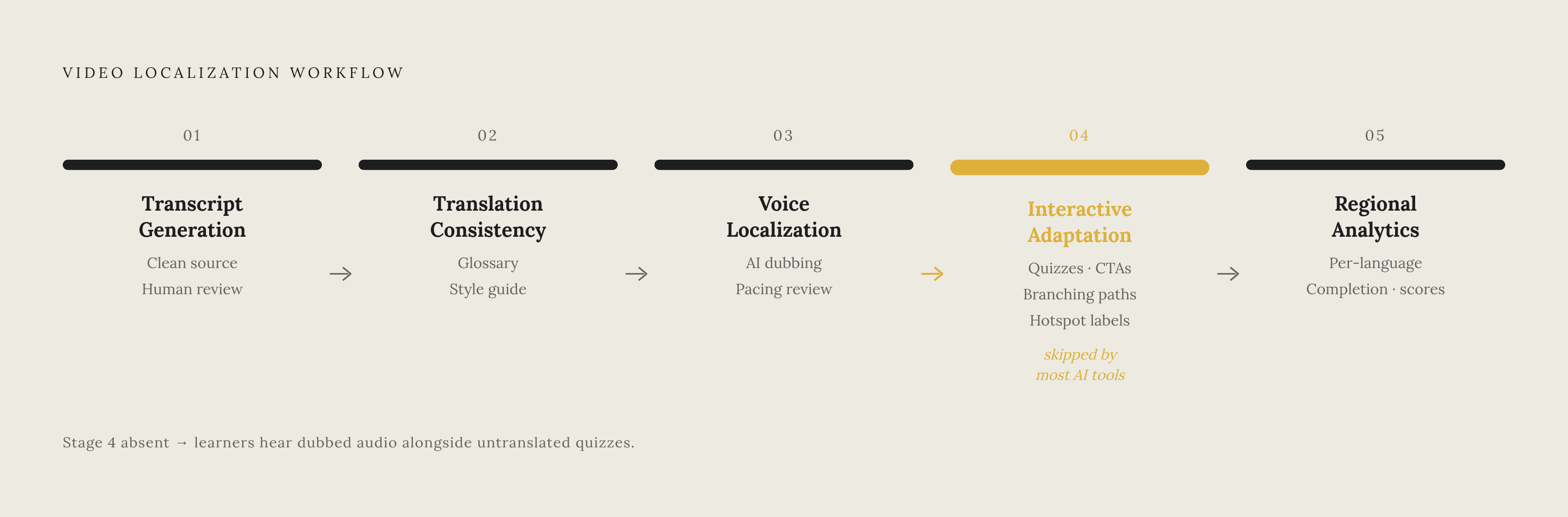
Teams that localize training video successfully treat it as a five-layer operational workflow, not a one-step translation task. The layers must be sequenced correctly to avoid rework. The first is transcript generation. Produce a clean, reviewed source transcript before any translation begins. Errors here propagate through every downstream stage. A glossed-over product name or a misheard compliance term becomes a defect in every language version.
The second layer is translation consistency. Apply a terminology glossary and style guide so brand names, product terms, and legal language are treated consistently across all language versions and all future updates. This is where a team locks in how its product names and compliance terminology will appear in every locale. The third layer is voice localization, using AI dubbing or hybrid review of synthesized audio, with attention to pacing, prosody, and any content requiring emotional range.
The fourth layer is interactive adaptation. Translate and rebuild quiz questions, branching paths, hotspot labels, and CTAs for every language version. This happens separately from the audio track and is a non-negotiable step, not an optional add-on. The fifth layer is regional analytics. Track per-language completion, engagement, and assessment performance so the team can identify where a specific language version is underperforming and diagnose whether the issue is translation quality, cultural fit, or technical delivery. Because AI localization treats the source document as the unit of work, a well-structured workflow means updates cascade across all language versions from Layer 1. The team does not restart from scratch.
What to look for when choosing an AI localization tool for training content
Most AI video translation tools address the media layer, subtitles and dubbed audio. Training teams need to evaluate against the interactive and LMS layers that most tools skip. Start with interactive layer localization. Can the platform translate quiz questions, branching paths, hotspot labels, and CTAs, not just audio and subtitles? Then check SCORM and xAPI export with per-language tracking. Does the platform produce LMS-compatible packages that preserve completion and assessment data for each language version separately?
On-screen text handling is next. Does the platform detect and translate text embedded in the video frame, not only the audio track? Voice cloning with a consent workflow matters too. Does the vendor have a documented consent and data-residency process for voice replication? Language coverage and accuracy tiers should distinguish between primary pairs and less common pairs, and surface confidence levels that indicate when human review is warranted. Update propagation rounds out the checklist. When the source video changes, how much of the localization workflow needs to be manually restarted?
Clueso addresses the training content production workflow from a different angle. It transforms raw screen recordings into polished product videos and step-by-step documentation simultaneously, including AI-generated voiceovers, smart zoom, captions, and accompanying SOPs. Its one-click translation across 40+ languages builds localization into the production workflow rather than adding it as a downstream step. For software training, where the content is screen recordings of a product UI, that means the video and its documentation are localized together. The gap between audio localization and on-screen content localization closes at the point of production rather than in post.
How to decide: a practical decision framework for training teams
The right localization method is determined by four variables: content volume, update frequency, content risk, and interactive complexity. Volume and update frequency favor AI-only or hybrid. A library of 50+ modules updated quarterly makes traditional dubbing economically unworkable regardless of quality preferences. Content risk favors hybrid at minimum. Human review of AI output before publishing is a low-cost addition that meaningfully reduces mistranslation risk for customer-facing and compliance-critical material.
Interactive complexity requires a platform that handles the full interactive layer. If the chosen tool cannot, that is a workflow gap that produces broken learner experiences, not a minor quality issue. Emotional register points to traditional dubbing or hybrid with professional voice review for character-driven content, sensitive HR topics, and flagship brand work. The practical starting point for most teams is to default to hybrid for any customer-facing or compliance content, use AI-only for internal, high-volume, evergreen modules, and reserve traditional dubbing for content where emotional performance is the instructional vehicle.
The most common mistake is choosing a method once for the whole organization and applying it uniformly. That either overspends on traditional dubbing for routine modules or under-delivers on quality for high-stakes content. The framework itself is stable even as the technology matures. The hybrid pattern will likely compress further toward AI-only as quality improves, but the decision model remains the same: match method to content risk and operational volume.