Accuracy Risks of AI-Generated Software Documentation
Language models hallucinate, drift, and abstract—creating predictable documentation failures.
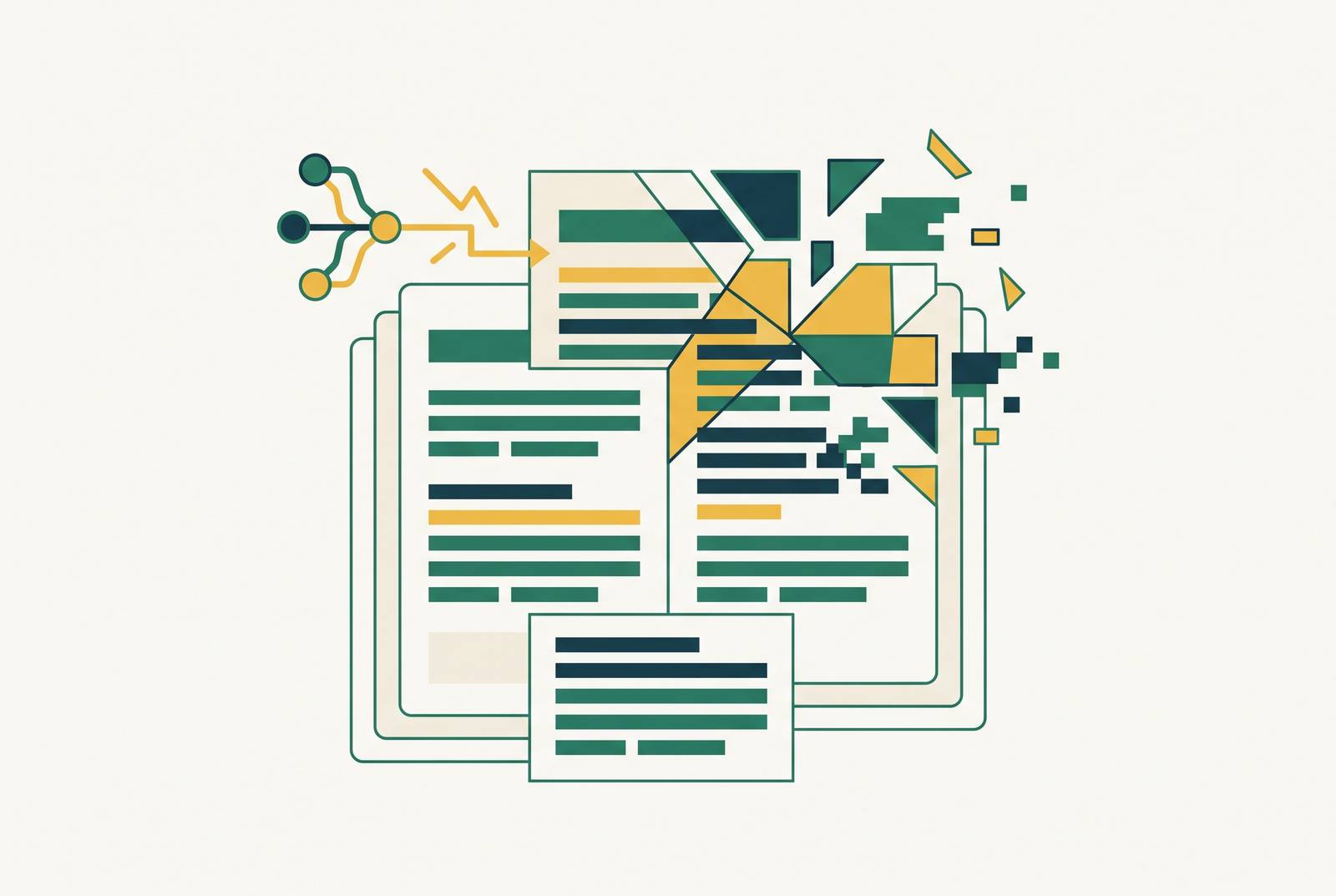
AI-generated software documentation fails in predictable ways, and understanding those patterns is the first step to controlling them. The failures cluster around three structural causes: hallucination, version drift, and generic abstraction. Each one maps to a specific weakness in how language models work. None of them can be fixed by infrastructure alone.
Why AI-generated software documentation fails in predictable ways
Language models generate the most plausible continuation of their inputs, not the most accurate description of a product's current behavior. This is the core mechanism behind every failure mode that follows. When source inputs are absent, incomplete, or stale, the model fills the gap with confident-sounding invention.
The problem is not that AI writes badly. It writes fluently, often more fluently than a rushed human draft. That fluency is itself a risk: well-formed prose suppresses reader skepticism. Errors pass review more easily than the awkward mistakes a less polished human draft would surface.
General AI writing tools can miss key technical distinctions, invent details, or produce generic explanations that do not match the product. Better prompting does not fully resolve this. The limitation is structural, not a matter of asking more carefully. Three distinct failure modes follow from it: hallucination, version drift, and generic abstraction.
Each mode traces back to the same root. A model works from whatever text it has been given. Where that text falls short of the product's actual state, the model does not stop and ask. It produces plausible output anyway. Understanding this is what makes the failures predictable, and prediction is what makes a review workflow possible.
How hallucination introduces invented facts into product documentation
Hallucination is the most visible failure mode because it produces falsehoods stated with full confidence. The model invents feature names, policy rules, and UI states that do not exist in the product. It does not hedge. It presents the invention as fact, in the same register it uses for accurate descriptions.
The Cursor incident of April 2025 shows what this looks like at full consequence. Cursor's own AI support agent told users that a nonexistent policy prevented using the product across multiple devices. No such policy existed. The bot presented the explanation as an official company rule, and some users publicly canceled their subscriptions over it. A company's AI hallucinated about its own product to its own customers, and the churn was direct.
The failure extends beyond support documentation into developer-facing content. In 2025, a pattern called slopsquatting emerged: AI coding assistants hallucinated the names of software packages that did not exist, and attackers registered those names and filled them with malicious code. A hallucinated package name in documentation became an exploitable supply-chain attack surface.
Residual hallucination persists even under constrained, document-grounded conditions. When models are given a source document and told to summarize only from it, top models still hallucinate at measurable rates. The rate is not stable across evaluation conditions. Governance systems cannot set a single acceptable threshold and move on. They must assume any output may be confidently wrong and build verification around that assumption.
How version drift makes accurate documentation go stale, and why AI accelerates it
Version drift is documentation that was accurate when written but no longer matches the product. This is an old problem. AI makes it faster to produce, wider in distribution, and harder to detect. A traditional screen-recorded guide becomes obsolete the moment a single UI button changes location. AI can compare documentation against current code or product specifications to identify outdated content, but that capability is rarely applied systematically after initial publication.
The SOP-specific version of the problem is structurally harder. A process can change without any visible event: no release note, no changelog, no UI update. Drift goes undetected until a downstream failure surfaces it. There is no trigger for review because nothing announces that something changed.
The cascade problem is what makes version drift a new-in-kind risk. A stale document is no longer only a human inconvenience. It is an infrastructure risk. AI assistants pull from knowledge bases and ingest those documents as sources of truth. The error propagates into model outputs across every team using that assistant.
When documentation is generated from text sources alone, version drift becomes invisible until it cascades through downstream systems. Clueso's approach is to produce documentation by extracting information directly from current screen captures, transforming live recordings into both polished walkthroughs and step-by-step SOPs. The content's freshness ties to the actual product state, making drift visible and addressable before it propagates.
The result of unchecked drift is a corpus that is partially correct in ways that are not visible from the outside. Training new hires on such SOPs teaches the workflow as it used to be, not as it is. The error compounds silently.
How generic AI output fails to capture product-specific behavior
Generic abstraction is the hardest failure mode to catch in review because the output is not false. It describes something plausible, the way the category of software generally behaves. It just does not describe the product's actual behavior, terminology, or workflow.
AI is most effective when it transforms trusted inputs into structured drafts: specs, tickets, SME interviews, API definitions, UI labels. When those inputs are absent or vague, generic output is the predictable result. The model falls back on what it knows about software in general rather than this software in particular.
The harm is specific. A user following a step sequence that describes the category of software but not the product will reach a decision point where the UI does not match the instructions. The workflow breaks. The user is stuck, and the documentation cannot tell them why.
Localization compounds the problem. Technical terms often lack direct equivalents in other languages. A translated document that loses terminological precision can introduce functional errors that neither the translating team nor the receiving audience can easily detect, particularly in markets without available SME reviewers.
The customer education consequence is direct. When onboarding content depicts generic or incorrect step sequences, users fail to reach core value milestones. That failure directly accelerates early churn, which is the highest-leverage retention risk in the customer lifecycle. Generic abstraction is not a cosmetic problem. It costs customers.
Where each failure mode hits hardest across documentation use cases
Each failure mode carries its highest risk in a specific documentation context. Understanding the pairing determines where review resources should concentrate. SOP and internal process documentation face version drift as the primary risk. A process can change without a visible trigger, and the downstream cost is training programs that teach an outdated workflow. The error compounds rather than corrects.
L&D and training content interact with all three modes. Inaccurate training content, when used for reinforcement, compounds the error rather than correcting it. The standard mitigation strategy of continuous micro-learning modules actively worsens accuracy problems if the underlying content is wrong. Repeating an error makes it stick harder.
Compliance and regulated documentation are a distinct escalation in stakes. Specialist review before publication is non-negotiable here. AI can accelerate drafting and retrieval, but human oversight and audit trails are required by the ALCOA+ standard and emerging regulatory expectations. The cost of an error is not customer confusion. It is legal exposure.
Why the prevailing fix, RAG and governance frameworks, is necessary but not sufficient
Retrieval-augmented generation and governance frameworks reduce hallucination rates and version drift. They do not eliminate them. The residual risk is unpredictable enough that any production workflow must assume it exists.
Even document-grounded approaches carry residual risk. When models are constrained to a provided document, hallucination persists. The governing assumption cannot be that RAG makes outputs safe to publish. RAG narrows the problem. It does not close it.
Model accuracy is not stable across framing and context. The same model can experience large accuracy collapses depending on evaluation conditions. A governance system calibrated to average performance will fail at the tail. Documentation errors tend to cluster at the tail: edge cases, legacy features, compliance-adjacent language.
Autonomous accuracy control that prevents outdated information before it happens is an emerging direction for 2026, but current practice still requires human editorial oversight. Teams must validate AI outputs. They cannot yet delegate that responsibility fully to autonomous agents.
The skills gap compounds the problem. AI adoption demands new skills in prompt engineering, model validation, and AI oversight. The humans needed to catch AI documentation errors are often the same people who have not yet been trained to use the tools responsibly. The review layer is thin exactly where it needs to be strong.
The right conclusion is not to abandon AI-generated documentation. It is to stop treating infrastructure as a substitute for a structured review workflow. RAG and governance reduce the problem space. A review workflow addresses what remains.
Building a review workflow that catches errors without losing the speed advantage
A review workflow designed around the three specific failure modes catches errors more reliably and more efficiently than a general editorial pass. The workflow begins by matching review type to failure mode. For hallucination, fact-check named features, policy statements, and UI element names against a live product source. The product itself, not another document, is the reference. SME spot-check is the minimum standard for any content that will be customer-facing or used in compliance contexts.
For version drift, establish a documentation changelog tied to product release notes. Every sprint or product update triggers a review flag on affected documents. This is not a full rewrite. It is a targeted check of the specific steps or UI states that changed. For internal SOPs, the check runs on a scheduled cadence, not only at publication, because a process can change without any visible event. The review trigger must be time-based as well as event-based.
For generic abstraction, require that AI drafts are generated from specific product inputs: UI labels, actual user flows, product specs. Not general prompts. The output of an AI tool working from the right inputs is structurally less likely to produce generic content.
Prioritize review effort by consequence. Compliance and regulated documentation get qualified specialist review before publication, no exceptions. Customer-facing onboarding content gets SME review of step sequences and UI states, since hallucination and generic abstraction directly affect time-to-value and early retention. Internal SOPs get scheduled version drift checks.
Governance infrastructure supports the workflow at the systematic level. Maintain audit trails for AI-generated content: which model, which inputs, which human reviewer, and when. Compliance documentation for AI-generated artifacts remains an immature practice, but the regulatory direction, including the EU AI Act and FDA-EMA joint principles, is toward formal provenance requirements. Use AI as a standing audit to scan documentation for terminology inconsistencies and contradictory guidance across large sets, not as a one-time cleanup. Treat localization as a separate accuracy checkpoint: translated content requires terminology review in the target language, not just a fluency check, because precision loss in translation can introduce functional errors.
The input grounding principle is visible in how some tools are designed. Clueso builds AI assistance on top of actual screen recordings, the product as it exists rather than as a model imagines it. The source input for AI-generated voiceovers, captions, and step-by-step documentation is grounded in real product behavior. That structurally reduces the surface area for hallucination and generic abstraction before review begins. Human review then addresses what the grounded input cannot prevent.
What teams should treat as non-negotiable regardless of how mature their AI workflow is
Certain accuracy practices hold regardless of which AI tools a team uses or how sophisticated its governance infrastructure becomes. They address failure modes that are structural to how language models work, not incidental to any particular tool. Human SME review is not optional for customer-facing or compliance-adjacent content. AI fluency is not a substitute for product knowledge. The cost of a published error, in customer trust, compliance exposure, and support volume, exceeds the time cost of a review step.
The source input determines the accuracy ceiling. AI cannot produce documentation more accurate than the inputs it is given. Teams that invest in high-quality, up-to-date source materials are investing in the accuracy of every document those inputs generate. Specs, UI recordings, release notes: these set the ceiling.
Documentation must be treated as an adaptive system. Static, publish-and-forget content is incompatible with AI-assisted workflows because the same AI systems that generate documentation also ingest it. A stale document does not stay in one place. It propagates. Accuracy and speed are not opposites if the review workflow is designed around specific failure modes. A targeted SME check on named features and UI states takes less time than a general editorial pass and catches more of the errors that matter.
The technical writer role is shifting toward information architecture, context curation, and quality systems. Teams that invest in those skills now will be better positioned to maintain accuracy as autonomous AI agents take on more of the drafting and maintenance work. The tools will change. The discipline of grounding output in the product as it actually exists will not.