Human Oversight Checkpoints in AI-Assisted Training Video Workflows
Building approval gates into AI video production prevents meaning-drift across outputs.
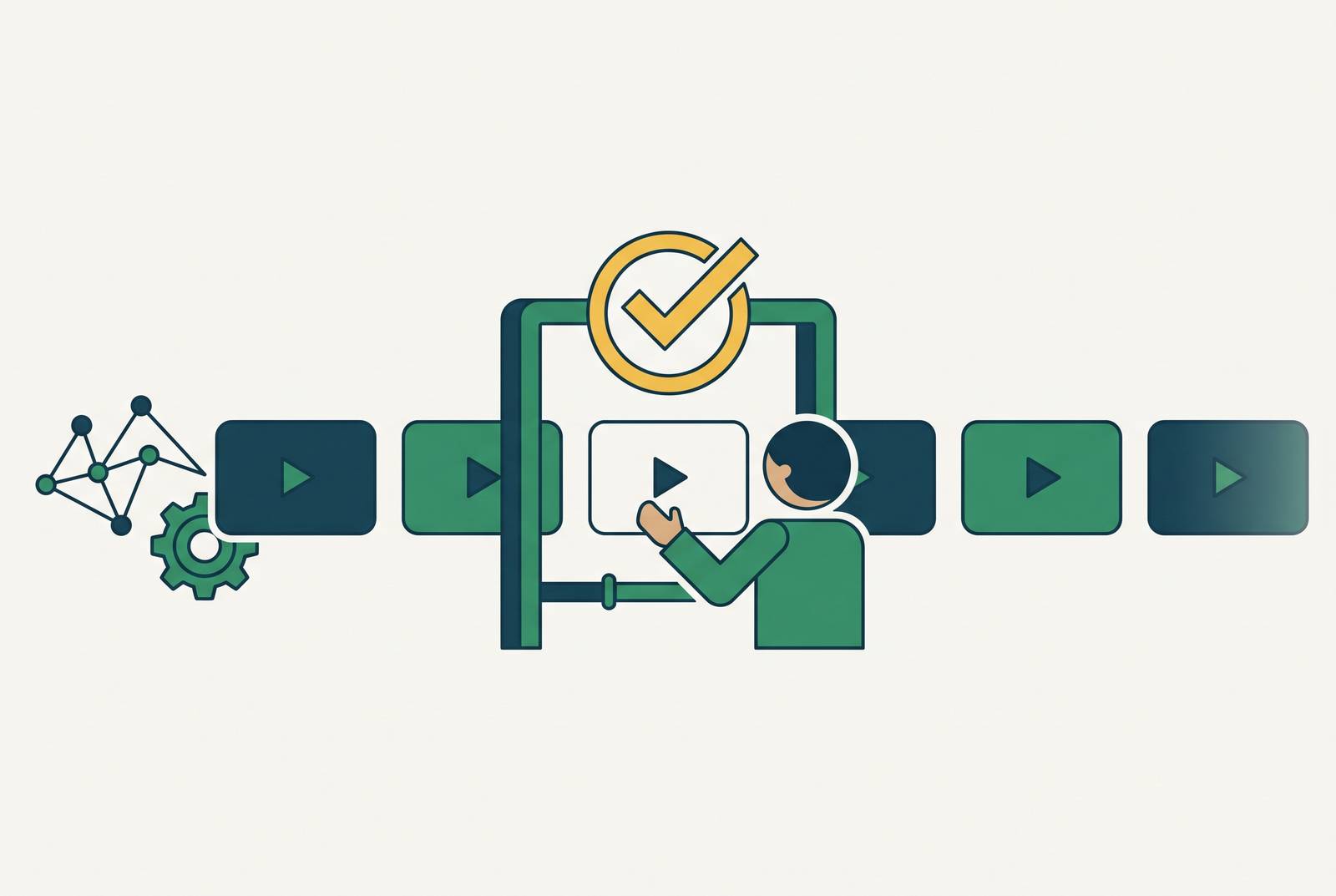
Clueso can turn one screen recording into both a product walkthrough video and step-by-step documentation, so each format does not need its own recording. This article explains the human oversight checkpoints that make that workflow dependable. The central rule is simple. AI can handle production, but people must approve the source, preserve its meaning, check the depicted actions, and authorize release.
Why AI-assisted training video production creates a new category of quality risk
A production workflow that once took weeks can now finish in hours. AI handles work including indexing, transcription, proxy generation, and routing, while people retain control of the story, rights, and final approvals. That compression also removes pauses in which someone might notice a mistake. A script can reach lifelike voiceover, smart zoom, and captions before anyone has read its instructions carefully.
The danger is a professional-looking video that gives the wrong instruction with complete confidence. Even a polished video no longer hints that someone has checked the content with care. In workflows such as Clueso’s, which produce video and documentation from one screen recording, a mistaken interpretation can reach both the video and the formatted how-to article. One missed error becomes a shared defect across two learning resources.
Good source material does not solve this problem on its own. AI can invent details, misread the structure of a document, or restate an approved policy in words that change its practical meaning. It does not consistently understand domain-specific rules or what a learner in a particular role needs to do. Source quality is therefore necessary but insufficient. The safeguard is a human comparison between what was approved and what the production process actually says.
The five-stage workflow and where errors are most likely to enter
The workflow has five stages, which are source definition, scripting, visual production, scenario or interaction design, and review. Source definition establishes what the training will teach and which material carries authority. Any gap at this stage becomes part of the foundation for later work. The remaining stages can make that material clearer and more engaging, but they cannot make an outdated rule current.
Meaning-drift is most likely to happen during scripting. A policy written for reading must become language that a presenter can speak naturally. AI can shorten dense passages and make them easier to follow, but it can also change the rule in trying to explain it. An instruction may keep words that sound familiar but lose the condition that says when it applies.
Visual production adds footage, avatars, and diagrams, while scenario design adds choices and what happens as a result. Both make claims that someone must judge in context, including whether the action shown fits the situation and whether the outcome follows the policy. Review is the fifth stage and the one most vulnerable to compression under time pressure. This creates a mismatch in the workflow. Most errors come early, especially in source definition and scripting, while checks for them wait until the end. Checkpoints close that gap by having people check the work before the next stage builds on a mistake.
Checkpoint one: validating the source before AI touches it
Review should begin before there is a video to watch. The first decision is whether the source is current, complete, and clear enough to teach from. An outdated procedure does not become reliable because AI explains it fluently. A contradiction does not disappear because the resulting article has neat headings.
The reviewer selects the sections that determine what the learner needs to know or do. That choice establishes scope as well as accuracy. A 20-minute video that tries to cover everything can lose the learner before it gets to the instruction they need. What goes into the lesson therefore affects whether people get to and remember what they need to learn.
The test is concrete. The reviewer must be able to establish that the selected version is currently in force, has no open amendments, and clearly states what people must do. If any of those conditions is unmet, the source needs work before production begins. For systems that accept recordings, documents, or slide decks, including Clueso, choosing what to record or upload makes this decision explicit. Because the chosen material can feed both video and documentation, this is the highest-leverage checkpoint for source errors. It prevents a flawed foundation from being converted into two finished outputs.
Checkpoint two: SME sign-off on the AI-drafted script
A subject matter expert, or SME, is not reviewing the AI-drafted script for grammar. The expert is deciding whether its instructions preserve the approved meaning. Fluency can make this difficult because a readable script invites agreement. The reviewer may recognize the general subject and miss the practical change. Approval must therefore rest on what a learner would do after hearing the script.
The SME should compare the script with the source section by section. For every instruction, the comparison must cover its conditions and exceptions as well as the main action. A standalone reading can reveal awkward tone, but it provides no reliable anchor for detecting a missing qualifier. The side-by-side review keeps that anchor visible.
Consider the condition “unless the customer has already completed verification”. Removing it may make a sentence shorter and easier to speak, but it also changes the instruction for customers who have already completed that step. The sentence that is left can have correct grammar and still teach people to do the wrong thing. The reviewer must catch the lost exception. This is why pacing and readability cannot substitute for factual review.
The comparison also needs to catch additions. A script that confidently supplies a detail absent from the approved source is not preserving meaning, even if the detail sounds plausible. The same applies when a change in structure makes an instruction appear to apply more broadly than intended. The SME’s task is to distinguish explanation from alteration. Approval means that a learner acting on the script would behave as the source intends.
Where video and step-by-step documentation are generated together, as Clueso supports, the SME can check the article and script in the same session against the same source. Their agreement with each other is not proof of accuracy because both may contain the same interpretation error. Expert time remains scarce, but this is where it buys the most protection against meaning-drift. Correcting the script before production is faster and cheaper than repairing a published video and its accompanying instructions.
Checkpoint three: visual and scenario accuracy review before final assembly
An approved script does not make the visuals accurate. In software training, the interface, click sequence, and screen state after an action all teach the learner what to expect. A walkthrough may show an earlier interface or a sequence that has since changed. Someone who uses the software must therefore check every step and UI state shown against the product as it is now.
The source of the visuals changes the review task. Clueso builds its primary walkthrough workflow from a recording of live software, including through its browser agent, rather than relying on generated imagery to depict the interface. That reduces the risk of invented UI details. It does not remove the need to establish that the recording is current. Here, the checkpoint centers on the recording’s currency and the accuracy of the actions it captures.
Animated diagrams and process steps shown in the video need the same checks. A diagram makes a claim about sequence, while an avatar’s action makes a claim about correct behavior. Review must cover those claims and whether the depicted people, environments, and equipment fit the audience. Branching scenarios need close attention because each outcome teaches what happens after a choice. A plausible but incorrect consequence for a wrong choice can teach the wrong lesson with apparent authority. Before final assembly, a human reviewer must check that each branch shows what actually happens under the approved policy.
Checkpoint four: final sign-off as a compliance and governance act, not a courtesy review
Final sign-off is not a request for someone to give the finished video a quick look. Without a defined scope and a named accountable reviewer, it offers only the appearance of oversight. Earlier checkpoints approve the parts, but the final review checks the learning resource as a whole. The sign-off should record who approved each dimension and when. That record states who is responsible, which publishing the video alone leaves unsaid.
The SME must check the facts in the whole video, including its audio and visuals, against the approved source. Accessibility review covers captions, visual contrast, and pacing against the organisation’s standards. People need to check both the words and the timing of AI-generated captions. Legal or compliance reviewers must judge privacy and consent for the people, settings, and data shown. Learning design adds a separate test of whether the sequence is understandable and gives the learner something they can act on.
The Governed AI-Assisted Engineering framework, or GAIE, provides a useful governance model, with an important boundary. It addresses agentic code generation in regulated domains. Within that scope, it sends tasks through oversight tiers and sets out which evidence artifacts are needed so compliance can be audited. The relevant principle for video production is that approval should leave an accountable record. A final sign-off requires a carefully made decision.
For localized content, a regional SME also needs to check the meaning and market-standard terminology as part of the final review. For RTL languages, that review must include UI directionality and punctuation mirroring. These are part of release accuracy.
How to prevent oversight checkpoints from becoming the bottleneck they were meant to prevent
If the same domain expert must inspect every output without a clear brief, the workflow has moved its bottleneck. Design each checkpoint around a specific decision and provide the material needed to make it. Checking whether a script preserves an approved source is a bounded task, unlike an open-ended request to review a video.
Saarland University and Microsoft’s 2026 research on post-task workflow representations involved 20 participants. The study found that users could understand the work and spot errors better with structured, graph-based representations of AI agent executions than with just the prompt and final output. The study did not look directly at training video checkpoints. Reviewers therefore need a structured account of the work. In this workflow, reviewers have the approved source, script, and steps shown in the video to check against each other.
The intensity of review should also reflect the stakes. GAIE classifies tasks by regulatory impact, customer proximity, reversibility, and data sensitivity, with lighter oversight possible after demonstrated clean performance. Using that principle to design the workflow supports having people check all the work at every checkpoint for compliance, customer-facing, and safety content. Stable internal material with a clean review history can use lighter checkpoints and spot-checking. Lower effort should follow evidence of lower risk.
Making video and documentation together can also mean less work to coordinate, because reviewers can check both against one source. That shared review should cover the script, video, and accompanying SOP or how-to article without treating consistency between them as proof of correctness. Well-designed oversight preserves the speed advantage by concentrating judgment where errors enter and where their consequences matter most. AI does the heavy lifting, while humans retain authority over what is taught and what is released.