When Informal Screen Recordings Undermine Software Training Programs
Outdated screen recordings waste training time because no one owns keeping them current.
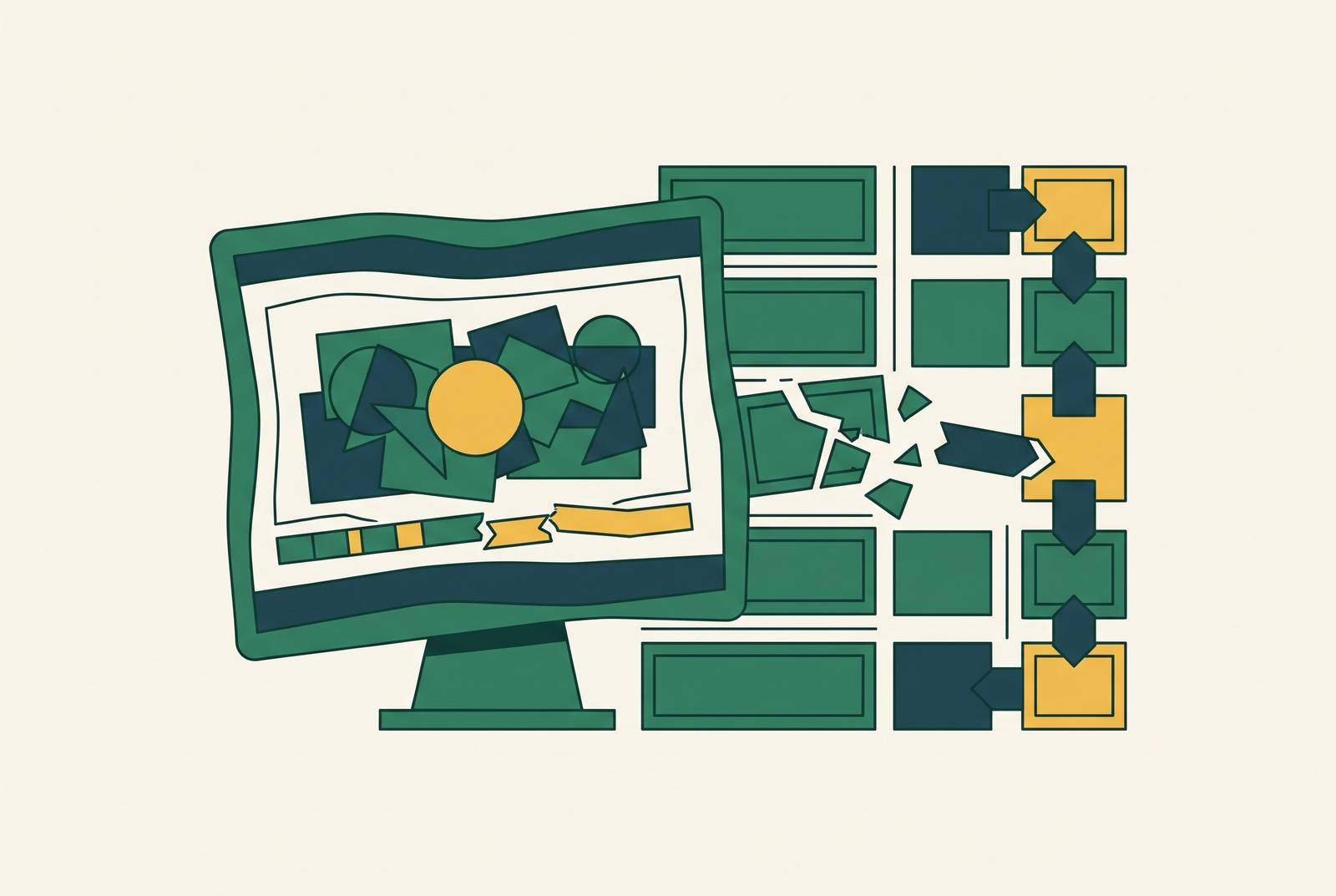
A product launch ships. Sales needs a training video. Someone pulls up the walkthrough recorded last quarter, and it shows a button that no longer exists. This is the recurring failure mode in software training built on informal screen recordings, and it has nothing to do with production quality. Three separate structural failures compound inside that one broken video: content that goes stale without anyone noticing, no clear owner responsible for fixing it, and a format that cannot grow past the one person who hit record.
Informal screen recordings create a structural problem, not just a polish problem
Each of those three failures, staleness, missing ownership, and a ceiling on scale, does damage on its own. Put together, they reinforce each other, so the mess they make gets harder to untangle the longer it sits. A recording made in ten minutes to answer one question gets treated like a durable piece of training infrastructure, and the gap between those two things is where the trouble starts. Communication and training are not the same obligation: a clip shared in chat just needs to answer a question once, while a training program has to stay accurate, stay consistent, and produce outcomes that can be measured over time.
How version decay takes hold
Stale training content results from treating recording as a single finished act instead of an ongoing responsibility, not from anyone dropping the ball. Software changes constantly. Screens get redesigned, menu paths move, field labels change wording, and every one of those changes should trigger a review of whatever training references the old version. Fixing that requires someone to notice the change, find every recording it affects, update them, check the update for accuracy, and republish, and each of those steps needs a person attached to it. When no one has explicitly been assigned that job, the default outcome is nothing happens. The recording stays online, new hires keep watching it, and the distance between what the video shows and what the software actually does grows wider without anyone registering it.
The sharpest version of this appears when a recording points to a button, a menu path, or a field label that simply isn't there anymore. A learner follows the steps exactly as shown and ends up stuck on a screen that doesn't match anything on their own. For companies pushing frequent product updates, the pace of decay moves faster than any manual review schedule can keep up with, and the review burden doesn't grow steadily. It grows with every new recording added to the pile, so the backlog compounds rather than holds steady.
Regulated industries feel this most sharply. FDA inspectors have cited training records that fail to show what revision of a procedure employees trained on, and fail to show that employees reviewed the procedure after it changed. An informal recording leaves precisely that gap open: no revision stamp, no review trail, nothing connecting the video to the current version of the process it claims to teach.
The accountability gap in informal workflows
Stale recordings don't stay broken because teams can't fix them. They stay broken because fixing them was never written into anyone's job. Ownership was never assigned at the moment the recording was made, so there's no one whose role includes going back to check it.
Think about how these recordings usually get made. A product manager who happens to know a feature well records a quick walkthrough. A customer support rep records one because they got the same question for the fifth time. A trainer records one to cover a gap before the next scheduled session. Whoever made it, the file lives wherever they happened to share it, a Slack channel, a shared drive folder, an email thread. No version control marks which copy is the current one. Duplicates spread across tools and teams, and when the underlying product changes, nothing in that setup tells anyone that a specific recording is now wrong.
Updates, when they happen, happen reactively. Someone notices the wrong recording still circulating in a live onboarding session, or a new hire mentions that the steps on screen don't match what they're looking at. When documentation and training sit in separate systems, the problem doubles: the SOP may be updated while the video next to it keeps teaching the old process, or the reverse happens, because nothing links them to surface the discrepancy. The fix is assigning ownership explicitly and building a system that surfaces what needs updating and when, rather than waiting for someone to stumble onto the mistake.
Why informal recordings don't scale
Even a recording that's accurate, well-prepared, and free of errors runs into a hard limit: it was built for one audience, one moment, and one language. Every new hire cohort, every new team, and every new region means you start the process over from scratch.
The clearest sign of this limit is the live-session reflex. When a recording doesn't fully stand in for a live walkthrough, trainers just run the session again, and keep running it, and each repeat eats time but leaves nothing durable behind and gives no one visibility into whether the material landed. Language compounds the problem. A recording made by one person in one language is effectively closed off to anyone who doesn't speak that language fluently, because reaching them takes a full re-recording or a separate localization project. Global teams end up structurally underserved by a format that was never designed with them in mind.
Quality problems compound the limits on scale. Most informal recordings get made without any outline, without clearing the desktop, without checking the audio, without a single test run, and the result is full of pauses, fumbled explanations, background noise, stray notifications, and visual clutter that makes the final product hard to follow no matter how large the intended audience is. There's a privacy risk sitting inside that same carelessness: an unprepared screen capture can expose notifications, account names, open browser tabs, or personal messages, and a tutorial meant to build trust ends up undermining it before a learner finishes the first lesson. None of this is a matter of inconvenience. It decides whether a training library compounds in value over time or turns into a recurring labor cost that keeps generating rework.
The compounding of all three failures in practice
These three failures rarely occur one at a time. They feed each other, and the longer the cycle runs, the harder it gets to break.
A CS manager records a walkthrough to cut down on repeat questions. It gets shared widely because it's genuinely useful. Six months pass, and a product update changes two screens. No one owns the recording, so no one updates it. New hires keep training on it anyway, because it's the one they were handed. Support tickets tied to the changed screens start climbing. The manager eventually records a new version, but the old one is still sitting in three different Slack channels, and now both versions look equally current to anyone who stumbles across them.
At that point, the original recording has generated more support work than it ever saved, and not because the person who made it did anything wrong. The format was never built to survive time passing, ownership changing hands, or distribution spreading past a single team. Learners absorb the cost directly. The retention benefit that makes video worth using in the first place only holds when the content is accurate and well-structured. If a recording shows a deprecated interface, you get neither that retention benefit nor the quick scanability a well-organized written guide gives you. Support ticket volume, repeated onboarding sessions that shouldn't be necessary, and, in regulated industries, compliance exposure appear at the organizational level, each one a direct downstream cost of the same structural gap.
What structured training programs do instead
Organizations that have moved away from informal recording toward structured, governed training programs report gains in support deflection, onboarding speed, and completion rates that aren't marginal. The pattern holds across different programs: one topic per video, a clear learning objective attached to each piece, and completion tracking that shows whether the content is actually working, all design choices informal recordings skip entirely.
The savings came from eliminating the hidden costs of the informal approach, repeated live sessions, inconsistent messaging, and zero completion visibility. A named structure for content, built-in tracking, and a single governed source eliminate the staleness, the ownership gap, and the scaling ceiling at the same time, rather than patching each one separately, because together they address the three failures already diagnosed.
AI-assisted production and the effort barrier to structured training
The strongest objection to fixing any of this is resources. Structured production has needed dedicated time, specialized skills, and a budget, and most teams don't have that sitting around. That argument no longer holds. AI-assisted workflows compress work that used to require a specialist, scriptwriting, editing, voiceover, into something any team member can run through directly.
The alternative to informal recording is a workflow that starts the same way an informal recording starts, with a screen capture, and then applies AI to clean up the script, generate voiceover, apply smart zoom, add captions, and produce an SOP, all from that single recording. Producing the video and the step-by-step documentation from the same source solves version drift at the structural level: when the underlying recording gets updated, both outputs update together instead of drifting apart the way a separately maintained SOP and video do. Screen recording itself stays the right format for software walkthroughs. No AI-generated animation can show the actual interface with the precision a real recording gives you. What changes is everything that happens after the recording is made, since the editing and writing labor that used to make structured production feel out of reach gets handled automatically.
Products change too fast for structured content to keep up, or so the update-velocity objection goes, but modularity answers it. If you break a complex process into smaller, modular recordings, a product change only means you re-record the module it affected, not rebuild the whole course from scratch. That makes a structured library easier to maintain over time than a sprawling collection of informal recordings, not harder.
What teams should establish before the next recording
Better recording habits alone don't fix any of the three structural failures. To fix them, you need explicit decisions about ownership, format, and how often content gets reviewed, decisions most teams have never actually made. Every piece of training content needs a named owner whose job includes checking it and updating it when the product changes, so that work doesn't sit there waiting for someone to get around to it. Format should get decided before recording starts, since a software walkthrough calls for a structured, modular screen recording while compliance or policy training is often better served by a scalable, localizable format like an AI avatar, and that choice up front shapes whether the content can actually be maintained and scaled later. Teams running multi-region programs need a governance model where a centrally approved master course gets created first, regional versions inherit its structure and core content, local teams only modify the sections designated for them, and updates to the master sync out to every regional copy, which addresses the scaling failure at the structural level instead of patching it region by region. Measurement needs to be built in before launch, not bolted on afterward, covering consumption data like views, completion rate, and rewatch rate, behavior data like feature adoption and tickets deflected, and business outcomes like retention and NPS, since all of that tracking infrastructure needs to already be in place when content goes live. For most teams, the realistic starting point is an audit: find the informal recordings currently in circulation, identify which ones are actually driving onboarding or training right now, assign owners to them, and rebuild the highest-stakes ones using a structured, AI-assisted workflow, a scope that's manageable and delivers real accountability and quality gains without demanding a full program rebuild on day one. The goal isn't getting everything perfect immediately. A training program that knows what it contains, who owns each piece, and when it was last checked for accuracy is already a fundamentally different thing than a scattered library of informal recordings, regardless of how polished any single video in that library looks.