The Build-or-Buy Case for a Customer Training Video Library at Scale
AI-native tools let teams maintain training videos faster than outsourcing production updates.
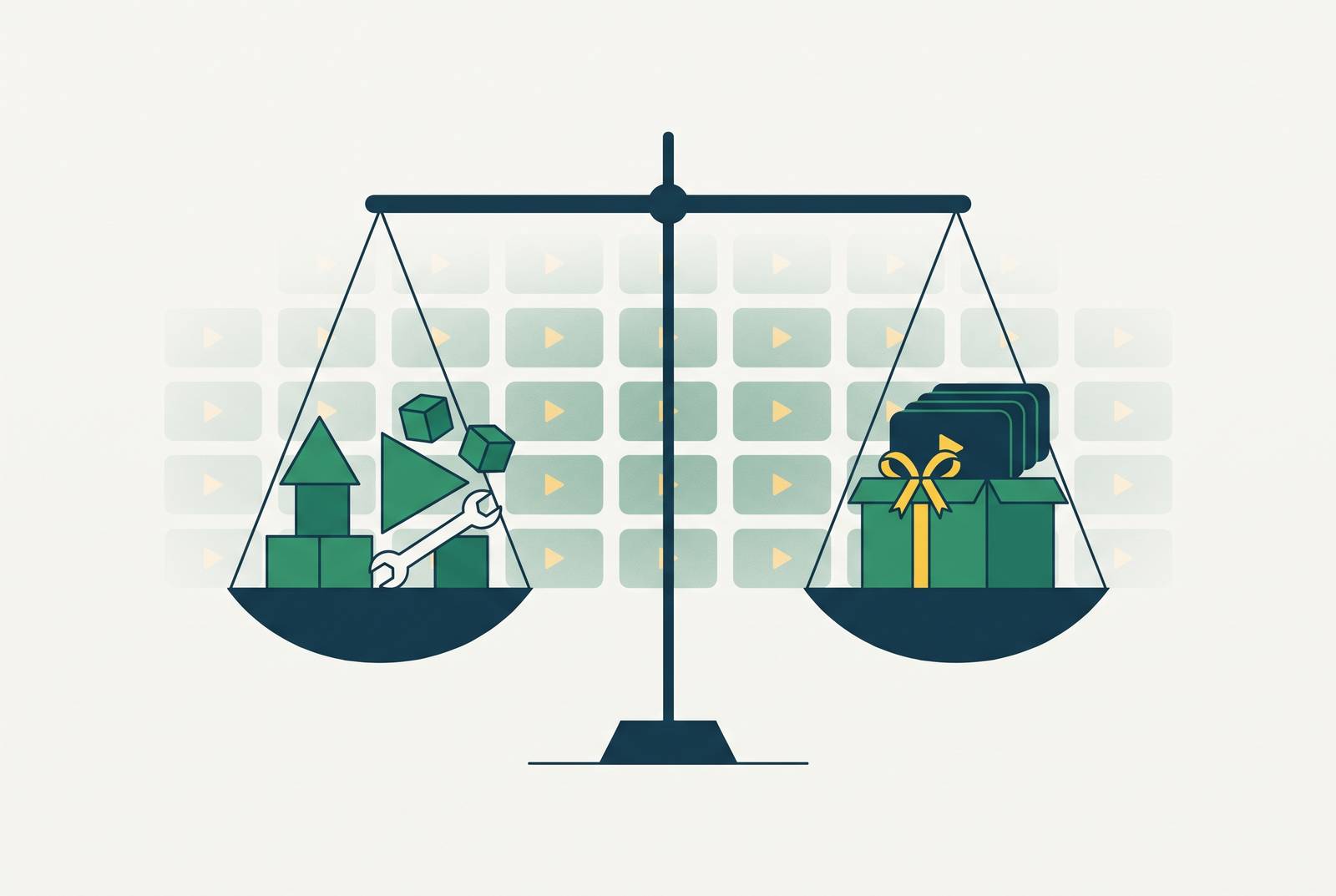
Customer success and L&D teams can make software training videos without a media team by using AI-native production tools to turn screen recordings and scripts into modules with narration and captions. The build-or-buy decision turns on the cost of keeping those modules current. For most mid-market SaaS companies, the strongest approach is to buy production infrastructure while owning the content and update workflow internally.
Why the build-or-buy question keeps getting the wrong answer
A team has a spreadsheet open, comparing vendor quotes with an internal production estimate. Studio time, contractor fees, and platform licenses all have a place. The comparison looks complete enough to make a decision. But its largest column is missing entirely. Every product update, UI change, new market, and compliance revision creates work after the initial budget has been approved.
The familiar objection is that the team only needs to build the library once. That assumption breaks as soon as the software changes. A training library is maintained continuously, even when its budget treats it as a single project. Comparing only the first invoices therefore favors whichever option looks cheapest before the ongoing work starts.
What a training video library actually costs to keep current
The dominant expense is the recurring labor of keeping modules accurate as the product, process, or policy beneath them changes. Traditional production treats a video as a fixed asset, scripted, recorded, edited, and published. Then the asset starts to age. For software training, that aging is tied directly to the product, because a UI redesign makes every affected screen recording a candidate for replacement. The recording can still look good while teaching the wrong steps.
The expense compounds as the library grows. Hundreds of modules can require individual re-recording and re-editing after a major release, consuming more engineering and creative time than the original build. Each module adds to what learners can use and what the team must keep up to date. That duty is especially hard to ignore when customers use the training, because getting the steps right is part of their experience. Teams that handle every revision as an isolated production job eventually face a large-scale rebuild they did not budget for.
That is where owning production becomes more attractive. The advantage is avoiding contractor fees on the first batch of videos and having a way to revise training whenever the underlying product changes, without restarting a production project each time.
How AI-native production changes the maintenance equation
AI-native production replaces much of the re-recording and re-editing cycle with script changes and regeneration. The video becomes closer to a living document. A team can change a paragraph and regenerate the narration. For software training, the workflow starts with a screen recording and adds AI-generated narration and callouts. When the interface itself changes, the affected screen recording still needs replacement, but a narration change need not trigger a reshoot.
This changes what the team is buying. Instead of purchasing a finished library, it acquires a production capability that non-specialists can operate. The useful comparison is therefore between recurring outsourced production and an internally run workflow supported by vendor software. A faster way to make the first video helps, but a faster way to update every later video changes the operating cost.
The tool alone does not solve the problem. Short modules with separate scripts, captions, and narration segments let a product change touch only the affected units. A long, tightly joined course can still demand broad revisions even when AI handles production.
Where the build-or-buy break-even actually sits for most SaaS teams
The break-even depends on learner volume, update frequency, and language scope. Off-the-shelf material or a small purchase can work well for a small audience that uses content only now and then, when that content rarely changes. That choice keeps fixed costs low without the team having to run production itself. Building a capability has less value when there is little recurring work for it to absorb.
Frequent product releases change the relationship. As updates accumulate, the cost of repeatedly buying production work becomes harder to justify against a reusable AI-native workflow. More languages widen that gap because each revision affects more versions of the same lesson. Learner volume supplies the scale of the training need, while update frequency and language scope determine how much work is required to keep that training accurate.
For most mid-market companies, the strongest answer is hybrid. A vendor supplies infrastructure for encoding, delivery, and localization, while the team owns its content and custom workflows. This lets the team control the content without having to build infrastructure it can already buy. It also separates two purchases that are often confused, namely buying finished content and buying the means to produce content independently.
What the decision looks like for different team types inside a SaaS company
Customer success and customer education teams need training that keeps up with product changes every sprint. Onboarding that is out of date can cause support tickets. Accuracy is therefore an operating requirement. These teams have a strong case for owning an AI-native production workflow internally, so that training revisions do not depend on an outside production queue.
L&D teams face similar pressure when compliance requirements or internal policies change, often without additional headcount. Their localization needs may be lower than those of customer-facing teams, but their content can require different presentation formats. Sales enablement has a different bottleneck again. Core playbooks change less often, while rep-specific and deal-specific assets create demand for quick personalization. For those teams, turnaround time can outweigh the maintenance burden of the core library.
Product teams sit at the fastest-moving end. Their feature documentation changes frequently, but the content is often short and structured enough to suit a standard operating procedure, or SOP, converted into video. These differences make a shared production platform a good fit, with each team able to use it on its own. Centralizing the capability need not mean centralizing every production request, and treating video as specialist-only work would preserve the bottleneck the platform is meant to remove.
Choosing the right production format for the content type and update cycle
Format is an update-cost decision before it is a production-quality decision. Screen recording with AI-generated narration fits software walkthroughs, SaaS onboarding, and SOP content because the learner needs to see the actual interface. The recording supplies the current UI state. The script supplies narration that can be regenerated separately when the explanation changes.
AI avatars with scripted narration fit policy explainers, compliance content, and leadership communications where a presenter adds credibility but scheduling a person for each revision is impractical. Narrated visual explainers suit abstract systems and architecture overviews where neither a face nor a screen recording adds clarity. Those subjects tend to change less often, so the format has less effect on what it costs to keep them up to date. The best fit follows what the learner needs to understand and what the team will need to replace.
For teams choosing a structure, the practical rule is one topic per video, with captions and a clear learning objective. Each unit should be short enough for the team to replace on its own. This also sharpens the criteria for self-service training software, including screen capture, script editing, regenerated voiceover, captions, and easy module replacement. Localization belongs in that evaluation too, because a translated narration track does not automatically update the interface visible on screen.
Localization as the hidden multiplier in the total-cost calculation
Each added language means more work to keep each module up to date. Traditional localization requires re-recording or professional dubbing, adding cost and elapsed time whenever a video changes. A buying decision based only on primary-language production therefore omits a recurring expense that can later dominate the budget. Localization is an upfront workflow requirement.
AI localization cuts that work by using the script from the primary-language video to make translated narration. This removes the need for a separate narration production cycle for each language. Visible UI elements must still match the localized product interface, so the workflow has to account for both the spoken explanation and the screen recording.
The build-or-buy implication is direct. A custom workflow without native localization gets harder to keep up to date as more languages are added, even if it works well for primary-language production. A platform that makes localization part of the production step has a structural cost advantage over a process that sends every update into a separate downstream project. Language support therefore belongs beside update speed in the original purchase decision, rather than appearing only when a new market needs training.
Measuring whether the library is working after you build it
An unmeasured library accumulates assets without showing which ones deserve maintenance. Views, completion rate, and rewatch rate show whether learners use the content. Feature adoption, support tickets deflected, and time-to-action show whether it helps them act. Retention, NPS, and expansion revenue show what keeping the library up to date is worth to the wider business. These are different questions, and a high view count cannot answer all of them.
Completion rate is an early signal of staleness. Learners may stop because the interface has changed or the workflow has moved. A decline is a reason to inspect the affected module, rather than automatically commission a new production style. Module-level tracking through a learning management system makes that inspection more precise. SCORM, xAPI, progress tracking, and analytics are therefore buying criteria for serious training programs.
Measurement makes the original decision self-correcting. When teams can identify underperforming modules, they can target updates to those units, avoiding a library-wide audit or replacement. Without that feedback, the library can drift until a full rebuild appears to be the only practical answer. That repeats the original mistake at the content level, treating production as a large one-off project rather than a continuing operation with targeted repairs.
What the total-cost picture looks like when AI production is the capability you own
Finished content gives the team an output, while an internally operated platform gives it a way to keep changing that output. The distinction resolves the apparent build-or-buy contradiction. A team can buy software and still own its update pace, while a team that builds videos without a maintainable workflow can inherit a growing liability.
For customer success and L&D teams without dedicated video staff, the practical recommendation is to buy the shared infrastructure and own the work that depends on product knowledge. That means vendor-supplied encoding, delivery, localization, and analytics, with internally managed content creation, updating, and brand consistency. The capability should cover screen recording, script rewriting, voiceover, captions, and accompanying documentation where those outputs are needed. Teams can gain these benefits without every subject expert having to become a video specialist.
The final buying test belongs in the future. Instead of asking only what the first video costs, the team should ask what it will cost to keep the hundredth video current in three languages eighteen months from now. That question exposes whether the purchase delivers a finished asset or a production capability the team can keep using.