Pricing Model Comparison for Training Video Creation Platforms
Different pricing models encode different assumptions about who creates videos and how often.

All four claim to solve the same problem, which is getting training video made. None of them are charging for the same thing. Training video platforms price against different units entirely: a seat, a minute, a credit, a license, an author, a feature tier. Comparing the sticker prices without first figuring out what each one measures produces a number that looks like a comparison but isn't one. The real task is matching a pricing model to how a team actually works, and that match matters as much as any feature list.
The five pricing archetypes and what they signal about platform workflow
The market for this category has settled into five structurally different ways of charging money, and each one encodes an assumption about who's creating, how often, and how finished the output needs to be. Reading a price tag without reading the assumption behind it causes most buying mistakes.
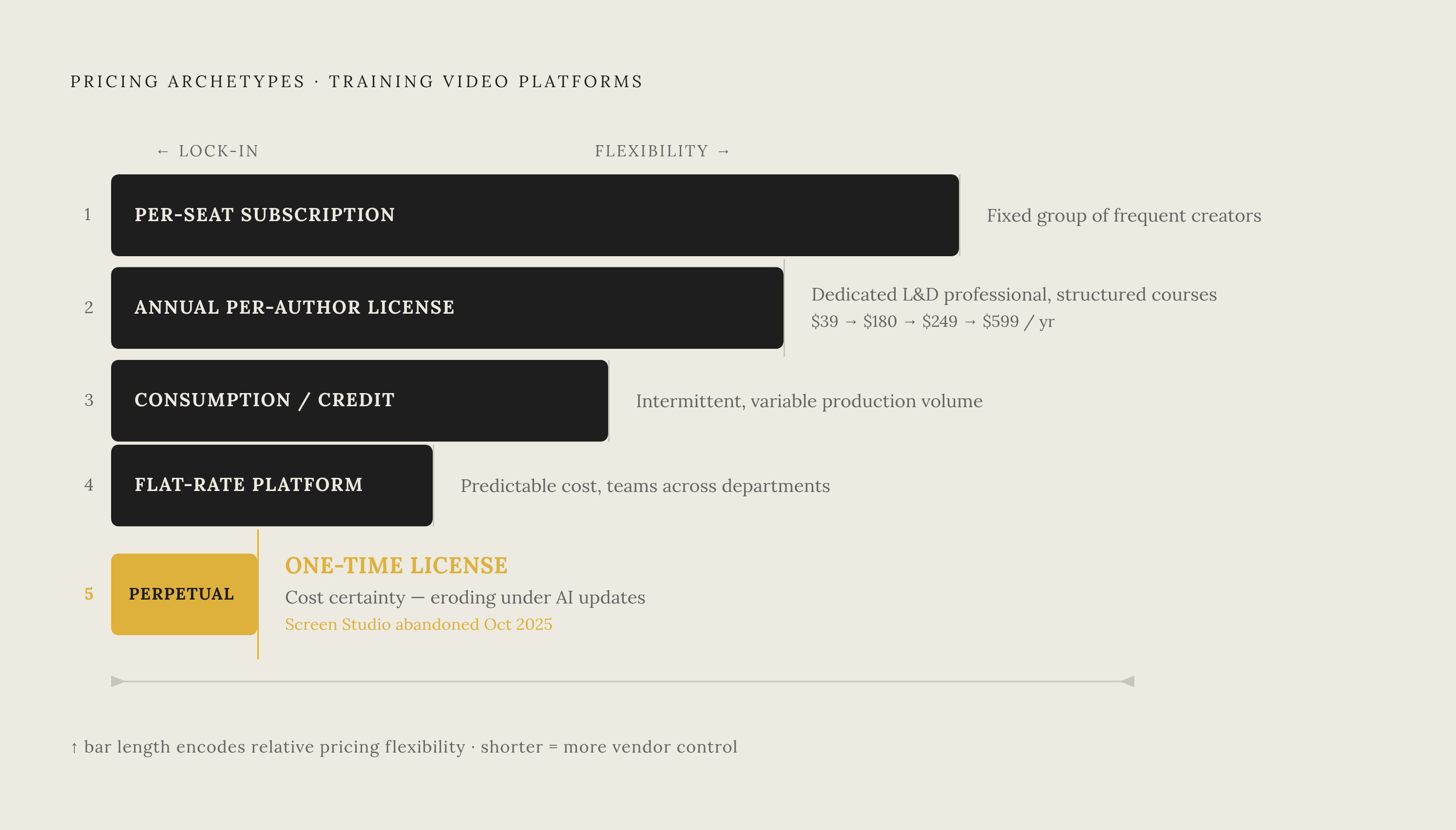
The first archetype is the per-seat subscription, a recurring monthly charge per user. It assumes a fixed group of people who create content often enough that a standing license for each of them makes sense. Cost scales with headcount rather than with how much gets produced, which rewards frequent creators and punishes anyone who only occasionally needs to make a video.
The second is the annual per-author license, the model eLearning suites with embedded video tend to use. It assumes a dedicated author, usually an L&D professional, building structured courses. The license price reflects a whole authoring suite: quizzes, branching logic, LMS publishing, with video as one piece of it, not the product itself. Camtasia's tiers show the same logic in miniature: Starter runs $39 a year, Essentials $179.88, Create $249, and Pro $599. The price climbs with the depth of the production workflow on offer, not with how many people are using it.
The third archetype is consumption or credit-based pricing: pay for what gets generated. It assumes production volume that's intermittent or variable rather than steady, so cost tracks output instead of seats. That's a different risk profile from a subscription, one where a quiet month costs little and a busy one costs more.
The fourth is the flat-rate platform subscription: unlimited creation, with tiers built around which features unlock. It assumes teams want predictable cost no matter their output, which shifts the pricing risk from the buyer to the vendor. Vyond and iSpring Suite represent the course-authoring version of this model, where the flat rate buys the entire authoring environment, quizzes and branching and LMS publishing included, and video is not metered by the video.
The fifth archetype is the one-time perpetual license. It assumes a mature, stable product and a buyer who values long-term cost certainty more than a steady stream of new AI features. That assumption is getting harder to hold: Screen Studio moved away from perpetual pricing in October 2025, a signal about where AI-native tools are headed more than a judgment on the tool itself. Software that depends on continuously updated AI models doesn't sit still long enough for a one-time purchase to make sense indefinitely.
What the billing model reveals about a platform's intended user
A pricing model is a statement about who the vendor built the product for, and the biggest source of hidden cost is a mismatch between that assumed user and the team actually buying the tool.
Per-seat pricing assumes the person creating the video is also editing it, voicing it, and publishing it: a specialist who owns the whole production chain start to finish. Annual per-author licenses assume something more specific still, a dedicated L&D professional producing structured courses with quizzes and LMS integration, where video is folded into a bigger authoring job as one piece among many.
Consumption pricing assumes production comes in bursts tied to events: a compliance refresh once a quarter, a launch video series, an onboarding module for a new market. Flat-rate platforms built for teams, Clueso among them, assume the opposite: that customer success, product, sales, and L&D all need to produce content on their own, without funneling every request through one specialist. The fixed price subsidizes breadth of use across an organization over depth of use by a single author. One-time perpetual tools assume the buyer wants ownership and cost certainty more than an AI feature set that keeps improving, an assumption that gets harder to sustain as the underlying technology keeps moving.
A capable team can make nearly any pricing model work, which is a fair objection to all this. That's true for specialists. But training content increasingly gets made by people who aren't video specialists at all, product managers, customer success managers, compliance officers, pulled in because they know the subject matter, not because they know editing software. For that kind of user, a per-seat charge on every occasional creator, or a consumption fee on every small update, adds friction that slows content production down or stops it completely. A customer success team needing to update five onboarding videos after a product redesign shouldn't have to route that work through one licensed specialist or watch a credit meter tick down for a routine fix.
Feature gates and the real cost of a pricing tier
The price advertised on a landing page is rarely the price a training team ends up paying, because the features that make a video usable as actual training content, SCORM export, localization, team collaboration, brand controls, tend to sit behind mid-tier or enterprise plans.
SCORM export matters here specifically: it's the packaging format that lets a learning management system track whether someone completed a module and how they scored on it. Several platforms in this category lock SCORM behind their enterprise tier, so a team that needs LMS-trackable content has to budget for the enterprise price regardless of how much video they actually plan to make. Localization works the same way. One-click translation and multilingual voiceover frequently show up as enterprise features or paid add-ons, so a team that needs its training content in more than one language hits a cost step-up that never appeared in the headline number.
Vidocu illustrates the problem directly: its enterprise tier is custom-priced, and SCORM export lives behind that tier. A team trying to evaluate it on published pricing alone can't actually determine its real cost without a sales call.
The fix is a short exercise before any price comparison happens. List the three to five features a team considers non-negotiable, SCORM, localization, team seats, branded output, whatever applies, and find the tier on each platform under consideration that actually includes all of them. That tier, not the entry-level number on the pricing page, is the real price being compared.
Output volume, update frequency, and total cost
Monthly price is the wrong comparison basis. Total cost over 12 to 24 months tells a much more honest story, and it shifts hard depending on two variables: how many videos a team makes and how often those videos need updating.
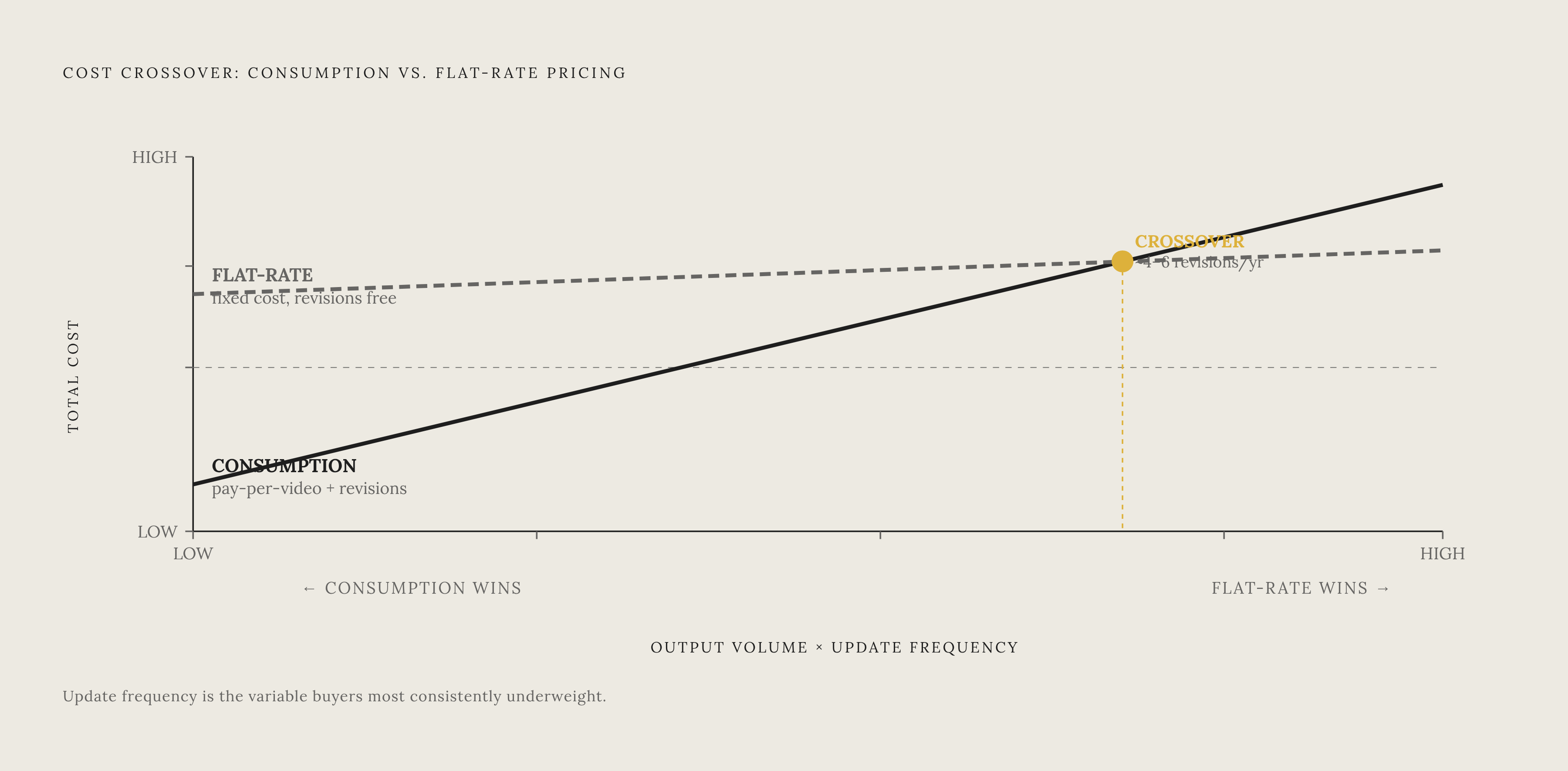
A team producing fewer than a dozen videos a year, rarely revising them, usually comes out ahead on consumption or credit-based pricing, paying only for what actually gets produced. Flip the scenario to a team producing dozens of videos a quarter with updates rolling in constantly: the flat-rate model wins instead, the per-video cost approaches zero as volume climbs, and the speed of revising content matters just as much as the speed of creating it.
Update frequency is the variable buyers tend to underweight. A training video tied to a software product that ships monthly updates might need four to six revisions a year per module. On a consumption model, every one of those revisions draws down credits or triggers a new charge. On a flat-rate model, revisions cost nothing extra. Running that math across a library of modules compounds the gap quickly.
One-time perpetual pricing still has a place, just a narrow one. Final Cut Pro, at $299.99 as a one-time purchase, wins on cost over several years, but only for a solo creator who doesn't need a constantly updated AI feature set and whose content doesn't require frequent revision. Add a second team member or a second language requirement, and per-seat costs or feature-gated upgrades on the alternatives start stacking up in ways a solo license never faced, erasing that advantage.
The localization cost gap that most pricing comparisons ignore
For any team whose audience spans more than one language, localization is a pricing event that can multiply total production cost by however many languages a team needs, unless the platform's billing model absorbs that cost some other way.
Traditional multilingual production, recording, professional dubbing, re-editing per language, gets priced per minute of finished video, per language. At those rates, even a modest library of training content localized into five languages turns into a serious budget line, and it recurs every single time that content gets updated, not just once.
Platforms that fold localization into a flat subscription price, rather than billing per language or per minute of translated output, change the underlying economics for any team working across borders. Clueso's one-click translation spans more than 37 languages and comes included in its plans rather than priced as a separate workflow or an add-on charge, which matters for a global team weighing five-language localization as a recurring cost versus a fixed one.
Subtitles alone don't close that gap. Treating subtitle-only localization as "good enough" undercounts two real problems: learners split their attention between reading and watching when the audio stays in the source language, which hurts retention, and several jurisdictions have legal requirements mandating native-language audio for workplace training, not just text on screen. A pricing comparison that skips localization skips the cost that appears first and grows fastest once a training library has to serve more than one market.