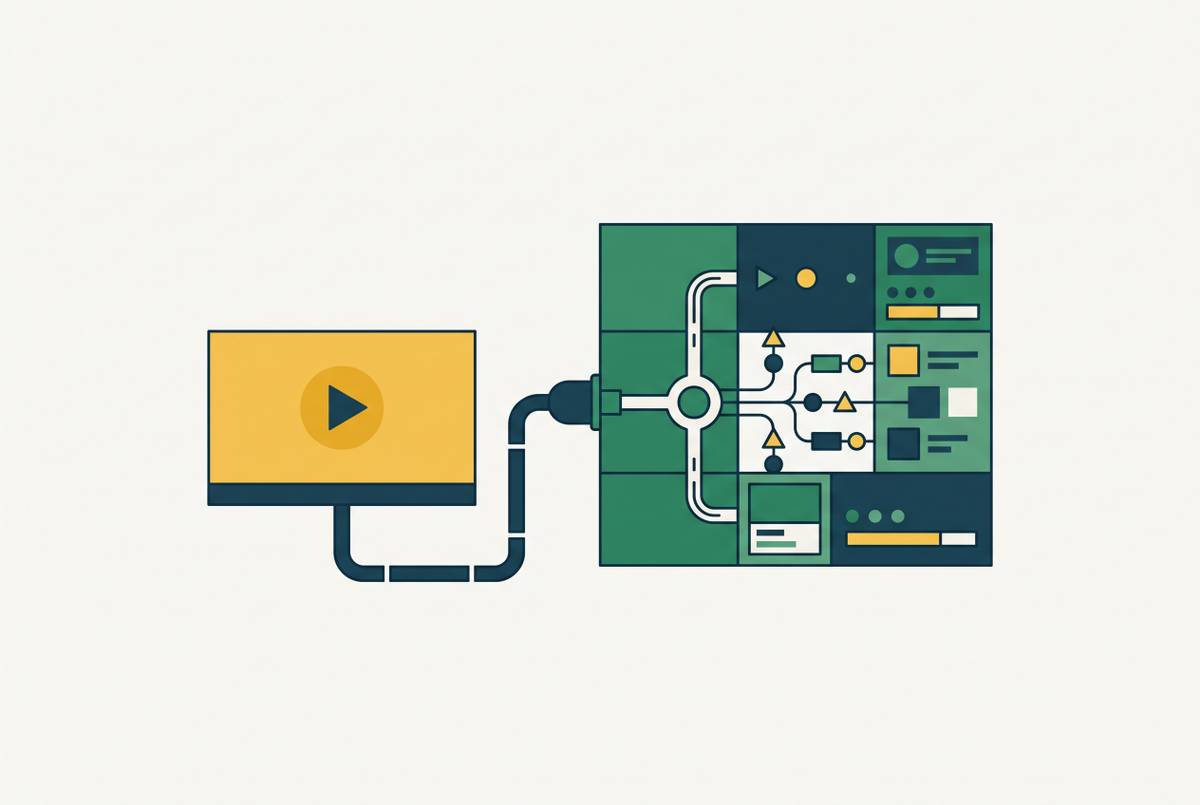
Vendor Lock-In Risk in Training Video and Documentation Platforms
Teams building video libraries can become locked in before they realize it's happened.
Vendor lock-in in training video and documentation platforms compounds faster than in most enterprise software, and it compounds more quietly. The same speed that makes AI-powered production tools worth buying is the force that accelerates dependency on them. A platform that turns a script into a finished training video in minutes lets a team build a proprietary content library faster than any procurement review can track. The asset library becomes the thing holding a team in place before anyone on the team realizes it has happened.
Peer-reviewed research published in the ITEA Journal of Test and Evaluation frames lock-in as what happens when proprietary architectures, data formats, or integration dependencies limit an organization's ability to switch suppliers, reduce costs, or adapt systems over time. Advanta's 2026 vendor lock-in risk taxonomy adds a sharp diagnostic test: a function that cannot describe its AI methodology without using vendor product names has not escaped lock-in. That test applies directly to learning and development teams and customer education teams building video libraries today.
Four layers of lock-in apply to this category specifically, and they stack on top of each other. Format lock-in determines what a team can export. Workflow lock-in determines what a team can rebuild. Contract terms determine what a team can afford to leave. AI model dependency determines what a team didn't know it depended on. Each layer gets its own treatment below, in the order a team would discover them, starting with the one that's easiest to see and ending with the one that's hardest to plan for.
Layer one: proprietary content formats and data ownership in practice
Nearly every vendor in this space offers some version of the same reassurance: you own your data. That statement holds up legally in a narrow sense, and it tells a team very little about what happens on the day they try to leave. Fin's vendor lock-in evaluation guide draws the distinction precisely: customers own their data in the narrow contractual sense, while the vendor controls the infrastructure that makes that data operationally useful. Ownership without access is not much of an asset.
Real data portability requires more than a download button. It requires full export of content in standard formats like CSV and JSON, API access without volume restrictions, scheduled exports to cloud storage, and a defined retrieval window after cancellation. Contract evidence from adjacent enterprise AI agreements shows how often these pieces are missing. Export provisions frequently skip machine-readable format requirements compatible with common interchange standards, and even where export is technically possible, the window to do it is often too short for a structured migration of anything substantial.
Training video platforms make this problem worse than text-based tools do. A single video might carry raw footage, an AI-generated voiceover, an avatar likeness, a branded template, a smart zoom configuration, and embedded captions, and each of those pieces can live in a different proprietary layer inside the platform. None of them are guaranteed to export together cleanly. Platforms like Clueso that generate video and documentation together create a specific version of this risk: if the article co-pilot stores SOPs inside the platform's knowledge base alongside the video assets, the workflow and the artifact become entangled in a single proprietary system, and a clean export gets significantly harder than exporting video alone.
A vendor that requires a paid professional services engagement to extract a customer's own data, that charges additional fees for data access, or that stores content in a format requiring heavy transformation before it's usable elsewhere has built a format layer that works against the customer at exit. Format lock-in is the layer a team notices first, because it shows up the moment someone asks "can we get our videos out of here." The next layer is harder to spot: it isn't about the files but about how the team learned to work.
Layer two: workflow and methodology embedding, where the real switching cost lives
A clean data export solves one problem and leaves a bigger one standing. Teams that have built their entire production process around a single platform's input formats, approval chains, and automation logic face a switching cost that has nothing to do with the files themselves. It has to do with how the team works, and that's much harder to rebuild than it is to export.
Advanta's risk taxonomy treats workflow lock-in as its own distinct variant, separate from format: training built around one vendor's product such that switching breaks the workflow. In a training video platform, that workflow includes the script cleanup process, the voiceover selection and configuration, the zoom and caption logic, the SOP generation flow, and the localization pipeline. Each of those is a learned behavior tied to one platform's interface and one platform's output model. AI-powered platforms like Clueso embed their methodology into the production workflow itself: the script rewriting logic, voiceover synthesis, zoom and caption automation, and documentation generation all operate as an integrated sequence, and a team that has standardized around that specific sequence faces a real re-learning cost even when its final assets export without a hitch.
The sharpest test for this layer comes straight from Advanta's taxonomy: can a team describe its content production methodology, meaning input format, review process, output standard, localization approach, in plain language without naming a specific platform? If the answer is no, the methodology is already embedded in that platform, whether or not anyone intended that to happen. ITEA's research recommends a direct operational defense: cross-train personnel on multiple platforms, and maintain documentation that would let the organization transition vendors if it needed to. Standard operating procedures should minimize dependence on vendor-specific knowledge or vendor-specific tools.
The most resilient architecture available to a team separates the source from the production layer. Keep source documents in systems the team already owns, a help center, Confluence, Notion, and have the production platform pull from those sources as the single copy of record. That way the content survives regardless of which platform eventually produces the output. Modular content design helps at this layer too: short, atomic instructional units that each cover one task can be updated individually without rebuilding an entire course, and they move across platforms far more cleanly than a single monolithic video file ever will.
Layer three: contract terms that turn dissatisfaction into an exit penalty
Technical dependency and workflow dependency create friction when a team wants to leave a platform. Contract terms are what turn that friction into a formal financial penalty, and most enterprise AI contracts reviewed in 2026 included provisions that work against the customer at the exact moment they try to exit. Advanta's risk taxonomy names four contract-level variants that recur together: proprietary data formats with no export path, workflow built around one vendor's product such that switching breaks the workflow, multi-year contracts with steep early-termination penalties, and a compliance posture that references vendor-specific certifications rather than portable standards. Enterprise AI contract analysis backs this up at the clause level. Termination-for-convenience provisions often set export windows too short for a structured migration of a training video and documentation library of any real size, so the right to leave can exist on paper without existing in practice.
The intellectual labor a team puts into a platform creates a related problem beyond the contract's termination clause. Custom configurations, behavioral rules, and prompt libraries a customer builds may be contractually owned by that customer while remaining technically inaccessible without the platform that houses them. A team can own an asset it cannot retrieve, and a contract that doesn't address that gap leaves the ownership clause mostly symbolic.
Advanta's mitigation framework gives teams specific language to negotiate for instead of accepting the default terms a vendor offers. Explicit portability clauses belong in the contract, spelling out format, frequency, and completeness of export. Exit-assistance obligations matter as much as portability: a vendor that commits to helping with migration is offering something different, and more useful, than one that commits only to a data dump on the way out. Continuity terms that keep API access live through the migration window prevent a team from losing access the day the contract ends and before the migration is finished. And contractual documentation that the underlying methodology is vendor-agnostic gives a team language it can point to later, when a dispute over what was promised actually matters.
ITEA's 2026 research points to a structural fix that sits above individual clauses: modular contracting and performance-based acquisition, where the production layer and the storage layer are contracted separately, and performance obligations are written so they don't require one specific vendor's platform to satisfy them. On the practice side, Advanta identifies quarterly exit-readiness reviews as a mitigation in their own right, not just a point to raise in negotiation. A documented test of whether the team could migrate within a defined window turns "can we leave if we need to" from a hypothetical into something the organization actually knows the answer to. Contracts can close most of the gap that format and workflow lock-in open up. They cannot close the newest gap, because that one lives above the contract, in the AI models the platform depends on.
Layer four: AI model dependency moved up the stack in 2026
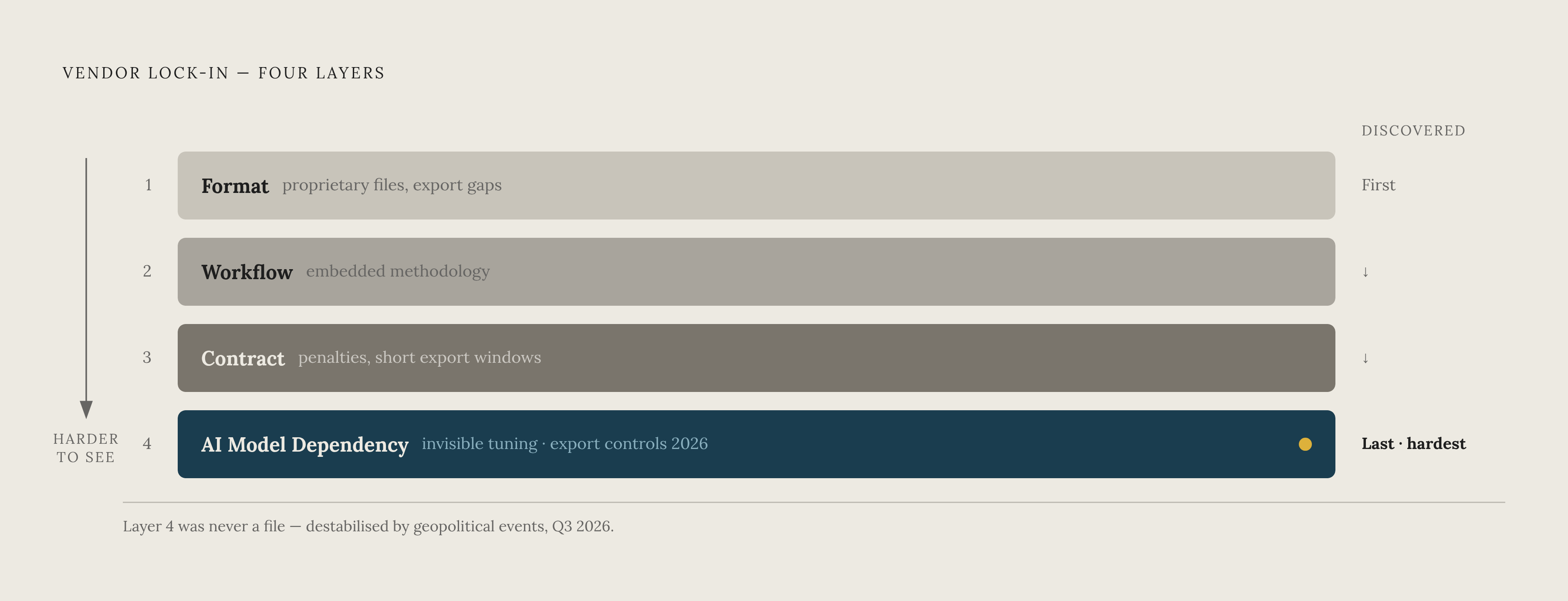
AI-specific lock-in behaves differently from the three layers above it. It's invisible at the point of procurement, it compounds through use rather than through anything written into a contract, and it was materially destabilized by geopolitical events in the third quarter of 2026. If a team has spent months adjusting voiceover tone, script style, and localization behavior inside one platform's AI layer, it has built up tuning that lives inside that environment. That tuning cannot be exported as a file, because it was never a file to begin with. It's behavior trained into a model.
US export-control measures in the second quarter of 2026 suspended access to frontier models and moved the center of lock-in risk from the model layer to the stack layer, the Trusted Agentic AI Landscape Q3 2026 report found. Training platforms that depend on specific underlying models from major frontier providers now carry an upstream dependency risk that was invisible at the time most organizations signed their contracts. The same analysis names two distinct forms this takes. API dependency happens when a platform bends its entire architecture around one vendor's design choices. Agent framework capture happens when proprietary orchestration layers compound switching costs quickly, particularly once AI is integrated with a vendor's cloud and data platform, making the AI decision inseparable from a much larger infrastructure commitment.
For training video platforms, the relevant risk is ecosystem entanglement. A platform that also handles hosting, analytics, LMS integration, and localization has built a surface area of dependency wide enough that no data export clause can cover it on its own. ITEA's 2026 research recommends three concrete defenses: favor platforms built on multi-model architectures or open standards rather than a single proprietary model, require vendors to disclose which underlying models their platform depends on, and factor that upstream model risk into vendor risk reviews alongside the platform's own contract terms.
There's a regulatory dimension too, and it applies now. If a general-purpose AI model provider operates in the EU, it has to disclose training data summaries, implement copyright policies, and undergo risk assessments for the largest models. For any enterprise with EU exposure, a training video platform's compliance posture with respect to its underlying AI models is a legal requirement to check, not a procurement nicety to skip. With all four layers now visible, format, workflow, contract, and model, the practical question for any buyer is which platform manages the combination best, and nowhere does that combination get tested harder than in localized, multilingual content.
How the four layers compound in localization and global content
Localized training content is where all four layers converge into a single, nearly insurmountable switching cost. Format, workflow, contract, and model dependency apply at the same time, to a library the team has strong financial reasons never to rebuild.
Once localized video content exists inside one platform, the financial case against switching grows regardless of how satisfied the team is with quality or price. Rebuilding a multilingual library means paying the localization cost a second time, and that cost alone can override every other reason a team might have to leave. The workflow layer gets more tangled here than anywhere else in the stack: one-click translation features, language-specific voiceover selection, and localized caption workflows are all platform-specific behaviors that don't transfer to a new vendor. A team migrating away has to reconstruct the localization process itself, not just move the finished content.
The model dependency layer adds a third problem on top of the first two. AI-generated localized audio is tuned to the platform's specific voice models, so a migrating team's localized content can sound noticeably different on a new platform even when the underlying script hasn't changed at all, which forces re-approval for any content that's regulated or tightly branded. Training retention in non-native languages carries its own business risk independent of any of this, and when localized content lives exclusively inside one proprietary platform, an organization's reach into its global workforce depends on that one vendor's continuity and pricing decisions holding steady.
The clearest mitigation at the localization layer is sequencing. Keep source scripts in open formats before localizing them, not after, so the source-language master stays the portable asset while the localized output is treated as a derivative that can be regenerated if it has to be. Contracts should require export of localized assets in standard video formats, not just raw project files that need the originating platform to open. A team that gets this sequencing right keeps the option to leave even after the localization work is done. A team that doesn't has built a library it can watch but can no longer move.